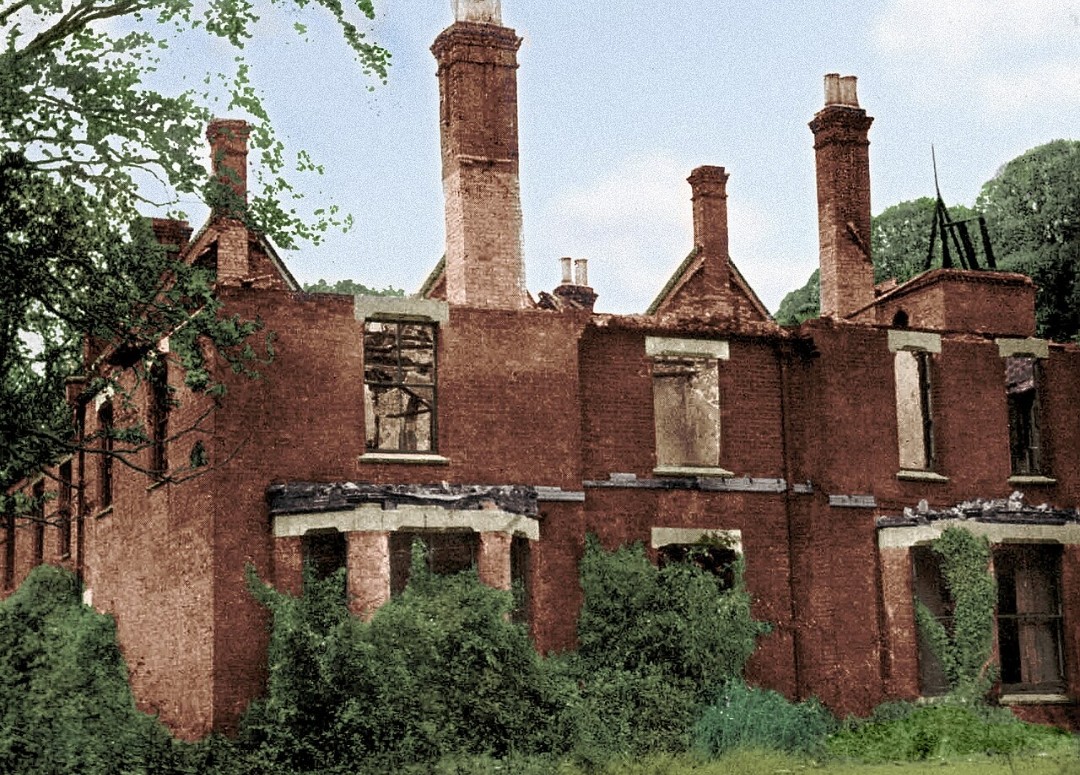
Paranormal enthusiasts will likely have heard of Borley Rectory, one of the most haunted old buildings in Essex, England. However, very little remains of it today. What was its story, and whatever happened to it? Read on to find out.
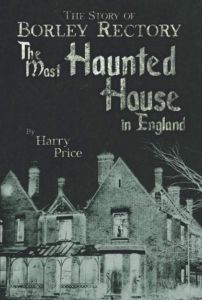
Described as the most haunted house in England by psychic researcher Harry Price, this Gothic-style Victorian rectory was built back in 1862, on Hall Road, Borley, Essex, for the rector of Borley parish and his family. It was actually the first rector who built it, a Reverend Henry Dawson Ellis Bull.
It was built to replace a previous rectory that had burned down on the site in 1841. The rectory was enlarged by adding a wing to accommodate Reverend Bull’s 14 children.
The house was 35 feet high with four floors and 11 acres of grounds. It had 32 rooms including 11 bedrooms. However, ever since it was constructed, this house had a reputation for being haunted by something.
The nave of Borley church (nearby) was likely built in the 12th century, and there were several farmhouses and the remains of Borley Hall, once the abode of the Waldegrave family.
Legend had it that a Benedictine monastery was erected in the area in 1362, and it was rumoured that a monk from the monastery had had a secret relationship with a nun from a nearby convent. Their relationship was discovered, leading to the monk’s execution and the nun supposedly bricked up alive in a wall of the convent. (However, this legend was debunked in 1938.)
The first paranormal happenings at the rectory were reported in 1863 – a few of the parish locals heard unexplained footsteps in the building.
On July the 28th 1900, four of the Reverend’s daughters saw something that to them looked like the spirit of a nun at dusk, about 37 metres away from the house. They attempted to talk to it, but it vanished when they drew closer.
The local organist Ernest Ambrose later said that the Bull family seemed convinced they had witnessed an apparition on several occasions.
During the next forty years, different people claimed to have experienced a variety of bizarre things, including a phantom coach driven by two headless horsemen!
In 1892, Reverend Bull died and his son Henry (“Harry”) Foyster Bull succeeded him. Reverend Harry Bull died on June the 9th 1927, and the rectory stood deserted for a while.
Reverend Guy Eric Smith then moved in with his wife in October 1928, and soon after, when Mrs Smith was cleaning out a cupboard, she discovered a brown paper package containing the skull of a young woman.
After that, the Smith family reported a few odd incidents: the sound of servants’ bells ringing even though they had all been disconnected, lights appearing in windows, inexplicable footsteps, Mrs Smith seeing a horse-drawn carriage at night.
The Smith family contacted the Daily Mirror newspaper and asked to be put in contact with the Society for Psychical Research. On June the 10th 1929, the newspaper sent a reporter along with Harry Price, the conjuror and paranormal researcher.
The reporter wrote a series of articles concerning the oddness at Borley Rectory.
Reports of haunting in the rectory intensified after Harry Price visited the place, the first visit occurring on June the 12th 1929. Stones, a vase, and other objects were apparently thrown and “spirit messages” were tapped out on the frame of a mirror. As soon as Price vacated the premises, these particular phenomena stopped and later on, Mrs Smith said she thought he might have been falsifying the phenomena. Harry Price wrote two books about his visits to the rectory.
The Smith family left Borley on July the 14th 1929, and the parish had somewhat of a challenge finding a replacement rector.
On 16th October 1930, Reverend Lionel Algernon Foyster finally moved in with his wife Marianne and adopted daughter Adelaide. Reverend Foyster was a cousin of the Bulls, and he wrote an account of the strange goings-on between the time they moved in and October 1935, which he sent to Harry Price. According to this account there was bell-ringing, shattering windows, the throwing of stones and bottles, writing on the walls, and Adelaide’s room managed to lock itself with no key.
Marianne Foyster told her husband about a range of poltergeist activity including something throwing her from her bed, and in one instance Adelaide was attacked by “something horrible.” Reverend Foyster attempted an exorcism twice, but failed. In the middle of the first attempt, he was struck on the shoulder by a fist-sized stone.
The multiple reports in the Daily Mirror atttacted the interest of paranormal researchers, who concluded the events were being caused, deliberately or unconsciously, by Marianne. Marianne later admitted she thought some events were being fabricated by her husband in cahoots with one of the psychic researchers, but other events she thought were genuine supernatural occurrences. She also later confessed that she was having an affair with a lodger named Frank Pearless, and that she used paranormal explanations to hide her meetings with him.
The Foysters left Borley in October 1935 because of Lionel’s ill health. The rectory was left empty again.
In May 1937, Harry Price took out a year-long rental agreement for the building, and through an advert printed in The Times, he recruited a team of 48 “official observers” (mostly students) who spent lengths of time, (mainly on weekends) in the house, recording any phenomena that might happen. The investigations found nothing more violent than odd sounds, fluctuations in temperature, and the occasional sighting of a figure.
In March 1938, Helen Glanville, a daughter of one of Price’s team, held a seance in Streatham, London. She apparently contacted two spirits, the first being a nun called Marie Lairre. Marie was apparently a French nun who left her order and travelled to England to marry a member of the Waldegrave family. She was said to have been murdered in an older building where Borley Rectory was now situated, her body either buried in a cellar or thrown into a disused well. The writing that appeared on the walls was alleged to be her asking for help – one message read Marianne, please help me get out. Her spirit became the White Lady of Borley.
The second spirit contacted said it was called Sunex Amures, claiming it would set Borley Rectory on fire at 9pm that night (March the 27th, 1938). It also said that the fire would reveal the bones of a murder victim.
On February 27th 1939, the new owner of the rectory – Captain W H Gregson – accidentally knocked over an oil lamp when unpacking boxes in the hallway. Luckily the house was never connected to a gas or electricity supply, and water was taken from a well in the courtyard to combat the fire. However the flames spread fast and the building was very damaged.
The insurance company carried out an investigation and said the fire seemed to have been started on purpose.
A woman named Miss Williams in nearby Borley Lodge said she saw the figure of a spectral nun in an upstairs window during the fire, and demanded a fee of one guinea for her tale, according to Harry Price.
In August 1943, Price conducted a dig in the cellars of the ruined house and found two bones, thought to be from a young woman. The parish of Borley refused to give the bknes a burial ceremony, as locals believed they came from a pig rather than a human, so the bones were given a Christian burial in Liston churchyard instead.
Harry Price died in 1948, and Daily Mail reporter Charles Sutton claimed Price had faked phenomena. While visiting the rectory in 1929 with Price, Sutton got hit on the head by a large pebble and, on seizing Price, he found his coat pockets full of various-sized stones.
Three members of the Society for Psychical Research – two of whom had been Price’s loyal colleagues – conducted a formal study of his claims about Borley Rectory and published The Haunting of Borley Rectory in 1956. They found that Price had indeed been falsifying evidence, manipulating the “ghost photographs” and possibly writing the messages on the walls himself when in the house alone, because the writing showed signs of having been done with pencil or chalk, the handwriting showing signs of being disguised.
The study or “Borley Report” also found that phenomena had been caused by rats and odd acoustics due to the shape of the building.
Marianne Foyster later admitted that she had never seen any apparitions and that the ghostly sounds had been caused by the wind, friends she had invited over, and her own self while playing practical jokes on her husband.
Many of the legends of Borley Rectory had been conjured out of nowhere. Reverend Harry Bull’s children – who were living there before Lionel Foyster – were surprised when told they had been living in England’s most haunted house, and said they had seen nothing.
However, the SPR’s report and a biography of Price haven’t dissuaded the general public from being interested in the house, and there have been quite a few books and TV programmes on its history and ghostliness.
Even the BBC was going to broadcast a documentary on it in 1956, but ended up cancelling it when threatened with legal action by the widow of the last rector to live in the rectory.
In 1975, the BBC aired an episode of The Ghost Hunters that focused on Borley rectory, with a psychic investigation of the church nearby as well.
Recent films include the partly animated Borley Rectory: The Most Haunted House in England in 2017, the film Ghosts of Borley Rectory in 2021, and Borley Rectory: The Awakening in 2025, which is set in 1900 and shows the origins of the ghost story.
The ruins of Borley Rectory were demolished in 1944. The former site is now part of a private garden.
The timber gateposts from the driveway along the North-East of the building (its true front) survived the demolition and stayed there for quite some time before the late Ivan Banks bought them for £20 and took them home with him to Maidenhead, where he applied wood preserver to them and put them in his garden. Shortly after he published his book about Borley Rectory (The Enigma of Borley Rectory) Ivan Banks died. No one knows where those gateposts are now or even if they still exist.
The rectory had a well in its courtyard, the water from which was pumped into storage tanks in its attic. The pump wheel survived the 1944 demolition, standing there until the rubble was cleared away. The pump machinery was scrapped but it was planned for the pump wheel to be taken to America. The wheel stayed in a garden at Borley for years before someone restored it and it is now owned privately by someone.
The great Borley bell (which hung on the opposite side of the courtyard to the water pump) survived because Harry Price took it as a souvenir when Captain Gregson bought the building in 1938. Price hung the bell outside his workshop in West Sussex, and after he died it was given to Peter Underwood (a ghost-hunter and prolific author) in 1973 by the executor of his estate (the University of London). Underwood hung the bell outside his house in Bentley, Hampshire, before moving to London some years later.
The rectory boundary stone also survived. It was originally positioned on the edge of the upper lawn, which is a slightly odd position for a boundary stone. The poet James Turner (who was living in the former Rectory Cottage in the 1940s) gave the boundary stone to Peter Underwood.
Sources
https://en.wikipedia.org/wiki/Borley_Rectory
http://www.harrypricewebsite.co.uk/Borley/ModernBorley/relics-borley.htm
https://hauntedhosts.com/library/famous-hauntings/borley-rectory-most-haunted-house/

