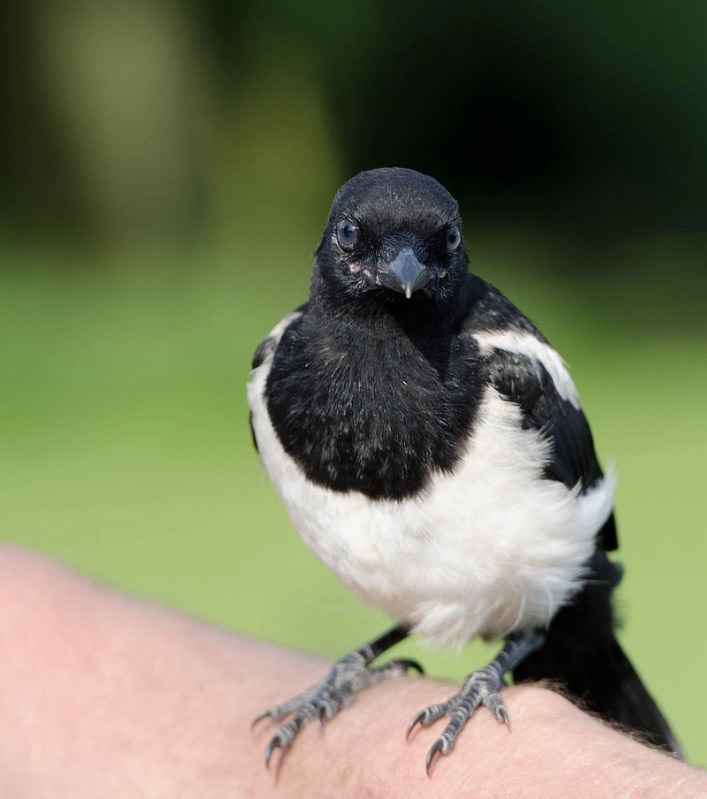
The original rhyme for what number of magpies you see and what “results” from that was published in 1780. The rhyme has its roots in ornithomancy, or bird divination (which was used by the ancient Greeks and Romans).
Most of you are probably familiar with this poem:
One for sorrow,
Two for joy,
Three for a girl,
Four for a boy,
Five for silver,
Six for gold,
Seven for a secret never to be told
…which is the modern version. However, there are more lines after that going up to thirteen:
Eight for a wish,
Nine for a kiss,
Ten a surprise you should be careful not to miss,
Eleven for health,
Twelve for wealth,
Thirteen – beware, it’s the devil himself!
Magpies, like owls, were seen as a bird of either good or bad omen in some cultures and in Britain since at least the 16th century. Other superstitions about magpies included:
- Scottish people believed magpies were evil and had a drop of the Devil’s blood hidden under their tongues
- It was also believed in Scotland that if a magpie’s tongue was scratched with the sharp edge of an unmilled silver sixpence, followed by a drop of human blood being put into the scratch, the magpie would become able to talk in human language!
- The French believed that evil priests reincarnated as magpies or crows.
- Early Christians saw the magpie as vain for not having fully black feathers to mourn Jesus’s death. The magpie was said to be the one bird who didn’t sing or offer any comfort during the crucifixion.
- In Sheffield, the magpie is said to be the only bird that refused to enter Noah’s Ark, choosing to sit on the roof chattering about the flood instead!
- In the times of cockfights, fowls’ eggs were sometimes placed in a magpie’s nest so that the chicks would absorb the magpies’ aggression
- Dried and powdered magpie flesh was an old remedy for epilepsy and other bits of the magpie were used variously to cure vertigo, bad eyesight, and melancholy.
- People used to believe that eating the leg of a magpie would help you recover from being bewitched.
- Their chattering calls were thought to signify the arrival of guests in the near future, or if they chattered on the roof, the arrival of “evil tidings.”
- One belief was that the magpie was the offspring of a raven and a dove, and as a result hadn’t been baptised during the flood in the Old Testament.
- A Swedish belief states that the magpie is a witch’s bird, and that witches can take the shape of magpies on Walpurgisnacht, when they travel.
- In Germany, the magpie is a “bird of the underworld.”
- In ancient Rome, magpies were associated with fortune-telling and magic.
- In ancient Greece, magpies were sacred to the god of wine, Dionysus
- In China, the magpie was seen as a “bird of joy” in the Manchu dynasty and was seen as representing the yin and yang, fertility and domestic happiness.
- There is a long-held supposition that magpies love to steal shiny objects. In fact, they are more likely to avoid them according to research done by Harrabin in 2014.
These beliefs may come from the aggressive and territorial behaviour magpies can have when nesting. They have been known to swoop at pedestrians and peck or scratch at people’s heads!
The omens of the rhyme are likely to come from medieval times, but the first version of the rhyme to be published was in a 1780 supplement to the 1778 edition of The Plays of William Shakespeare by Samuel Johnson and George Steevens:
One for sorrow,
Two for mirth,
Three for a wedding,
Four for death.
This was in an appendix, contained in a note scribbled by Reverend Henley: “The magpie is called in the west to this hour, a magatipie, and the import of the augury is determined by the number of these birds that are seen together: ‘One for sorrow: Two for mirth: Three for a wedding: Four for death.'”
Another early version appeared in the 1842 edition of John Brand’s Observations On Popular Antiquities. John Brand was a clergyman of the Church of England and spent his time researching and documenting English folklore.
An early version of the poem was extended in Proverbs and Popular Sayings (1846, by Michael Aislabie Denham) with the words “hell” and “Devil” censored out:
One for sorrow,
Two for luck;
Three for a wedding,
Four for death;
Five for silver,
Six for gold;
Seven for a secret never to be told,
Eight for heaven,
Nine for ––––,
And ten for the d–––l’s own sell!
Sometimes “luck” would be changed to “mirth” and “death” would be changed to “birth,” although those last two words are total opposites (or opposing sides of the same coin…)
Another version was in Brewer’s Dictionary of Phrase and Fable:
One’s sorrow,
Two’s mirth,
Three’s a wedding,
Four’s a birth,
Five’s a christening,
Six a dearth,
Seven’s heaven,
Eight is hell,
And nine’s the devil his old self.
A tradition in England is that if you see a solitary magpie, the way to ward off the “sorrow” or bad luck is to say Good morning, Mr Magpie, how are Mrs Magpie and all the other little magpies? or to salute the magpie and turn around three times.
One 19th century custom in Shropshire was to say Devil, Devil, I defy thee! Magpie, Magpie, I go by thee! then spit on the ground three times.
Another custom in Westmorland and North Lancashire is to draw a cross on the ground when you see a lone magpie, or say this rhyme instead:
Magpie, magpie, chatter and flee,
Turn up thy tail and good luck fall me.
Other variations include taking off your hat to it, bowing, and wishing the bird a good day, or spitting over your left shoulder, turning around three times, crossing your fingers and saying:
I cross the magpie,
The magpie crosses me;
Bad luck to the magpie,
And good luck to me.
Sometimes, birds within the Corvidae family (crows, jackdaws) are involved with this traditional rhyme in places where magpies aren’t often seen, e.g. in America, or in India, where they apply the rhyme to the myna bird.
The “one for sorrow” idea may stem from the knowledge that magpies mate for life, so a widowed magpie is, naturally, a melancholy bird.
Other Strange Iterations
“1 for sorrow, 2 for mirth,
3 for a wedding, 4 for a birth,
5 for silver, 6 for gold,
7 for a secret never to be told,
8 for the tale that the stars have spun,
9 for a gate that can’t be undone,
10 for a river of forgotten lore,
11 for a key to the spectral door,
12 for a mirror reflecting the night,
13 for a beast that lives in spite,
14 for a heaven that none can reach,
15 for a lesson that none can teach,
16 for dreams trapped in stones,
17 for the gods’ hollow moans,
18 for the abyss that gazes back,
19 for the knowledge that which we lack,
20 for a magpies’ final verse, in a realm where shadows converse.”
“1 for sorrow
2 for joy
3 for a girl
4 for a boy
5 for silver
6 for gold
7 for a secret that’s never been told
8 for love,
9 for marriage,
10 for a baby in a golden carriage.”
“I saw eight magpies in a tree,
Two for you and six for me.
One for sorrow, two for mirth,
Three for a wedding, four for a birth.
Five for England, six for France,
Seven for a fiddler, eight for a dance.”
“Ravens perched on a single branch
What do your numbers foretell of chance?
One for sorrow
Two for mirth
Three for a wedding
And for four a birth
Five for rags
Six for gold
Seven for a secret
Never told
Eight for love
Nine for hate
Ten for a new friend at the gate
Eleven for a house
Twelve for sails
Lucky thirteen for secret spells.”
“…Eight for a wish,
Nine for a kiss,
Ten for a time of joyous bliss”
“Eight for a wish,
Nine for a kiss,
Ten for a letter,
Eleven for worse
And twelve for better”
“…Eight bring wishing
Nine bring kissing
Ten, the love my own heart’s missing!
(from Warwickshire, England)
“…Eight you live
Nine you die
Ten you eat a bogey pie!”
(from Yorkshire)
“One for sorrow,
Two for joy,
Three for a girl,
Four for a boy,
Five for rich,
Six for poor,
Seven for a bitch,
Eight for a whore,
Nine for a funeral,
Ten for a dance,
Eleven for England,
Twelve for France”
“One for sorrow,
Two for joy,
Three for a girl,
Four for a boy,
Five for rich,
Six for poor,
Seven for a witch.”
“One is sorrow, two mirth,
Three a wedding, four a birth,
Five a sickening, six a christening,
Seven a dance, eight a lady going to France.”
There is also a version by the comedian John Finnemore, which goes up to 1000. You can hear it on “John Finnemore’s Souvenir Programme” series 9, episode 6.
Sources
https://en.wikipedia.org/wiki/One_for_Sorrow_(nursery_rhyme)
Magpie Rhyme – One For Sorrow, Two For Joy
One For Sorrow … Magpie Nursery Rhyme
https://www.countrylife.co.uk/country-life/how-to-salute-a-magpie-70304
https://www.hypnogoria.com/folklore_magpies.html
Telling Magpie Rhymes: Predicting the Future with Magpies

