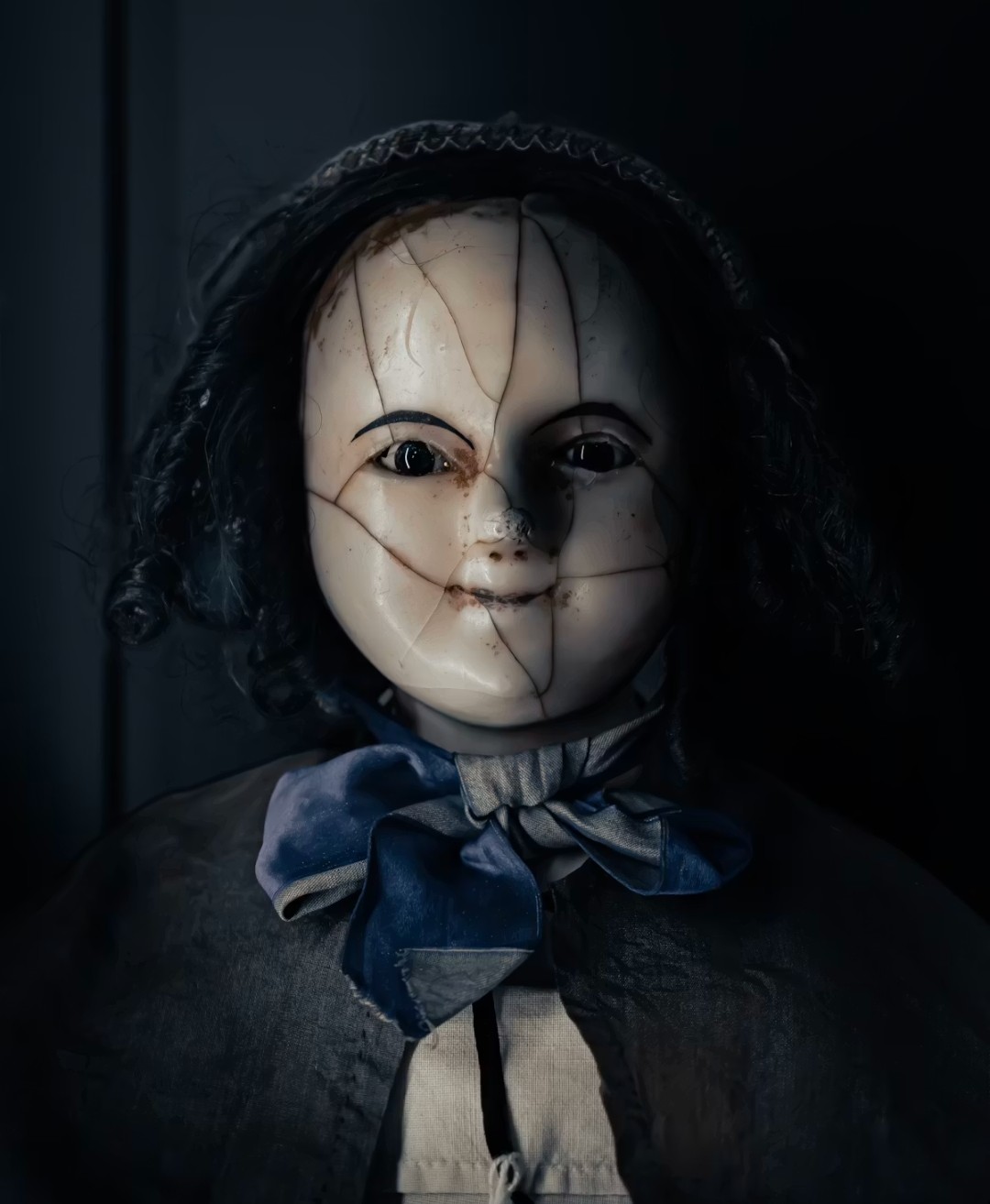
This week we’re diving into humanoid objects, their bizarre powers, and why humans are so fascinated with them.
Dolls might be the most ancient toy in existence but they were also used in religious rituals. The earliest ones were made from clay, wood, stone, bone, leather, ivory, or wax.
The ancient Egyptians had flat, paddle-shaped dolls carved out of wood as early as the 21st century BC. Dolls with articulated limbs and removable clothing were in existence in roughly 200 BC. Greek clay dolls were articulated at the hips and shoulders and stories from 100 AD provide evidence that little girls were playing with them. They were sometimes worked with strings or wires.
There were wooden, clay, and ivory dolls in ancient Rome and these dolls have been found in the graves of Roman children. There were rag dolls in Rome in at least 300BC. In both Rome and Greece, boys would dedicate their toys to the gods when they reached puberty, and girls dedicated their toys to the goddesses once they got married. If they died before marriage, the girls’ dolls were buried with them.
But why did human beings have this urge to create small figures out of inanimate materials and why were they so attached to them? And why are dolls so creepy despite this attachment?
Magic
In some cultures, dolls that had been used in rituals were then given to children as playthings. In other cultures, the dolls used in rites were taboo – too infused with magical powers for children to touch.
The idea of sticking pins in voodoo dolls to affect a person through sympathetic magic is a well-known one and is often stereotypically associated with the Vodou religion of Haiti, even though that religion doesn’t use them. The voodoo doll belief is likely influenced by the European poppet or kitchen witch. The use of effigies to magically affect someone has been noticed in African and Native American cultures as well.
The Hopi Native American tribe made dolls out of cottonwood representing each Kachina or ceremonial masked spirit.
In Inca mythology, Sara Mama was the grain goddess. She was associated with maize that grew strangely or in bunches. This maize was sometimes dressed as a doll of Sara Mama.
Similarly, Native Americans used corn husk dolls, made from the dried leaves of a corn cob. These dolls had no faces.
In Japan, Hina dolls were used to deflect misfortune or absorb spiritual harm, protecting the families that owned them. However, hina dolls could be corrupted and supposedly turn malicious, thereby becoming objects to dread and avoid!
The urge to create miniature versions of gods or goddesses, or even of other humans, seems to come from the basic human desire for control.
Voice and Movement
Doll-making also seems to be an outlet for self-expression and giving voice to the forbidden.
The artist, Hans Bellmer created surreal dolls with interchangeable limbs in the 1930s and 1940s in Germany, protesting the Nazi party’s idea of the perfect Aryan body.
The East Village artist, Greer Lankton was famous in the 1980s for creating theatrical window displays of drug-addicted, anorexic, or mutant dolls.
In Iran during the Qujar era, people criticised the politics and social conditions of Ahmad-Shah’s reign using puppets in order to escape punishment for speaking out. According to Islam, women are not allowed to dance in public, but dolls and puppets are often free in a way that human beings aren’t, in spite of their attached strings. Layli (a hinged, dancing doll) is popular among the Lur people of Iran.
Loving Longevity and Easing Isolation
The people of Guatemala used “worry people” – tiny dolls half the length of a finger, dressed in various materials – to ease their anxieties. They would tell their worries to these tiny figures and put them under their pillows before going to sleep, with the belief that, in the morning, the worry people would have taken the worries away.
Dolls were used in ancient Egyptian funeral rites. These dolls would be buried with the deceased and often represented servants or family members.
In the Victorian era, “memorial dolls” were made out of wax representing children who had passed away. They were quite lifelike, often dressed in the child’s clothing and adorned with locks of the child’s hair. They would be displayed in the home to provide a source of comfort to the child’s parents and relatives.
Until the middle of the 19th century, most dolls were made in the image of adults. Child-like or baby dolls didn’t make an appearance until about 1850. By the late 19th century, dolls of babies and children had flooded the market. The dolls had painted eyes, mouths, and hair, and they had a voice box sewn into them that cried “Mama” when the body was tilted. During 1923, 80% of dolls sold to children in the U.S. were “Mama dolls” (named after the sound they made).
Here was the best approximation of a child, something vulnerable that you could hold onto and cherish for ever because it couldn’t die. Something with no opinions of its own that couldn’t contradict or abandon you. (Perhaps this is why much of humanity is currently reliant on talking to AI chatbots.)
Starting in the 20th century, most porcelain and plastic dolls were made for the adult collectors’ market.
In the modern era, this phenomenon of subconsciously trying to freeze-frame our children has gone one step further with the invention of Reborn dolls. These are vinyl, silicone, or a mixture of both. They are customised, painted, and have realistic hair sewn into their scalps by Reborn artists so that they are visually indistinguishable from real babies and children. Some even have heartbeat sounds and breathing simulators as well as weighted bodies. These intricate creations are sold to collectors (and parents suffering from the emotional aftermath of losing a baby or a child), often for thousands of pounds.
Reborn dolls are sometimes also given to elderly people suffering from dementia, to ease loneliness, give them something to care for that is external to themselves, and perhaps to help them remember looking after their own flesh and blood children in the past.
Education
Dolls have also been used for instructional purposes, and still are (e.g. for learning CPR). Lifelike dolls are used by health professionals, medical schools and social workers to educate doctors and nurses about health procedures or investigating cases of child sexual abuse. Artists sometimes use articulated, posable wooden mannequins to help them draw the human body.
Dolls have been collected for historical importance, and they have been used – perhaps not consciously nowadays – as a way to indoctrinate children into gender stereotypes. Plastic action figures and superhero figures are predominantly marketed towards boys, indirectly giving them an image of strength, risk-taking behaviour, and stoicism to try to live up to. Girls are usually given fashion dolls and dolls of babies, which subconsciously insinuates that they ought to be caring for others and looking visually appealing.
Pediophobia and the Uncanny Valley
The fear of dolls and similar objects is known as pediophobia (literal translation: “fear of children”) or glenophobia. The psychologist Ernst Jentsch said that uncomfortable feelings arise when there is uncertainty as to whether an object is alive or not.
The Japanese roboticist, Masahiro Mori, expounded this theory and came up with the “uncanny valley” hypothesis – if something is obviously non-human, its human-like characteristics stand out and are endearing… but if that thing reaches a certain threshold of human appearance, its non-human characteristics stand out, making it disturbing. Talk to any AI chatbot and see the weird maelstrom of irrelevant emotions passing over its eyes and mouth without quite landing, like a kaleidoscope of imitative feeling, and you’ll experience the uncanny valley effect.
The fear of dolls may have started around the time that dolls began to look just that little bit too realistic, perhaps when porcelain dolls with glass eyes were invented. There is something oddly corpse-like about those glass eyes as they stare into the hollows of your soul… and something that feels wrong about skin that’s so… cold… and shatters easily.
In modern times, the fear of dolls is influenced by pop culture, for example horror movies including Chucky, Annabelle, and M3gan. Stories passed from generation to generation could also have portrayed dolls as vehicles for evil powers or evil entities. (Dolls can be seen as vessels for spirits when they are used in rites or for protection.)
A linked fear is automatonophobia or the fear of non-human figures which imitate human behaviour.
Humans tend to anthropomorphise objects, even animals, as a way to make sense of and relate to the world. The common psychological quirk known as pareidolia leads us to see faces and figures in patterns such as clouds, wallpaper, tiles, and knots in wood. We are born with the instinct to find a face, our eyes automatically triangulating between anything that looks like two eyes and a mouth.
However, we aren’t born with the uncanny valley propensity. Research has shown that children under age 9 don’t experience the uncanny valley effect.
Haunted Dolls
…And then there are stories concerning dolls that could be seen as legitimately, well, concerning.
Annabelle
In the 1970s, a nursing student named Donna was gifted Annabelle, a Raggedy-Ann doll with red hair and a flat triangle for a nose. Her mother gave her the doll as a birthday present. Soon afterwards, Donna and Angie (her roommate) noticed the doll seemed to change positions and move from room to room of its own accord when they weren’t looking. They also kept finding cryptic messages scrawled on bits of parchment paper, even though neither of them owned any parchment. In the end, their mutual friend Lou was attacked by an unseen entity that left claw-marks on his chest. They contacted Ed and Lorraine Warren (two well-known paranormal investigators) who concluded that there was a demonic being controlling the doll with a view to gaining possession of a human body. The Warrens removed Annabelle the doll and placed her in a glass case in their museum of the occult. Annabelle is still in her glass prison to this day.
Robert
Robert is a three-foot-tall straw doll dressed in a sailor suit, residing in Key West, Florida for over 100 years. In the early 1900s, a little boy named Robert “Jean” Eugene Otto got the doll as a present from his grandfather. “Jean” named the doll after himself and was very attached to it. Soon the household was experiencing strange occurrences such as objects being moved on their own and eerie giggles. When something happened, the boy said it was the doll that caused the mischief. Neighbours said they had seen Robert the doll moving from window to window when the family wasn’t at home. After Robert died, the doll was donated to the Fort East Martello museum, where he is still on display. He is surrounded by hundreds of apology letters because those who visit him and show disrespect towards him pay for it with bad luck later. Robert became the basis for the doll “Chucky” in the horror movie Child’s Play.
Okiko / Okiku
In Japan in 1918, three-year-old Kikuko Suzuki was diagnosed with a terminal illness. Her seventeen-year-old brother Eikichi travelled to Sapporo city in search of a present to help cheer her spirits. He bought a traditional Japanese doll as a souvenir from a maritime exhibit. It was dressed in a kimono with a hairstyle known as “okappa” (a shoulder-length cut with bangs sweeping across the forehead). The doll was about forty centimetres tall, with black porcelain eyes.
Young Kikuko became emotionally attached to the doll as soon as she saw it and named it Okiku. She died of her illness a year later, and spent the final months of her life clinging to the doll. The Suzukis put the doll on the altar of their family shrine.
Shortly after Kikuko died, the Suzuki family noticed something odd. The doll’s hair had begun to grow, the ends becoming uneven. It was almost imperceptible at first, but within weeks the doll’s hair reached its knees!
Every time they cut its hair, it grew back. The Suzuki family came to believe that their daughter’s soul was now inside Okiku, and they began a monthly ritual where they cut the doll’s hair.
The Suzukis had to leave their home during World War II, and they were afraid of the doll and Kikuko’s ashes falling into the wrong hands. They decided to bring the urn and the doll to the Mannenji Buddhist temple in the Hokkaido region, and the monks took over responsibility for caring for Okiku and keeping her hair cut.
The monks witnessed how the doll’s hair carried on growing even under controlled environmental conditions, and they published photographs of the doll sporting different length haircuts. Scientific analysis has found that the doll’s hair originally came from the head of a young human female.
Numerous reports say that – upon close observation – Okiku’s hair shows natural growth with visible roots and realistic texture. Some visitors and monks have even seen subtle changes such as moisture in the doll’s eyes, subtle movements in its lips, and even in recent years the perception that the doll’s mouth is half-open and teeth can be spotted inside. Some have seen subtle movements in the doll’s hair or even changes in its facial expression depending on their emotions and the time of day.
Mandy
This porcelain doll in Canada causes disturbances and weird sounds in the Quesnel Museum in British Columbia, where she is on display.
She arrived at the museum in 1991, after her previous owner found her among her grandmother’s belongings. The woman gifted her granddaughter Mandy to give to her newborn daughter. The doll had been incarcerated inside a chest for many years and the woman decided it was too creepy to be near her baby.
Local legend has it that the woman heard the doll crying in her attic before she decided to give it away.
Since arriving at the museum, Mandy got up to all kinds of tricks. After being left alone in the museum lab overnight, the next morning the lab was in disarray as if a small child had had a temper tantrum. Another night a reporter was alone in the museum developing photographs of Mandy in the basement and heard footsteps on the floor above him. His equipment malfunctioned.
There were other incidents of Mandy somehow defeating recording equipment when people tried to film or photograph her.
A woman from Surrey claimed her house was broken into shortly after she saw Mandy, and the only thing stolen from her house was a porcelain doll.
A family came to see Mandy in her case and as they stood in front of it, the young daughter fainted. Her blood pressure was so low she had to be taken to hospital for overnight monitoring.
More information here: https://www.curiousarchive.com/mandy-canadas-most-mischievous-haunted-doll/
Letta Me Out
This is a marionette doll in Australia which was reportedly discovered beneath a house in Wagga Wagga, New South Wales, and seems to move on its own. It is believed to be inhabited by the restless spirit of a young boy. The doll is cared for by a man named Kerry Walton.
In 1972, Kerry was attending his grandmother’s funeral in Wagga Wagga. While staying there he explored a nearby abandoned house which was said to be haunted. Ever since he was a child, he had heard disturbing stories about the building, including that of an old man seen moving about the property dragging a sack of human heads. One night, Kerry grabbed a torch and decided to investigate. As you do.
He explored deep into the basement and was shocked to find what appeared to be a child’s dead body with its bright eyes entrained on him. On closer viewing, it was merely a child-sized, distorted, wooden doll. It had large, brown eyes, a sharp nose, and a twisted smile full of tiny, carved teeth. Kerry felt somehow that he must take the doll out of the house with him, so he did, placing it in a sack and locking it in his car boot.
Then Kerry left his grandmother’s house with his brother and returned home to Queensland. It began to grow dark when he and his brother heard faint movement and a scream from the rear of the car. Convinced they had imagined it, Kerry’s brother joked that the doll must be trying to escape the sack, screaming “Letta me out” and so the doll was named.
At home, Kerry put Letta in his living room. Soon his family became uneasy with it. Some of them maintained the doll’s expression would change when no one was looking. They said its eyes would change colour. The doll started moving around inside the house of its own volition – the family found footprints across the floor every morning. The footprints supposedly matched the shoe-soles of Letta.
One night, Kerry’s son woke up screaming after seeing the doll inside his bedroom. He said the doll had been talking and moving its head on its own. From that point, things got weirder. Objects close to the doll would break, picture frames near it would crash to the ground. Light bulbs exploded suddenly. People, even visitors, experienced discomfort whenever they were near the doll – nausea, vomiting, and faintness, often followed by fear then extreme sadness.
One group of women who came to see the doll all began to scream and cry then fainted simultaneously. Cats and dogs would behave strangely and try to attack the doll. Whenever Letta doll was placed inside a moving vehicle, it would start to rain.
In one instance of financial need, Kerry tried to sell Letta doll. However, after he drove to the prospective buyer’s home, he physically couldn’t remove the doll from the car, as if an unseen force was controlling him.
Kerry took Letta doll to the Australian Museum in Sydney for examination by experts. From the nails in its feet, they determined the doll was about 200 years old. They were convinced the doll was made in Eastern Europe. Its style was similar to that of the Traveller community in Romania. The doll’s hair was real human hair and the structure underneath it was built similarly to a human brain.
Kerry then took Letta doll to a psychic. The psychic said the doll was possessed by the ghost of a young boy. Years ago, the doll was made by a gypsy dollmaker in a Romanian village. He made it for his son. The son died from drowning, aged six. The father laid the doll on his son’s grave and either the boy’s soul entered the doll naturally or the father used black magic to make it happen.
Another Traveller boy took the doll from the grave and kept it. One day, he was riding a horse with the doll on his lap and accidentally dropped it. He reached down to pick it up from behind the horse, and the horse kicked him straight in the head, killing him instantaneously.
A rich man was visiting from Australia with his two daughters. The two girls found Letta doll and took it back to Australia with them. Not long after that, their father died in an accident and the two girls somehow lost the ability to speak ever again. However, no one knows how the doll managed to end up in a basement of a house in Wagga Wagga.
The Island of the Dolls (La Ila de Los Mungiercas)
In the canals of Sochi Milko near Mexico City, there is an eerie island festooned with thousands of hanging dolls in various stages of decay. They either dangle from trees or are scattered upon the ground, all put there by one man, the island’s caretaker Don Julian Santana. He found the body of a drowned girl in the canal, then found a doll floating nearby which he hung from a tree to settle her restless spirit… but he spent the next decade collecting and hanging dolls, believing the girl’s ghost was still present. Visitors to the island often find it unsettling with all those glass stares, the faint whispers on the wind, and the possibility of slight movement in all those frozen forms.
Sources
A Brief History of Dolls from the Ancient to Modern Industrial Eras
The History of Dolls: Their Invention and Origins Explained
https://diariopsicologico.com/en/doll-phobia/
https://en.uniproyecta.com/Okiku%3A-The-Disturbing-Story-of-the-Japanese-Doll-Whose-Hair-Grows-Back/
Mandy: Canada’s Most Mischievous Haunted Doll

