
30 East Drive, a 1950s council house in Pontefract, West Yorkshire, was once the node of one of Europe’s most terrifying poltergeist hauntings in the 1960s.
In August 1966, the Pritchards – Joe, Jean, and their kids Philip (15) and Diane (12) – moved into the council house in Pontefract, completely unaware of the building’s dark baggage.
The weirdness began with a layer of chalky dust falling from a level below head height, but not from the ceiling. Philip and his grandmother noticed this during a hot summer Bank Holiday, when his parents were away on holiday. His aunt (Mrs Kelly) went to the kitchen to find something to clear up the dust layer, then slipped in a puddle of water that appeared without explanation.
Mrs Kelly’s attempts to mop up the water were frustrated by yet more pools of water materialising on the linoleum, right in front of her and her nephew. On one occasion, a puddle spontaneously appeared on the living room floor.
Lights would flicker on and off, often in the early hours of the morning. Arbitrary objects would go missing then reappear later, including a packet of biscuits which vanished from the kitchen then turned up inside a locked cupboard in the living room.
Other stuff that happened included green foam appearing from the taps and the toilet even when the water supply was switched off, the tea dispenser turning itself on so that dried tea spilled all over the counter-top, lights flicking on and off, plants jumping out of their pots and landing on the stairs, cupboards shaking vehemently, photographs somehow becoming slashed with a sharp knife, and an endless amount of objects levitating or throwing themselves, even a solid oak sideboard.
Diane was targeted more than the other family members. A heavy oak wardrobe in her bedroom upended itself. She was once dragged upstairs by her hair, screaming, and on another occasion she was pulled from her bed and slapped in the face while she was sleeping, then had her hair yanked.
Plates flew off shelves and smashed against the kitchen walls. A knife once hurled itself out of kitchen drawer, narrowly missing Jean Pritchard. Electrical appliances malfunctioned. A grandfather clock toppled from the landing and broke near the front door just after a visiting vicar was vacating the house.
Exorcisms didn’t work. In response to attempts to eradicate it, the poltergeist made the walls seep holy water, slapped people’s faces or pushed them down the stairs, and even manifested “hands” that conducted the hymns aimed at laying it to rest – wearing a pair of women’s fur gloves! The next day a family friend, Mrs Scholes, took the gloves into the garden using a pair of fire tongs, drenched them in paraffin, then burned them.
The poltergeist known as Fred sounds like he has a sense of humour. Once, he removed a jug of milk from the fridge and poured it over the head of one of the children’s sceptical aunts.
However, Fred also had a violent side. He caused a few bruises and scratches, in particular to Diane. Later on, when Philip and Diane were leaving their teenage years, there was an event where Diane’s long hair suddenly stood on end and she was dragged kicking and screaming up the stairs. She was incredibly traumatised by this, and it left obvious fingermarks on her throat.
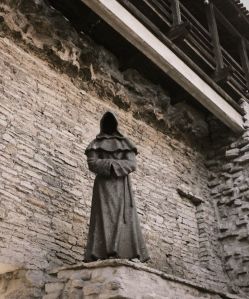
Accounts of the haunting also claim that doors slammed of their own volition, and apparitions of a hooded dark figure materialised in hallways or at the head of the staircase. Once, Jean was peeling potatoes at the kitchen sink and turned around to come face to face with the shadowy cowled figure, which had been standing quietly behind her. Strangely, she wasn’t afraid, and it disappeared. Perhaps she was too surprised to feel fear.
There was another event where Jean woke to find the shadowy monk floating over her bed, glaring at her.
The activity reached a peak between 1968 and 1969. One night all the lights in the house extinguished simultaneously and Diane screamed. After this, and after Diane had left home, the weird phenomena diminished a lot but never quite went away.
Ten years after the occurrences first started happening, a journalist with an interest in the Cluniac monks of Pontefract investigated the case, looking through old local newspaper reports, talking to friends, relatives, and neighbours, the local vicar, the mayor, and the Member of Parliament who had witnessed some bizarre stuff in the house. Neighbours had heard loud bangs coming from number 30, as well as lights flickering on and off in the small hours of morning.
People had reported sensations of being pushed or slapped by invisible hands, hearing guttural growls or chanting, and feeling sudden patches of coldness that moved through the house.
The haunting activity usually follows a pattern, beginning with small knocking sounds which build into chaos – especially during the night hours – without direct interaction or any response to human questioning.
EVPs (or electronic voice phenomena) captured in the house has contained threats such as “Get out,” and there have been shadowy figures seen in photographs taken there.
This haunting has scared residents and visitors so much that some of them have run out of the house in panic. It has drawn attention from the media, with the newspapers nicknaming the poltergeist “Mr Nobody” in 1968, though the family preferred to call it “Fred.” The house has had quite a few different owners and is a magnet for paranormal investigators. The current owner is Bil Bungay, an ad man who is a film producer.
The fact that the ghost or entity involved doesn’t respond to questions, and the tendency of the activity to follow a pattern, hints that this type of poltergeist may be a residual haunting – a loop of intensely emotional events that happened in the past, repeating themselves over and over. Residual hauntings are usually triggered by something, and in this case it seems to be set off by the presence of living humans on quiet evenings.
However, other behaviours of the poltergeist hint that it might not be residual and could be conscious. For example, after making a film about the haunting (When the Lights Went Out), Bil Bungay bought the house [and held a red carpet movie premiere there for it, with a red carpet leading up the garden path!] One day in February 2016, he was washing some dishes in the kitchen and felt the instinct to turn around. He turned in time to catch a tiny object forming over the dining room table, which then hurled itself at his head, missing by a hair, ricocheting off the window onto the kitchen floor. It was a wooden domino, and after Bil thanked “Fred” for showing him its ability to move objects, Fred kept on throwing small items at Bil: a marble, some screws, a red plastic ball, and Bil’s own hat.
The poltergeist didn’t only stick to number 30. It visited other homes in the neighbourhood and was sometimes seen passing outside. Carol, the next-door neighbour, was a psychic and could sometimes see “Fred”. She said the entity had visited her house a number of times.
Bil Bungay met two stars from the movie he’d helped to make – Hannah Clifford and Tasha Connor – and they tried to take a photo together at number 30 as a memento. However, Bil’s iPhone, though at 75% battery, suddenly went flat. After recharging it, there was no sign of the photo in his gallery, but a few weeks later, the photo came back on his phone.
After that, Carol (who was by then the holder of the keys to the house) was hearing thumps and bangs through the wall at 3 or 4am, seeing blue balls of energy in the corridor – and once, the duvet on her son’s bed shaped itself into the outline of a man lying down. She also claimed to see the shadow of a tall dark entity passing through the wall into her home.
The activity had been simmering away before Bil took possession of number 30 (though he didn’t live in it). There would be the sound of a TV playing loudly in the house while it was empty of living occupants.
After Bil bought the house, a documentary was being made about it. He visited the production crew on their last day of filming, and heard about some of the phenomena the crew had witnessed: a kettle switching on and overheating of its own accord, a remote thermostat constantly going missing, a researcher having the sensation of something pinning him down onto the bed, and a bunch of keys belonging to the producer going astray. Eventually the keys were found inside an old (unused) vacuum cleaner that was obtained from a charity shop to “dress” the house.
That last one was an interesting coincidence. When the Pritchards were living there, a set of keys to all doors in the house fell out of the chimney while Jean Pritchard was cleaning the flue. One of the keys was a large medieval door key.
At 2am on Bil’s visit to the production crew, everyone left except for him and two other people who were tidying things up. Bil went into the garden to clear up litter and noticed one side of a double gate was open, so he closed it – dropping the plunger into the hole, then moving a concrete block against the gate to secure it. The last couple of people left through the kitchen door, ready to get away from the place… but somehow the keys had gone missing again, and when Bil glanced around, the gate he had just closed was suddenly open again at 90 degrees, the concrete block pushed to one side. Bil’s colleagues were busy installing a lampshade upstairs before that, so they weren’t likely to have been able to open the gate as a prank.
The next day, Carol admitted to Bil that the gate opening was Fred’s doing, and that Fred did it a lot of the time. Neighbours told Bil that they saw Fred passing their windows in the dark hours.
Other visitors to number 30 experienced columns of icy air in the corridors, every radiator in the building somehow turning themselves up full overnight, and the cupboard under the stairs sometimes being impossible to open.
One afternoon, Bil was having hot drinks in the living room of number 30 with Carol and some of her friends, recounting earlier incidents and laughing, when they heard a popping sound like something plastic dropping onto the kitchen floor. On investigation they found Carol’s granddaughter, who had just entered through the front door, biting into a fake orange made out of polystyrene. When asked how she got it, the girl simply said a “man in black” had given it to her out of the fruit bowl.
But what was it that happened in the past that gave rise to Fred?
Stories say that the house is on the site of a medieval monastery (the Priory of Saint John the Evangelist), where a Cluniac monk was hanged for rape and murder near the property in the 16th century. Local legends talk about a “Black Monk” haunting the area. The house is at the top of the hill where the gallows once stood, and there was supposedly a stream with a small bridge over it in that location (poltergeists have been associated with underground running water, and the stream was buried long ago).
There is an old well below the house where the monk is believed to have been thrown after he was executed (along with the bodies of his victims, who also had their tongues cut out by the monk to silence them). The well causes a damp smell.
One of the monk’s victims was a girl about the same age as Diane. Perhaps that was what led the entity to target her.
Parties of 1 to 4 people can book a stay at number 30 East Drive, if they are insane enough. No alcohol is permitted and visitors have to sign a waiver before entering. Recently, Fred trashed a bed in the small room (that used to be Diane’s) at 3 am. There are 288 recent weird phenomena reported at the house. You can find those listed here.
The house has its own website here:
Sources
thehorrorcollection.com
Home
https://ghostwatch.com/paranormal-report/poltergeist-activity/england/the-black-monk-of-pontefract/

