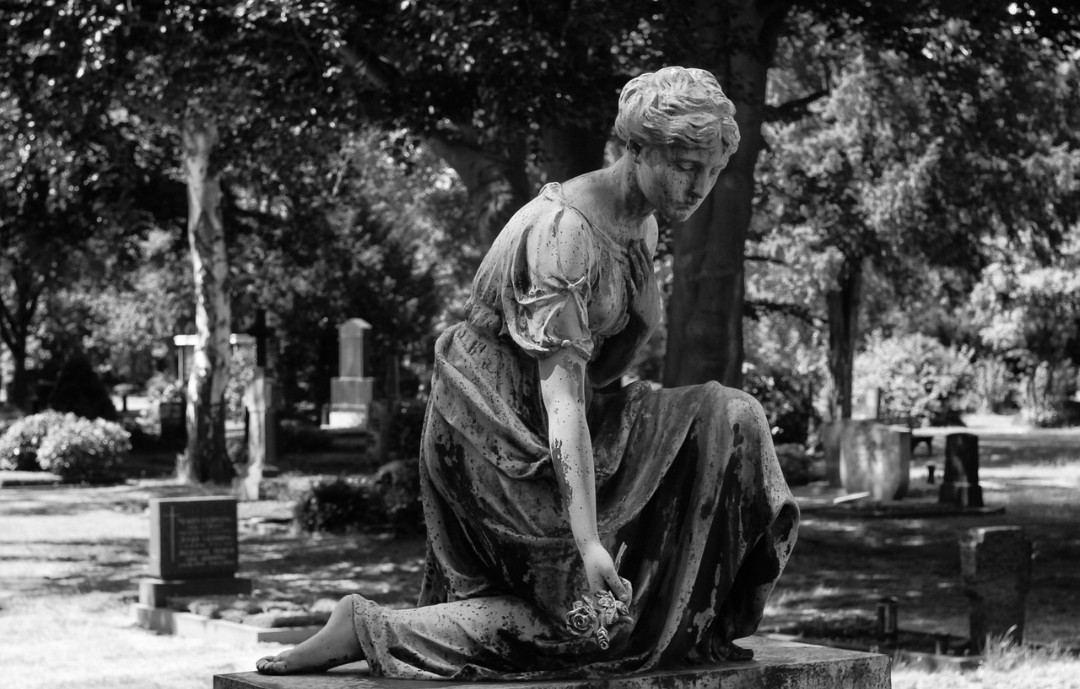
One of the earliest appearances of ghouls is in The Arabian Nights, or One Thousand and One Nights, portrayed as dangerous, flesh-eating demons. But how have they changed over time?

The Mesopotamians had gallu demons in their mythology, which had very similar traits to ghouls. It may be that the Arabian nomads swapped tales with the Mesopotamians. The gallu lived in the Underworld and carried their victims into the land of the dead to eat them.
In ancient, pre-Islamic Arabic folklore, ghouls or ghūls were a class of djinn or spirits that were the children of the Islamic prince of darkness, Iblis (or Satan). They constantly shapeshifted, but they always had the hooves of a donkey. They had an extreme hunger for human flesh. Djinn were spirits capable of possessing humans or animals.
According to the ancients, ghūls were always female (sexism much?) and were sometimes confused with the si’la or witchlike species of djinn that were totally unable to change shape.
These original ghūls would stalk the desert or lurk in graveyards, ruins, and battlefields in the form of attractive women, trying to distract travellers, then killing and eating them. According to the ancients, ghūls had to be struck dead with a sword, decapitating them with one blow – a second blow would bring them back to life. They would sometimes eat dead bodies but preferred to feast on the living.
In modern Arabic tradition, ghūls are human or demonic cannibals, male or female, frequently used to frighten children into behaving. The word ghūl comes from the Arabic ghāla, which means “to seize.”
Male ghouls are called ghūl and female ghouls are called ghulah. The female ghoul is often called Mother Ghoul or Our Aunt Ghoul in stories told to girls or young women. In these stories, the ghoul appears to men as a long-lost female relative or harmless old woman, and she convinces the men (usually husbands or fathers) to enter her home, where she can ingest them. The male character’s female relatives are often able to see through the Ghoul’s disguise, and the men survive if they listen to the women (or get eaten if they don’t).
The Ghoul is also believed to drink blood and steal coins, and also to assume the form of the person they have most recently eaten. Early ghouls were believed to carry diseases on their skin from the places they inhabited.
There were tales of one ghoul named Ghul-e Biyaban, who inhabited the wildernesses of Iran and Afghanistan.
In 1667, a hyena who attacked a woman in Mecca was called a ghul, possibly because of a perceived similarity to ghouls in early Arabic folklore. Originally, ghūls were hairy and canine, and would often shapeshift into hyenas to lure people into the desert. They were also humanoid, with hooves for feet.
Antoine Galland introduced the character of the ghoul into European society when he translated The Arabian Nights (or The Thousand and One Nights) into French, though he interpreted it rather loosely, adding in characters and stories that weren’t part of the original work. He added the character Amina (a woman who enjoyed hanging out with ghouls in a graveyard rather than with her husband) which led to the idea of ghouls preferring to eat dead bodies.
Ghūls became ghouls in the English Gothic horror tradition in the 18th and 19th centuries, and they were seen as grave-robbing creatures that fed on dead bodies and children. They are still shapeshifters, with the poet Edgar Allen Poe saying that they are “neither man nor woman… neither brute nor human”.
The first usage of the word “ghoul” was in William Beckford’s Orientalist novel, Vathek, in 1786.
Ghouls gained popularity in European stories from writing by the likes of Horace Walpole, Lord Byron, and especially H P Lovecraft.
Ghouls are believed to ride on dogs and hares and light fires at night to lead travellers astray. In their original form, they are thought to resemble hideous, hunched, corpse-like beings: skeletal frames, glowing eyes, rotting flesh, but with more intelligence than zombies, able to walk on two legs but preferring to crawl or run on all fours. Nowadays, they are believed to transform into human shape, animal shape, or the form of someone recently deceased to lure travellers or gravediggers into their dens to eat them. In some tales, they hide in underground tunnels or crypts then emerge to hunt at night.
In their later forms, ghouls are still believed to be somewhat canine and with hooves, but instead of being hairy they have pale, rubbery skin. They have an even greater shapeshifting ability, and can even absorb the memories of their victims once they eat their brain, so they can blend into society. There are even tales of ghoul changelings (e.g. Pickman’s Model by H. P. Lovecraft).
In some stories, they are weak against sunlight, holy symbols, spells, or weapons imbued with divine power.
Recent stories of ghouls suggest that they are in basements and cellars of abandoned buildings, and could have an underground network of tunnels to travel through. They may even have access to the subway and are thought to eat the remains of subway crash casualties before emergency services manage to get there.
Later stories of ghouls hold that the creatures can also be killed using fire, electrocution, and concentrated acids.
According to the story “The Nameless Offspring” by Clark Ashton Smith, ghouls procreate by mating with humans who have been mistakenly buried (ergh…). Other stories say a ghoul is a former human who lived such an evil life, they changed into one (or transformed into one after death) or is a human who once cannibalised another human. Others believe that ghouls are created through the spread of an infectious disease, transmitted by the ghoul’s bite or contact with other bodily fluids.
It so happens that I redefined the meaning of what a ghoul is for the flash fiction “Deathwalk” which you can read for free in GossamerWight’s Uncanny Regimes anthology:
Sources
https://www.britannica.com/topic/ghoul
Ghouls
 Nightwalks