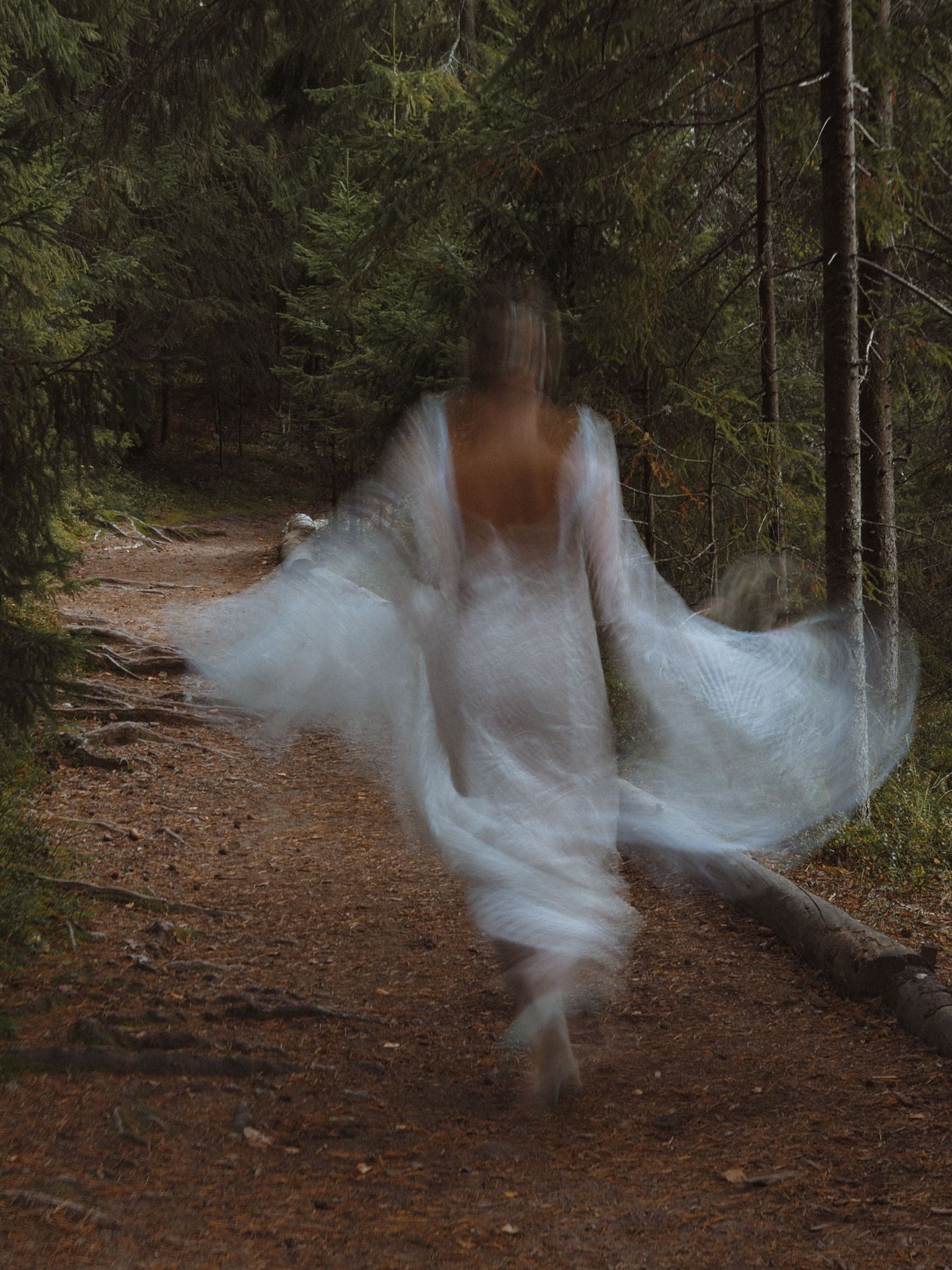
The Gwyllion is a mountain-dwelling spirit or faery in Welsh folklore, uncanny feminine entities that lead travellers away from the path into the mist and darkness…
Gwyllion (or Gwyllon) is the plural form of Gwyll or Yr Wyll, meaning “twilight,” “gloaming,” or “the wild.” The word is often applied to a type of ghost or spirit, or sometimes to night-wanderers (human or supernatural). These beings are seen as outlaws of the wild and up to no good, and they often resemble mysterious women or strange, elderly hags in ash-coloured clothing and oblong, four-cornered hats, an apron over one shoulder and a wooden milk-can in one hand. Travellers never see their faces, because when they do appear in the distance they are always facing away from the person seeing them, and never turns around.
One of the Gwyllion is the Old Woman of the Mist, who appears on the slopes wrapped in ragged clothing, her face half-hidden by a hood or veils of drifting clouds. Sometimes, she merely stands there watching you. Sometimes, she gestures for you to follow her. Or, she wails – a sound described in nineteenth-century stories as being “like a child crying itself hoarse on a cold stone floor.”
The word gwyllion was coined in the 17th century by the Welsh lexicographer, Dr John Davies of Mallwyd. The word was eventually associated with the mountain faeries / spirits beginning with Edmund Jones, a minister who was born in Aberystruth in 1702 and was obsessed with these beings. People nicknamed him the Old Prophet, and he spent tens of years collecting and writing down stories of apparitions told to him by people around Pontypool. He published these accounts in 1780 as the book A Relation of Apparitions of Spirits in the County of Monmouth and the Principality of Wales. 100 years after that, the American consul of Cardiff (Wirt Sikes) retold the material from Edmund Jones in a book named British Goblins. He filed the mountain apparitions under the heading “The Gwyllion,” and the name stuck. Wirt described them as belonging “to the twilight between ghost and fairy.”
Gwyllion are female faeries of terrifying aspect who haunt lonely roads in the Welsh mountains of Monmouthshire and Breconshire, and they lead travellers astray. They are gloomy spirits akin to hags or witches, distinct from the Ellyllon (Welsh elves) who are usually more benevolent. While they aren’t good entities, they aren’t inherently evil, either. They are more like lost souls, wandering endlessly.
The Gwyllion are often encountered at night or during misty days, and even if you’re perfectly familiar with the road you’re on, they can and will make you get lost.
Gwyllion often entered the houses of people in the parish of Aberystruth, especially in stormy weather. The elderly faery women were always made welcome out of fear of what they might do if offended. They would be given clean water and great care was taken to not have any knives or cutting tools in the corner beside the fire (where faeries would usually like to sit). It was good to be hospitable to them while indoors, but outside, it was a different story.
One such gwyll is known as The Old Woman and was haunting the Black Mountain in Breconshire. A man – Robert Williams of Llangattock, near Crickhowell – happened to meet her there at the same time that he became lost. Thinking she was human, he called after her to wait, but she never replied. He assumed she was deaf and tried to overtake her, but she led him further and further astray, always out of his reach, until he stumbled upon a marsh. She cackled, and, suspecting she was a gwyll, he drew his knife – and she disappeared.
It is interesting to note that many Welsh ghosts and faeries are afraid of knives, and can be banished by them. Perhaps this is because faeries are vulnerable to cold iron, or maybe the knife exorcism is an echo of Excalibur and the role it played in pre-medieval times. Other ways to make the Gwyllion vanish or protect yourself from their tricks is to offer them some food, such as a bit of cheese or a crust of bread, or to nod politely to them and wish them “nos da,” (good evening).
There was an Old Woman of the Mountain haunting Llanhyddel Mountain in Monmouthshire as well. She was seen as the ghost of a woman who was viewed as a witch when she was living. Her name was Juan White. A Monmouthshire man writing to Sikes in 1870 said he remembered her as the tenant of a ruined cottage on Lasgarn Hill near Pontypool when he was a boy, and that at midnight she appeared carrying her own head under her arm. As a gwyll, she uttered strange cries and shouts throughout her mountain to frighten travellers. (Gwyllion are believed to cry a sound like “wow-up,” based on the Welsh cry of distress: wwb, or ww-bwb. People of Aberystruth could hear that sound from many different directions in a short amount of time.)
There were also gwyllion on Bedwellty Mountain at night. A traveller – Evan Thomas – was crossing the mountain towards home in the valley of Ebwy Fawr and saw several spirits dancing around him and heard the sounds of a bugle overhead while invisible hunters rode past. Evan drew his knife, and they all vanished.
John ap John from Cwm Celyn, was chased across Milfre Mountain by disembodied shouts moving from Bryn Mawr to Bwlch y Llwyn to the Gilfach fields, and the cries always resounded in the direction he was heading in (towards Caerleon fair, and it was before dawn). He was struck by the trundling of a coach on a path that no coach would be able to use, and the same shouts sounded as if they were sitting on top of it. John dived off the road and waited face-down in heather until the sounds had abated. He stood and the birds had started singing, there were sheep on the hill, and the terror deserted him.
The Gwyllion have been associated with goats, too. There is a tale of a man named Cadwaladr who cared greatly for his goat, Jenny. However, he lost his temper with her for running off into the hills and caused her to tumble off a steep incline by throwing a rock at her. He clambered down to where she lay dying, and she licked his hand while he cried and sat with her head on his arm until the moon rose. At that point, she became a young woman with brown eyes. She hung her black slipper on the end of a moonbeam and held out her hand, which was beautiful but still felt like a hoof when he grasped it, and she led him up the slopes. Up on the summit, a vapoured crowd of goats with shadowy horns circled around him, bleating, and the king of the goats drove its head into Cadwaladr’s stomach, pushing him over a crag. The man then woke to find himself utterly alone and goatless in the sunshine, with the birds singing like nothing had happened.
Edmund Jones noted that the Old Women / Gwyllion had moved out of the open hills of Wales since about 1800, and into the coal-pits and holes of the Earth instead.
The Welsh faeries are known as the Tylwyth Teg, meaning “Fair Family,” and the Irish equivalent are the Aos Si. In Welsh folklore, the Ellyllon are found in valleys and groves and are loosely equivalent to elves, the Coblynau are found in mines and are similar to dwarves, brownies or household faeries are the Bwbachod, and nymphs (or at least, faeries of lakes and streams) are known as the Gwragedd Annwn. The Gwyllion are found in mountains and could be seen as hags, witches, the Irish folkloric idea of “stray sod” or even will-o-the-wisps (which I wrote a few posts about a while ago).
Sources:
https://sacred-texts.com/neu/celt/wfl/wfl04.htm
https://en.wikipedia.org/wiki/Gwyllion
https://en.wikipedia.org/wiki/Tylwyth_Teg
Gwyllion
The Welsh Gwyllion

