Part XIV of Amulets & Talismans
Babylon had special boundary stones (or “kudurru” stones in Akkadian, a language used in ancient Mesopotamia). These stones were seen as sacred and magical.
Kudurrus were a stone record of gifts (kind of like a receipt) especially for such things as land grants given to someone by the King.
Before the 16th century to 12th century BC, kudurrus were called narus and weren’t so highly polished. Kudurrus were usually made of limestone.
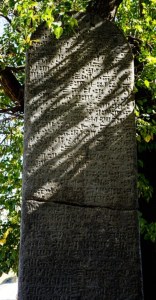
You might think that a kudduru stone was used to mark the physical boundaries of land, but that wasn’t the case! The stone would be kept in a temple, whilst a clay copy of it would be given to the landowner.
These stones were meant to be visible not only to people visiting the temple, but to the gods as well. Images carved into the stones showed an association with the divine realm, as they showed all the gods in charge of protecting the universe.
The gods’ images were in rows according to their rank in their hierarchy, and they were also represented by their symbols.
The order of the gods on the boundary stones revealed a lot about the beliefs held by the ancient Mesopotamians.
The kudurru’s top row was for the astral gods (Sin the moon god, Shamash or Utu the sun god, and Ishtar or Inanna, the goddess of Venus).
The second row depicted An or Anu the sky god, Enlil the air god, Ea or Enki the goddess of freshwater, and Ninhursag the Earth goddess.

In some cases, these two groups of gods would be separated and in other cases they would all be shown together.
The next three rows were for warrior gods, gods in charge of Earth’s fertility, and the gods of the Underworld respectively.
The text underneath the gods was divided into two sections, the first being a description of the land grant and conditions attached to it, the second being a list of curses that might fall upon anyone who violated the agreement!
Therefore, the kudurru stones were not just a contract between humans but between humans and the gods as well, as the gods would have been the ones doling out those curses.
Various kudurrus are on display these days in the British Museum and the Louvre Museum.
Babylonian Amulets
As well as lamashtu amulets, (which I covered in a recent post), the Babylonians used:
Humbaba amulets: carved stone heads of the demon Humbaba (or Huwawa). Humbaba was the guardian of the Forest of Cedars, where the gods lived. He was a giant raised by the sun god Shamash / Utu and was beheaded by Enkidu and Gilgamesh in the “Epic of Gilgamesh.” His face is grotesque (in some translations, his face is made of twisted entrails) and he has a grimacing expression… which is understandable under his unfortunate circumstances.
The stone heads of Humbaba, which were technically a sign of a known evil that had been defeated, were worn to ward off bad luck caused by other, unknown evils, in the same way that Medusa’s head was used in Greece.

Pendants and Beads of Deities: Gold pendants or beads depicting the symbols associated with different gods, e.g. two feminine figures with horned headdresses and long dresses would likely have represented Lama, a protective goddess.
A disc with rays emitting from the centre would have represented the sun god Utu or Shamash.
Forked lightning was the symbol for Adad the storm god.
A disc with rosettes on it would have represented Ishtar or Inanna, the goddess of love and war (who was also associated with the planet Venus.) She was also symbolised by a star or a lion.
Marduk, the patron god of the city of Babylon, was symbolised by a triangle-headed spade.
Nabu, the god of writing, was symbolised by a cuneiform wedge.
Sin the moon god was represented by a crescent moon.
These would have been used as fancy jewellery as well as for good luck.
Eye Stone Amulets: These have been talked about in this post here.
Clay Face or “Mask” Amulets: These came later on and were also of the demon guardian Humbaba’s face — though they weren’t large enough to be worn as literal masks. They were slightly larger than earlier stone faces of Humbaba and had two holes in them so they could be hung on a string. Scholars believe they would have been hung on house walls, particularly on the south walls, as the hot wind from the south was held to be a bringer of disease back then.
Beads of Pazuzu’s Face: These were often made of lapis lazuli so were of a blue hue, depicting the god Pazuzu’s face, which had a chin reminiscent of Bruce Forsythe’s and a ferocious grin. These were likely owned by more wealthy people in Babylonia.
A later representation of Pazuzu’s face was made of carnelian, a reddish-orange stone, with a narrower chin and a somewhat pig-like snout.

In some legends, Pazuzu was Humbaba’s brother and he was the personification of the south-west wind. However, he was a good defence against Lamashtu, a much greater evil who was later identified with Lilith, the first wife of Adam before he met Eve.
Pazuzu had a canine face, a scaly body, talons, and wings.
Pazuzu amulets were often carried by pregnant women or hung on the wall in the room where they were giving birth to fend off Lamashtu, who was seen as the cause of stillbirth and other problems in pregnancy / labour.
Ironically, Pazuzu is the name of the demon possessing the child in the film The Exorcist, even though he was seen as a guardian of the young in Babylonian times.
What is the Corverus Stone?
For many hundreds of years, the Corverus Stone was said to be hidden in the fountain in the centre of Corvin, a town in Dal-Rhiatah — the north-west continent and seat of the Dal-Rhiatan Empire.
It was dropped there by a sorceror during a battle with his enchantress lover, when the curse of the Grim was just beginning. The enchantress cast a spell which would have ensured all future children born in Dal-Rhiatah would be eaten by the Grim (or Ghosts and Witches). The sorceror was able to mitigate the curse so that some children would be born with the ability to repel the Grim.
The Corverus Stone — when worn by someone who has accepted it as a gift from a person with magic — protects the bearer from trickery and certain spells. However, as the Stone was not given to the sorceror, it burned his hands severely and he let it fall into Corvin’s fountain.
In book two of The Nighthunter series (currently in the works), the mysterious recluse known as Fletch has somehow obtained the Corverus Stone, and he gives it to Logan Bartholom (The Nighthunter) to help him in his quest to end the curse of the Grim.
The Corverus Stone is an exact twin to the Coven Stone. When joined with it on an altar at the top of a certain spire, it has a greater power — the power to rid the world of Ghosts and Witches…
If you want to read about the Nighthunter’s earlier exploits (which includes a sea voyage with a mad captain, a gigantic telepathic jellyfish that wants to eat people’s minds, and a cult that sacrifices people to a Ghost) you can get the first book, A Dark Heritage, here:
Next week: all about Selkies and why people would wear sealskins to protect against lightning…
Other Parts of Amulets & Talismans:
 Nightwalks
16 thoughts on “Babylonian Stones & Amulets… and the Corverus Stone”