Part XIII of Amulets & Talismans
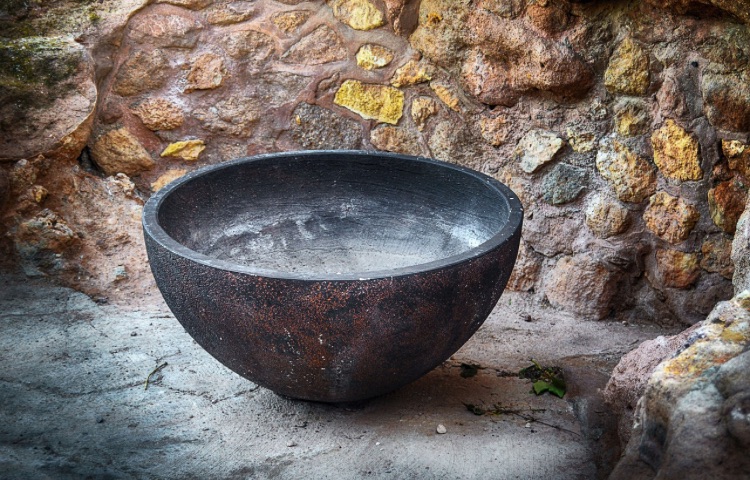
Incantation bowls are now discovered in the regions of Iran and Iraq. They were made there from the 6th to 8th centuries AD.
The bowls are usually carved with text going in a spiral on the inside from the rim towards the centre, but some are inscribed on the outside or in sections radiating from the centre.
Most inscriptions are in Jewish Babylonian Aramaic. This was the language used to write the Babylonian Talmud.
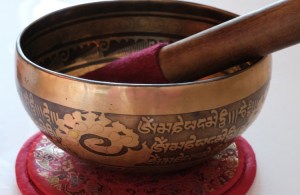
The incantation bowls were normally buried upside down in the ground, under thresholds and in courtyards (and in cemeteries) to capture demons and ward off evil.
In those times, Iraq / Iran (then called Mesopotamia) was home to a mixed population of different religions including Christians, Manichaeans, Mandaeans, Jewish people, and folks who followed the ancient Babylonian religion. These people spoke Aramaic dialects. Also present were Zoroastrians, who spoke Persian.
Most bowls recovered are inscribed in Jewish Aramaic using the Hebrew square-script, followed by Mandaic language and Syriac. A small amount have been found inscribed in Arabic or Persian.
About 10% of the bowls have been found inscribed in a made-up language that makes no sense. They were perhaps forgeries created by illiterate folks selling to illiterate customers!

A subset of these bowls were used in Christian and Jewish magic. They were used to protect from the evil eye, from Lilith (Adam’s first wife in the Jewish version of Genesis), and from Bagdana (who was some kind of demon). These bowls were used by any member of the Jewish settlement in Nippur and they had quotes from rabbinical texts inscribed on them.
This may mean that rabbinic texts were believed to hold the same kind of supernatural power as quotes from the Bible when it came down to dealing with demons. The bowls’ inscriptions also refer to themselves as amulets.
Hebrew Amulets
(or Kame’a)

The word “kame’a” is to do with the idea of binding or tying. Hebrew amulets are usually worn around the neck or wrist, or secreted somewhere on a person.
The amulets consist of text (letters or symbols) written on some type of material, some of these contain stuff from plants or precious stones. The text often contains holy names that are believed to be able to affect reality, along with words to summon angels or other magical beings.
Sometimes an “angel alphabet” is used, letters made with tiny circles on top of their ascenders. Sometimes the text has a numerological significance.

Symbols often used on Jewish amulets include seven-branched candles (or menorahs), tablets of the Law, stars of David (or hexagrams), swords, and stars of Moses (pentagrams).
Though a lot of Jewish religious authorities were against the wearing or usage of amulets for protection, they allowed the amulets to be used in necessary circumstances (e.g. for mothers in labour and newborn babies) or on the Shabbat / Sabbath — provided that the amulets in question had been written by a true expert in those matters and provided that the amulet had already been proven to be effective.
The Talmud stated that an effective amulet was one that had worked three times — whether it was a written one or one made out of herbs — and whether the person healed had been slightly ill or severely ill.
The expert that wrote amulets was called a ba’ale shem, or a master of the Holy Name. Sometimes rabbis wrote them as well.
Many books written by these experts in the 17th and 18th centuries contain texts used for amulets.

The amulet used for expectant mothers and childbirth would have words on it to banish Lilith, Adam’s estranged first wife, who became a demon that liked to harm children.
Sometimes it would be a very simple, “Adam, Eve. Lilith out” or it could be a long passage exhorting angels to help by including their names, e.g. Sanoi, Sansanoi, Semanglaf, and Semanglon.
Examples of amulets include:
The Hamsa
A palm-shaped object with an eye in the middle of it.

A red string fastened around the wrist

This became popular after some well-known followers of the Kabbalah (Jewish mysticism) started to wear red strings on their wrists. The string and the hamsa were designed to ward off the ayin hara or evil eye.
Kabbalistic amulets

These took the form of writing or letters on paper.
Prints / artwork with text on them
One example includes a folkloric print of David and Bathsheba from a scene in the Talmud, only with the names of Matriarchs, Patriarchs, and angels and demons written on it. This can be found in the Russian Museum of Ethnography in St Petersburg, or you can view it in this article here
The next instalment will most likely be about Babylonian stones and amulets, along with more information on the mysterious Coven Stone and its brother, the Corverus Stone…
Other parts of Amulets & Talismans:
 Nightwalks
16 thoughts on “Incantation Bowls & Hebrew Amulets”