
Part X of Amulets & Talismans
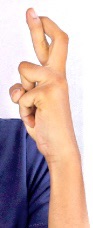
Crossing your fingers for luck, or to prevent “evil luck” has been a common thing in English-speaking regions for centuries — mostly in the UK, the US, and some parts of Scandinavia. Not only that, but it is used discreetly whilst someone is telling a lie or making a promise they have no intention of keeping. But what does this bizarre hand sign mean and where did it come from?
Before Christianity, people made a different gesture by crossing one index finger over the index finger of another person — usually when they were making a wish — and it symbolised a concentration of good spirits. The finger-crossing was supposed to be an “anchor” for that wish until it came true, as it was thought that beneficial spirits collected at the intersection of a cross and could be contacted there. (The cross represented a union between the spiritual and material planes.)
In the early days of Christianity (when Christians were persecuted) people invented hand gestures to recognise fellow Christians. One of these involved making a fish symbol by touching thumbs and crossing index fingers with another person to form the Icythus (or Christian Fish). Another was crossing the fingers to represent the cross and ask for its protection.
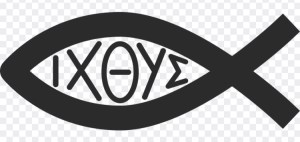
Eventually, that gesture changed so that people crossed fingers on their own.
In the Middle Ages, judges would cross their fingers behind their backs to “apologise” to God whenever they handed down a sentence, especially when pronouncing the death sentence, as only God was thought to be responsible for removing someone’s life.
By the 16th century, people were crossing their fingers to ward off evil luck and ill-health.
However, some folklore historians have said the hand-gesture wasn’t done in Europe until the 19th century and that before then, the sign for good luck was crossing your legs, and the sign that was used to ward off evil was to tuck one’s thumb inside a clenched fist. The thumb-in-fist for luck is still used in Germany, the Netherlands, and parts of Scandinavia.
Sometimes it is held that crossing your fingers when walking under a ladder prevents bad luck, but some people claim that it would only protect you until you saw a dog.
A cousin to this gesture is that of children linking their little or “pinky” fingers to seal a promise.
In some places, the crossed-fingers gesture is seen as incredibly rude. For example, in Vietnam, crossed fingers are taboo as they are thought to reference the female genitalia. Therefore, if you made this gesture in front of someone in Vietnam, they may think you were calling them the “c-word.”
In countries such as Sweden and Latvia, the gesture is taken to mean that you are lying about something.
Mudras
An interesting contrast with crossing the fingers for luck is the idea of mudras, or hasta mudras / hand mudras to be specific.
From the Sanskrit word meaning “seal,” “mark,” or “gesture,” mudras are poses or gestures, most often done with the hands, to target certain areas in yoga. They are also used in some Asian martial arts and in Indian dance moves.
Mudras are described in texts such as the Nātyaśāstra, (which is about the performing arts and lists 24 asaṁyuta [“separated” or one-handed] and 13 saṁyuta [“joined,” or two-handed] mudras.)
They are also found in Indian religious iconography.

Hatha Yoga
Mudras are used in hatha yoga, while seated, along with pranayama or breathing exercises, to benefit different parts of the body and affect the flow of prana or energy.
Unlike with older tantric mudras, these are used to affect internal areas such as the pelvic floor muscles, the diaphragm, the throat, the eyes, the tongue, the back passage, the private parts, and the abdomen.
Hasta Mudras are formed with both the hand and fingers. Along with āsanas or seated postures, they are used statically in meditation.
Iconography
Images of the Buddha can have several different combinations of mudras and asanas. The main mudras symbolise specific scenes in his life.
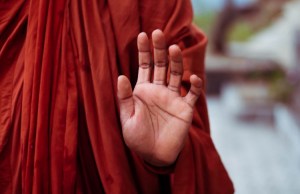
Abhaya Mudra: “gesture of fearlessness.” The Buddha made this gesture when he was attacked by an elephant.
Made whilst standing, the right arm bent and held at shoulder height. The palm faces forward, fingers closed, pointing upright. The left hand rests by the side.
In Thailand and Laos, this mudra is often shown by the Walking Buddha, which also sometimes makes a double abhaya mudra with both hands.
Bhumisparsa Mudra: or “earth witness.” Otherwise known as “earth-touching” or “Buddha calling the earth to witness.”
He was making this sign when he received enlightenment — sitting with his left hand, palm upright, in his lap, his right hand touching the earth.
In the legend, Mara or the evil one challenged Buddha, arguing for a witness to prove his right to achieve enlightenment. In response, Buddha touched the ground, and Phra Mae Thorani (the earth goddess) appeared to be that witness.

Bodhyangi Mudra: “mudra of the elements” or “fist of wisdom.” The left index finger is grasped with the right hand.
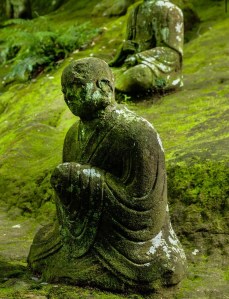
Dharmachakra Pravartana Mudrā: or “turning of the wheel.” This represents Buddha’s first sermon after he attained enlightenment.
It looks like two hands held close together in front of the chest in an attitude of thought / inquiry, the right palm forward and the left palm upwards, sometimes facing the chest.

Dhyana Mudra: or “meditation mudra,” “yoga mudra,” or “samadhi mudra.”
The two hands rest on the lap, the right hand on the left with fingers fully extended, the thumbs facing upwards towards one another diagonally, and the palms facing upwards.
This makes a triangle shape which symbolises spiritual fire. Some forms of the Buddha have this mudra but with a medicine bowl placed on the hands.
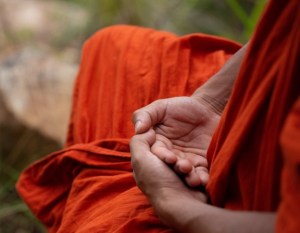
Varada Mudra: or “generosity gesture.”
Almost always made with the left hand and can be made with the arm crooked and the palm slightly turned up, or if the arm faces down, the palm is presented with fingers upright or a little bent. This mudrā is not often seen unaccompanied by another mudra made with the right hand, which is often abhaya mudrā.
In India, the varada mudra appears in both sitting and standing figures of Buddha and boddhisattvas. It’s especially associated with Vishnu in Hindu art.
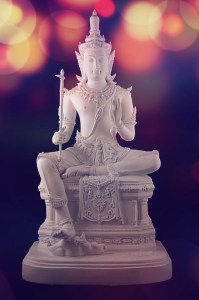
Vajra Mudra: or “thunder mudra.” The gesture of knowledge. This is done by pressing the thumb and tips of the fingers together, apart from the index finger which is fully extended.
Vitarka Mudra: or “gesture of discussion,” or “mudra of explanation,” or “chin mudra.”
With the other fingers straight (in a similar way to the abhaya and varada mudrās) the thumbs are touching the index fingers.
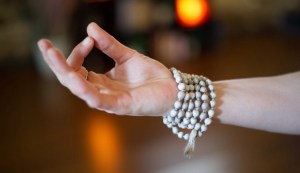
Jñāna Mudrā: or “mudra of wisdom.”
This involves touching the ends of the thumb and the index finger together, forming a circle, and holding the hand palm inwards towards the heart.
Sometimes sadhus (religious ascetics) chose to be buried alive in this meditative position.

Karana Mudra: almost the same as the Western “sign of the horns,” this is also known as the tarjani mudra and is thought to be the one that repels demons and gets rid of obstacles such as sickness or negative thinking.
The difference between the “sign of the horns” and this mudra is that the thumb doesn’t hold down the middle two fingers.

The Hasta Mudras in yoga are many and numerous (maybe as many as 399). Each gesture is related to the idea that the five digits symbolise the five elements:
The Thumb = Fire
The Index Finger = Wind
The Middle Finger = Ether or Space
The Ring Finger = Earth
The Little Finger = Water
You can read more about some of the different hand signs and how to do them in this document here.
Next week, tune in for a post about the ankh and more magical stones including a look into the Coven Stone…
Other parts of Amulets & Talismans:
 Nightwalks
16 thoughts on “Fingers Crossed & Other Handy Things”