Most people are aware that the horseshoe is a talisman that brings good luck. However, not a lot of folks know why or how they are supposed to work these days.
Because iron was a valuable metal, so that horseshoes were usually reforged and reused, archaeologists cannot know for certain when people first started to make horseshoes.
It may have been the Celts or the Romans who first invented them.
Iron was originally believed to ward off evil spirits, and the horseshoes were driven into a horse’s hoof using seven nails. Seven was a lucky number.
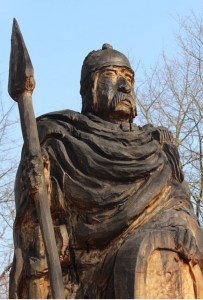
wooden figure of a Celt. From Jollymama on Pixabay
The horseshoe may have become an omen of good luck when 8th-century Chaldeans decided its crescent shape was a sign of various moon goddesses, which meant it protected against the evil eye.
There was a legend of a saint named Dunstan in 969A.D. He was a blacksmith before he became Archbishop of Canterbury.
One day, the Devil sauntered into Dunstan’s smithy and asked him to shoe his horse.
Dunstan pretended he didn’t know it was the Devil and agreed to fulfill this order.
However, instead of nailing the shoes on the horse’s hooves, Dunstan nailed a horseshoe to the Devil’s own foot, which caused the Devil a lot of pain!
A smithy. Image from FrauW-Werkstatt on Pixabay
Dunstan eventually removed the horseshoe, but on one condition: the Devil had to promise never to enter a house that had a horseshoe nailed to its door.
Sailors believed that nailing a horseshoe to the mast of a ship would help it to steer clear of storms.
There were two schools of thought as to which way up the horseshoe ought to be nailed: ends pointing upwards so it would act like a cup to “catch” all the good luck, or ends pointing downwards to pour good luck onto those entering the home.
Some folk believe that hanging a horseshoe upside down is bad luck, as then all the good luck inside it would fall out.
During traditional Scottish weddings, a page boy would present the bride with a silver horseshoe.
Image of horseshoe being hammered on an anvil from jackmac34 on Pixabay
Rutland, England’s smallest historic county, has a tradition where every nobleman visiting Oakham presents a horseshoe to the Lord of the Manor. The horseshoe is then nailed to the wall of Oakham Castle. The Castle has gained a large collection of horseshoes, the oldest of them being from the 15th century.
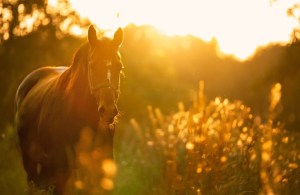
Apparently, the luckiest form of horseshoe comes from the hind feet of a grey mare.
Elf Arrows / Elf Bolts / Elf Darts or “Belemnites”
or the Elf-shotCondition
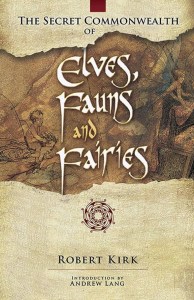
In The Secret Commonwealth of Elves, Fauns, and Fairies (1691) by Robert Kirk, the fairy or elf arrow is described as tipped with yellow flint and it states that the arrows inflict fatal wounds without breaking the skin.
Robert Kirk said that he examined such injuries. It is also on record that an Irish bishop was shot at by an evil spirit, and it was claimed that elf-arrows were manufactured by the Devil with the aid of imps who rough-hewed them while the archfiend (or the Devil) finished the work.
Robert Kirk’s book on Amazon
According to ancient Anglo-Saxon medical texts, e.g. “Wid faerstice” the condition known as elf-shot was caused by elves firing invisible, tiny arrows at a person or an animal (usually cattle).
The condition supposedly caused localised shooting pains. These days, diagnoses such as muscle cramps, stitches, or rheumatism would be much more likely!
Attributing strange aches and pains to elf-arrows or elf-shot was a common thing in Anglo-Saxon and Scandinavian Europe.
According to folklore, the elf-arrows came from the sky and were used by elves to kill cattle and affect humans.
Image from Juergen_Sieber on Pixabay
There is an Old English spell, “If a horse is elf-shot” (Gif hors ofscoten sie) meaning an internal injury, and this may be an allusion to elf-shot.
The word aelfsogoda – describing internal pains from jaundice or a bile disorder, also hints at elf-shot.
Image by GepaardmetKelly on Pixabay
The phrase “elf-shot” can also apply to witchcraft.
Elf-arrows (really Neolithic and Bronze Age arrowheads) were believed to be utilised by fairies or witches to cause harm.
According to Isobel Gowdie, a woman accused of witchcraft, elf-arrows were gifted to witches by Satan, and they fired them by flicking them with their thumbs in the Devil’s name.
A peculiarity of elf-arrows or elf-bolts is that they are never locatable when searched for, but they turn up in very unexpected places and situations.
For example, Sir Robert Gordon of Straloch, a Scottish geographer who wrote texts two hundred years ago, said that a man found an elf-arrow in his boot while out riding, and a woman found one in the top half of her dress. Both discovered the arrowheads in an unexpected way.
image from fluffy_marry on Pixabay
In 1590, Katherine Ross, or Lady Fowlis, was accused of witchcraft and put on trial for trying to destroy of some of her husband’s relatives by shooting elf-arrows at clay figurines of them.
Mentions of elf-shot continued in Scotland until well into the 20th century, though more modern cases focussed on animals rather than human victims.
Elfshot arrowheads were also sometimes used for exorcism.
Elf-arrows were also worn as amulets — sometimes cast in silver — as protection against witchcraft.
Prevention or healing of elf-shot could involve going to Church on the first Sunday of the season, or using a charm made from feverfew, red nettles, and waybread. All of these plants have spear-shaped leaves, which (according to the Law of Similarity or sympathetic magic) hinted at their possible use as a remedy for this.
Feverfew flowers. Image from Pezibear on Pixabay
Elf-shot cows refused food, became languid, and breathed hard. The old “knowing women” in Scotland would rub and search the cow’s skin, where they would pretend to find holes, not inside the hide, but in the fascia underneath. They massaged these “holes” and bathed them with salty water.
Once all the holes were found and massaged, two table-spoonfuls of salt would be dissolved in half a pint of cold water, then some of it was poured in the cow’s ears, and the rest of it poured down its throat. After some time, the cow usually recovered.
Some silver would be placed into the water as the salt was dissolving in it.
Another cure was to touch the cow with an elf-arrow, or make it drink water that had had an elf-arrow dipped into it.
Sometimes, when curing elf-shot cattle, the Anglo-Saxons would fold a sewing needle into a page from a book of psalms, then place it into the hair of the animal that was afflicted.
Image by fotshot on Pixabay
Cures for elf-shot horses included mixing dock seed, Irish wax, and holy water, then getting a priest to sing twelve masses over the mixture.
According to Dr John Hill Burton, (cited by Sir John Evans) in Scotland, as late as 1872:
“…elf-bolts, after finding, should not be exposed to the sun, or they are liable to be recovered by the fairies, who then work mischief with them.”
image of Loch Ness by simple on Pixabay
In Sutherlandshire, Mr Hew Morrison said that when he was younger:
“arrowheads of flint were religiously consigned to the nearest loch, or buried out of sight, as instruments of evil… Even so late as 1866 or 1867 I saw a cow which was said to have been killed by the fairies with these weapons; and when I pointed out to the owner of the animal that her death had been caused by rolling over, and her long horns penetrating the ground and keeping her in a position from which she could not rise, I was told that that was the common way in which the cows fall when struck by the arrows of the shithich or elf-bolts.”
Author of short stories, longer short stories and poetry. Passionate about music, doing various creative things, and making people laugh! An amateur artist and occasional book reviewer, he runs, edits and illustrates Once Upon A Crocodile e-zine.
View more posts
16 thoughts on “The power of horseshoes and elf arrows”






 Nightwalks
16 thoughts on “The power of horseshoes and elf arrows”