Part IV of Amulets & Talismans
In last week’s article on witch marks (and witch’s marks…) I touched on the “witch’s teat” and mentioned about cambions.
Here is the lowdown on these entities.
The witch’s teat — either some kind of skin tag or a supernumerary nipple — was a perversion of the maternal, and was thought to be used by the witch to feed her familiars or imps. Her familiar was supposed to provide her with help in magic in exchange for a draught of her blood from said teat.
The witch’s teat was also believed to be where Satan would drink from whenever he visited his followers at night, sometimes having relations with them and thereby making them pregnant.
Once the half-devil offspring had been conceived and born, it was called a cambion and could only feed from the witch’s teat and nothing else.
On the seventh day of the seventh week of daily feeding in this way, the cambion was thought to achieve adulthood and begin to cause bedlam with a wide range of demonic powers inherited from Satan. However, if the 49-day feeding frenzy were to be interrupted, it would have to begin again from scratch.

Witch Prickers (or Witch Finders)
All witches, warlocks, and sorcerers were supposed to have a witch’s mark that could be discovered — a sign of their pact with the Devil.
Persons accused of witchcraft would be examined from head to foot for this mark, which could be either a skin-tag, a mole, an extra nipple, or even an insensitive patch of skin. The Inquisitors were highly confident that they could distinguish between natural marks and witch-marks, so any protest from the accused that their mark was natural was usually ignored.
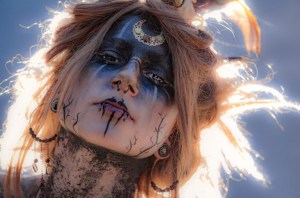
The authorities in witch trials would remove the accused of their clothing and shave off all their body hair so nothing could be hidden.
They would stick pins into any scars, callouses, or other thickened patches of skin, and this practice was known as pricking the witch.
This ordeal was often done in front of a crowd of public bystanders!
The Inquisitors also thought the Devil was capable of leaving invisible marks on witches, so if no likely marks were found, the poor woman (it was often women who were targeted) had to endure pins being stuck into her skin all over until an insensitive patch was located!
In early modern Europe, people were employed to help the Inquisitors find witches, and were given the epithet “witch-finders.”
The most notorious witch finder was Matthew Hopkins, born in 1620 and died in 1647. He dubbed himself the Witch Finder General.
His writings on witches gained a lot of popularity in 1645, in the English Civil War, and his words contributed to the usage of searching for witch’s marks as signs of guilt.
Two Scottish women actually disguised themselves as men — Mr Dickson and Mr Peterson — so that they could become witch finders!

So what in the nine Hells is a ghostmerchant?
In Book Two of The Nighthunter series (working title: The Curse of the Grim) there are individuals working to help the village of Corvin — and other places on the continent of Dal-Riatah — keep Ghosts and Witches at bay.
This is not as altruistic and kindly as it sounds.
The children born in Dal-Riatah are afflicted with a curse. They either naturally repel Ghosts and Witches (and are deemed “witchward”) or have the unfortunate capacity to summon Ghosts and Witches to them in response to stress (and are deemed “ghostbait”).
The children cannot help this. However, to ensure more safety in towns and villages, ghostbait children have to be gotten rid of in some way. That’s where the ghostmerchant comes in: this person goes to meet parents and guardians of ghostbait children and essentially abducts them, though most often the parents give consent to it out of fear.
The ghostmerchant takes these children into exile, leaving them in the fog-laden Barren Plains to be “eaten” by the Ghosts and Witches waiting hungrily in the mist.
The Nighthunter is working to put an end to the curse.

To know more about the Nighthunter’s adventures in Book One, A Dark Heritage, click below.
Other instalments in Amulets & Talismans:
Next week: All about the protection of horseshoes and what is it with elf arrows?
 Nightwalks
17 thoughts on “Cambions, Witch Prickers, and what in the nine Hells is a ghostmerchant?”