Amulets & Talismans Part III
Between the 16th and 19th centuries, strange marks were inscribed near the doorways, windows, and hearths of medieval churches, houses, and barns, and even in caves.
Carved into stone or woodwork, these marks were for the protection of inhabitants and their visitors. Protection from evil spirits and witches, hence the name “witch marks.”
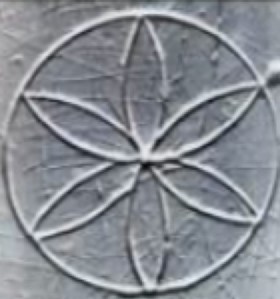
The most often found types of witch marks are hexafoils, or “daisy wheels” — six-petalled flower-in-circle patterns of varying size.
Some Wiccans believe hexafoils are actually sun motifs. Another school of thought holds that they were only geometric exercises for apprentices, but it is still widely held that these marks were used for supernatural protection.
Other forms of witch marks include 12-petalled daisy wheels, pentangles (which have been used since 3000BC to trap evil spirits), simple circles — either alone or intersecting — organised grids, “M” which is thought to stand for “Mary”, or AM for “Ave Maria” or VV for “Virgin of Virgins,” and even marks that look like sideways-on spectacles.
There are also tadpole-shaped burn marks known as “taper burn marks” that may have been burnt into the fabric of buildings during their construction to protect them from fire and lightning.
In churches, witch marks appear anywhere like an old form of graffiti, though some have been spotted on objects within the churches such as upon stone fonts and upon old chests.

They have also been located around the doorways of barns used to house grain, and also on the stonework of larger barns e.g. the 15th century barn at Bradford-upon-Avon, Wiltshire, in England.
Some historical houses have had furniture from the 17th to 19th centuries with hexafoil patterns on them.
Circular witch marks are quite often carved in an overlapping design.
Most reports of the discovery of witch marks come from the East of England.
Hexafoils can be inscribed using a compass or a tool which makes fixed-diameter circles. The outer circle has the same diameter as the arcs used to create the petal-pattern inside it.

For witch marks on stone, they were most likely made with a “divider”, a tool stonemasons carried. The marks have noticeable central holes. Dividers have appeared in paintings and drawings and on gravestones. They weren’t a tool that ordinary folk would have had access to.
For witch marks or hexafoils on wood, a tool called a race knife was likely used. The race knife was (and still is) used by carpenters to mark pieces of wood. It usually has a point so small-diameter circles can be drawn with it.
The circular witch marks have an “echo” with the Signs that Will has to seek to defeat evil in Susan Cooper‘s The Dark Is Rising, which I found interesting.
Witch marks have an interesting contrast to the more modern-day usage of tramp signs, which were apparently scratched outside houses to let fellow travellers know what sort of treatment they would receive at those places.
ON THE OTHER HAND…
Witch’s marks (or stigma diabolicum, devil’s marks) was a mark on a person’s skin that witch-hunters believed were an indication of witchhood during the mass hysteria of the witch trials.
Beliefs about the witch’s mark varied, depending on the location of the witch trial and the accusations made against a witch.
Usage of the phrase is found early in the 16th century, peaking in 1645, then fading from popularity by the year 1700.
These marks were thought to be an indelible marking from Satan upon his initiates to “lock in” their obedience to him. He was said to make these marks by scraping a claw across their skin, licking their skin to make a death-skull pattern, or using a heated iron to stamp them with a blue or red brand. The Devil was believed to mark new witches at the end of a nocturnal initiation rite.
Another form of witch’s mark was the witch’s teat, a raised lesion or bump somewhere on the body, often thought to look like a wart. The witch’s teat was believed to play an important role in the raising of cambions, half-demon half-human hybrids (more about that next week).

Curse Tablets
These were tablets in the Greco-Roman era with curses written on them. The Roman word for them was tabella defixionis, and the Greeks called them katadesmos.
The tablets were used to ask the gods (or the spirits inhabiting a certain place, or the Dead) to carry out an action upon a person or object, or otherwise control the person/object of the curse written on the tablet.
The tablets were often thin sheets of lead with words scratched into them in tiny lettering. The text was sometimes addressed to liminal or infernal gods such as Hecate, Charon, Pluto (or Hades) and Persephone, sometimes including a dead person as “go-between” (likely the person in whose grave the tablet had been hidden in).

Other times, the text merely listed the curse’s intended recipient, the crimes or conditions concerning them, and what consequences the curse-layer intended for them. Sometimes curse tablets only had a name scratched into them, leading some people to think an oral incantation must have accompanied the tablets.
Curse tablets to do with justice and making people pay for wrongdoing were often inscribed with extra meaningless words, e.g. “Bazagra”, “Bescu”, or “Berebescu”, perhaps to give them more supernatural power.
Many curse tablets included voces mysticae, or made-up words intended to represent the language only demons could understand, or that was appropriate with which to talk to the gods. These also involved secret names. Palindromes were also used as well as boustrophedon (reversed letters and alternate lines of reversed writing), pictures and charakteres or letter-shaped magic signs.
Some tablets had what looked like blank spaces instead the target’s name, which suggests curse tablets could be prepared in advance, the desired target’s name later inserted for the customer, if they were prepared by professionals using the above language and magic signs to add an air of mysticism to their craft.

Sometimes repetition of a certain formula would be used as well as invocations to Egyptian deities, archangels, and other biblical personalities.
Once written on, the tablets were often rolled, folded, or pierced with nails, then hidden underground, either buried in graves or tombs, thrown down wells or in pools, or placed in underground sanctuaries. Sometimes they were nailed to the walls of temples.
Sometimes curse tablets were used for love spells — if that was the case, they would be sequestered in the home of the desired person.
Sometimes the tablets were found accompanied by small dolls, often pierced with nails as well. The dolls resembled the target of the love spell with their hands and feet tied together.

Curse tablets also could include bits of hair or clothing. This was supposed to strengthen the effect of the spell by infusing it with the main “essence” of the person who was the spell’s subject. This was especially true for love spells!
Love spells have been found wrapped around some hair, probably to bind the spell inside.
Other tablets were not used as curses but as a way of helping the Dead. They would be placed at the grave-sites of those who died young or violently, in the hope that this would aid their souls to rest easy.
Many curse tablets discovered at Athens referred to court cases and cursed the persons whom the curse-layer were having a legal battle with, asking “May he…” followed by such afflictions as botching his words in court, forgetting what to say, or becoming dizzy.
Other tablets were intended to work against thieves, sporting opponents and business rivals.
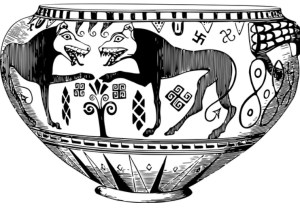
An early version of curse tablets, known as “Execration Texts” existed in ancient Egypt, around the 12th Dynasty. Names of enemies would be listed on clay figures or pottery which would then be smashed to pieces and buried under a building during its construction so that those enemies were “smothered”, or buried in a cemetery.
Next Monday: Cambions, witch-prickers, and ghostmerchants…
Read other parts of Amulets & Talismans here:
 Nightwalks
16 thoughts on “Witch Marks & Curse Tablets”