
Amulets & Talismans Part I
Witch bottles were a type of apotropaic magic (apotropaic = from the Greek apotrepo, which means to ward off).
These strange bottles are mentioned in historical sources from both England and America, the earliest mention being from 17th-century England. However, the term “witch-bottle” was not used for them until the 19th century, and they may have been utilised more for curative than preventative matters, according to this study.

Some of the earliest witch bottles were glazed stone jugs (or German stoneware “bartmann” jugs, bellarmines, or “greybeards”) glazed with salt.
The stone witch bottles usually contained rusted nails, urine, thorns, hair, menstrual blood, pieces of glass, wood, and bits of bone.
Witch bottles that were made later were fashioned out of glass bottles or small glass vials, or sometimes other containers.
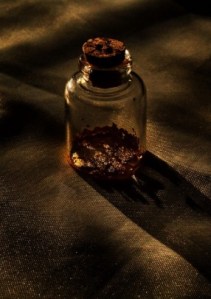
Folk healers and white witches made witch bottles for people who believed they were under a bad spell or had been cursed. They would include urine, hair and / or nail clippings from the spell-victim in the bottles, or red thread from sprite traps.
Later on, witch bottles contained such things as rosemary, pins, needles, and red wine instead. Sometimes, they put water from the sea or some earth in, or stones, knotted threads, sand, shells, herbs, flowers, feathers, salt, vinegar, oil, coins, or ashes. In a few cases, the bottles included a piece of fabric cut into the shape of a heart, sometimes with pins piercing it.
The witch bottle would often be buried at the furthest corner of the victim’s house, underneath the fireplace, or hidden somewhere in the house, though they have also been found in churchyards, ditches, and buried in riverbanks.
The witch bottles had to be placed at the entry and egress points of the building. The hearth was a place open to the sky so would have been a possible mode of entry for supernatural entities.
The usage of iron pins in witch bottles is significant as iron was viewed as a magical metal that witches and fairies found repellent.

It was believed that once the bottles were buried, they captured evil, which would be impaled on the needles / pins, drowned in the wine, then banished by the rosemary.
However, some witch bottles were thrown into a fire so that they exploded, thereby breaking the spell or killing the witch who had supposedly cast it.
The witch bottles were “active” so long as they stayed concealed and unbroken.
Witch bottles buried under hearths have only been discovered after the rest of the buildings were torn down or otherwise disappeared.

Circa 1670, a ballad, A miraculous cure for witchcraft, or, Strange news from the Blew-Boar in Holburn was printed anonymously. The ballad told of a bewitched girl near London, who was ‘vext in Body, and perplex in mind’.
After trying many solutions, the girl and her friends found a ‘chymist’, reputed for his art. He told them to put the bewitched girl’s urine into a bottle, accompanied by other ingredients, then bury it in a dung-heap where it was not to be touched or meddled with.
After following his instructions and waiting by the dung-hill all night, the witch came along looking “swell’d,” and demanded the bottle from them.
The girl and her friends refused the witch’s request and the witch departed and died. After that, the bewitched girl began to recover.
One early account from 1681 in Suffolk, England held that:
For an old Man that Travelled up and down the Country, and had some acquaintance at that house, calling in and asking the Man of the house how he did and his Wife; He told him that himself was well, but his Wife had been a long time in a languishing condition, and that she was haunted with a thing in the shape of a Bird that would flurr [sic] near to her face, and that she could not enjoy her natural rest well. The Old Man bid him and his Wife be of good courage. It was but a dead Spright, he said, and he would put him in a course to rid his Wife of this languishment and trouble, He therefore advised him to take a Bottle, and put his Wives Urine into it, together with Pins and Needles and Nails, and Cork them up and set the Bottle to the Fire well corkt, which when it had felt a while the heat of the Fire began to move and joggle a little, but he for sureness took the Fire shovel, and held it hard upon the Cork, And as he thought, he felt something one while on this side, another while on that, shove the Fire shovel off, which he still quickly put on Again, but at last at one shoving the Cork bounced out, and the Urine, Pins, Nails and Needles all flew up, and gave a report like a Pistol, and his Wife continued in the same trouble and languishment still.
Not long after, the Old Man came to the house again, and inquired of the Man of the house how his Wife did. Who answered, as ill as ever, if not worse. He askt him if he had followed his direction. Yes, says he, and told him the event as is above said. Ha, quoth he, it seems it was too nimble for you. But now I will put you in a way that will make the business sure. Take your Wive’s Urine as before, and Cork, it in a Bottle with Nails, Pins and Needles, and bury it in the Earth; and that will do the feat. The Man did accordingly. And his Wife began to mend sensibly and in a competent time was finely well recovered; But there came a Woman from a Town some miles off to their house, with a lamentable Out-cry, that they had killed her Husband. They askt her what she meant and thought her distracted, telling her they knew neither her nor her Husband. Yes, saith she, you have killed my Husband, he told me so on his Death-bed. But at last they understood by her, that her Husband was a Wizard, and had bewitched this Mans Wife and that this Counter-practice prescribed by the Old Man, which saved the Mans Wife from languishment, was the death of that Wizard that had bewitched her.
— from Joseph Glanvill’s Saducismus Triumphatus, or “Full and plain evidence concerning witches and apparitions,” 1681, p.109.

In England, witch bottles were most prevalent in East Anglia during Elizabethan times. Witch bottles were often buried under fireplaces, under floors, or inside a house wall. There are about 250 English witch bottles recorded, 130 of which are stone bellarmines.
There was a bottle found in Reigate, Surrey possibly hidden between 1700 and 1750. It was found corked up and full of liquid and nine bent pins, adjacent to the chalk floor of a 17th century building that was being excavated in London Road.
A silver bottle said to actually contain a witch was collected in Sussex in 1915, and is in the Pitt Rivers Museum.
In 2016, a glass bottle was discovered buried under the threshold of a man’s house in Trelissick, Cornwall. It was shown in an episode of Antiques Roadshow.
The show’s glass specialist, Andy McConnell, tasted a minuscule quantity of the bottle’s innards and estimated that it contained port or wine, though he said there was a rusty flavour and that it might have nails in it.
A later episode in 2019 revealed the bottle had been analysed by Loughborough University. Their findings showed it contained “urine, a tiny bit of alcohol, and one human hair” with some brass pins from the late 1840s and an ostracod or small seed shrimp.

Less than a dozen witch bottles have been found in America. An archaeologist named Marshall Becker found the Essington witch bottle during a dig on Great Tinicum Island, Delaware County, Pennsylvania.
Another bottle was found on mid-19th to early 20th century slave or tenant site in Dorchester County, Maryland, its cork stuck full of straight pins.
In 2016, a bottle full of nails was uncovered in the hearth of a Civil War site in Virginia which may have been a witch bottle.
Next Monday, we will take a delve into “witch balls” and what they were used for, and what “witches’ seats” on chimneys were all about…
Other parts of Amulets & Talismans:
 Nightwalks
16 thoughts on “Amulets & Talismans: Witch Bottles”