First published in the book “A Landscape Without Mirrors” from Fluky Fiction

The bridge loomed, casting everything near me into shadow. I felt the vulnerability that comes with being near something heavy and likely to fall; being up against something greater than myself.
My skin erupted into goose-pimples. I didn’t want to look up, yet.
Beyond the shadow, the land laid painted red and blue in the light of a sunset I didn’t recognise. The sun burned smaller, with a fiercer intensity, surrounded by a corona of purple and green.
A clatter. Laughter met my ear. To my right, he stood chuckling at me: my beautiful boy, already walking.
I looked up. The bridge hovered, the underside of it a soul-sucking ink blackness.
I opened my eyes in bed. Again, grief washed over me. It was a dream, coloured by wishful thinking.
I wasn’t sure how long I lay there with tears making tracks into my ears, but I found myself with twenty minutes to pull on some clothes, force myself to eat and catch the commute to work. They offered me compassionate leave, after the incident. I didn’t take it. I’m not sure what influenced my decision. Losing Yorn in the middle of a staff meeting—the sudden whooshing pain in my abdomen, the nausea, the sense of impending doom, and later on, noticing the blood in the staffroom toilet—might have had something to do with my stubbornness. I wanted normality, not pity. No… I wanted privacy.
Yorn would’ve been his name. If he was a boy.
I dreamed of the boy under the bridge for months, within a week of losing him. Obviously I knew the boy in my dream wasn’t, couldn’t be, Yorn. He was the same every time, always happy to see me. In the dreams I felt responsible for him somehow, so I semi-consciously adopted him as my Yorn. He stayed there every night, waiting for me under the bridge.
One night, the night of what would have been his due date, I dreamed it was different.
Everything was similar, but a sense of waiting mounted in my secret heart, accompanied by growing sorrow. It was strange. I didn’t know what I was waiting for. The more I dreamed the dream, the more nights that passed, I became certain I was waiting for a person. The tension it caused me was unbearable. The sadness increased exponentially along with the resigned anticipation I experienced. I woke up in the mornings with every single muscle in my body tensed and corded, even in my ribcage. Covered in clammy sweat. Sometimes crying or smiling while I cried. I felt guilty.
I stopped going to work and answering the phone. For me, time just stopped. Istopped. There was no me. I had tablets for depression but was loath to swallow them. They made me sick and more miserable.
Then the man came.
He was younger than me. I was thirty-four. He looked twenty. Dark hair, blue eyes. The most prevailing thing about him was the calm he carried with him, wrapped around himself like an armoured cloak. He walked out of the red and blue landscape.
Yorn had gone. I wondered if he was hiding.
“Who’re you?” I said to the man.
His features were vague, shifting. The only thing I was sure of were his eyes.
“I’m your guide.”
“What to?”
A hand, translucent and flame-like, flickered out of his coat sleeve, pointing to the bridge squatting over our heads. How I’d come to hate that bridge.
“This bridge of sighs. This place we must call Time.”
He reached out the hand to me, expecting me to take it. I hesitated. His skin was evanescent. I was scared my fingers would clutch at empty air. Small movements, like candle-flames burning across his body, made me afraid to touch him in case I scorched myself.
“It’s all right,” he said.
I took the hand.
I wanted to scream. My hand melded with his. A sensation like travelling through a narrow cyclone sucked all the breath from me. My brain reeled. I couldn’t see, there was light everywhere, blue in front of us segueing into red behind.
I blinked. An image of a blue and red desert. Then we were standing at the front gate of my house.
My heartbeat made my entire body judder.
“What was that?” I said. “Why are we here?”
“I took you through the Desert Spectrum. This is where we need to be.”
He led me down the weed-overgrown flagstone path. As we neared my front door, I noticed subtle changes. The windows were in a different style, the door painted another shade of green. A bicycle with a punctured tyre lolled, forlorn, against the wall.
It wasn’t exactly my house.
I felt uneasy. I owned a bike like that when I was eleven.
The man stopped to open the door. I tried to get an idea of his face, but still everything about him apart from his eyes eluded me. I wondered why only his eyes. Who had I met with eyes like that?
“You’ve not told me your name.”
He glanced at me. I thought he looked puzzled. Wasn’t sure. He was so blurry, like a reflection in a rainy windowpane, or a charcoal drawing in a dim room.
Wordlessly, he propelled me into the hallway. It was like mine, apart from the greyish-purple colour scheme and the coat hooks on one wall. A lot of jackets hung there, some child-sized. This definitely wasn’t my house. I didn’t have children.
“They’re waiting for you, through there.”
He pointed towards the living room. Light danced under the door, voices murmured. The TV was on.
The first person I recognised was myself. My own body—me—as a child. I walked in, she looked up from a jigsaw on the floor. Our eyes locked. I expected there to be panic, confusion, chaos. She blinked and continued with her task. Could she—could I—see myself? It seemed as if she did, but her face remained blank, calm and serious.
My mother and father were there, Joanne and Stephen. They reacted with no surprise to my presence whatsoever. I struggled to keep my head. They were younger, too, thirty-something.
A little boy sat staring at the TV whom I didn’t know. Was this my past, or another version of it?
I felt my guide enter the room behind me. The boy peered around at me. A fizzle of shock. He was almost exactly like me: light brown hair, wide hazel eyes, freckles. But I’d never had a brother. I grew up with my grandparents, in a two-up, two-down house, an only child. I didn’t know what to do in this situation. I had no words to say.
“Is she…me?” I asked the traveller. “Where am I?”
He didn’t answer. The girl who was me did.
“Auntie Bobbie, what’re you doing?”
They all stared at me now, faces creased in bewilderment. None of them looked at the man. I realised he was invisible to them. I also understood he expected me to interact with them, to blend in. I didn’t know why.
“Oh, nothing.”
With jellied legs I sat near my parents, whom I hadn’t lived with since I was seven. In my past, they took a holiday to Australia and decided not to come back.
“You were talking to the wall,” the younger me laughed. “Are you OK?”
“Fine.”
Really I wasn’t. I was surprised they couldn’t guess what I was going through from the expression on my face, but they gave no sign of spotting anything amiss.
The traveller still waited inside the doorway, silent. Passive as a statue. I checked.
I attempted passivity, watching the younger me playing with her brother. He was a couple of years younger than her, quiet, polite, shy. They were both peaceful, nicely brought up children. She doted on him like he was her twin, leading him around by the hand. They started to build a den together out of armchair cushions. In a high-pitched voice, he asked her things about the TV show he’d been viewing.
It was all so terrifyingly normal. They thought I was their aunt.
I couldn’t control my emotions any more.
“Need the loo.”
I left the room, climbed the stairs and paused on the landing that wasn’t mine. My eyes boiled with unreleased tears.
The man was on the landing with me. I jumped. I hadn’t heard him follow me.
“Is this my past? You’ve got it wrong. It’s too normal to be mine.”
His voice was gentle.
“You’re not asking the right questions.”
He still shifted and blurred, burned and smudged next to me. Those eyes. Where had I seen those eyes?
He took me back down the stairs and entered the living room properly with me. He seemed to change in dimension and appearance, though he only felt bigger to me. It was like standing near something heavy and likely to fall. When he looked at the copy of my family a dark shadow filled his eye sockets, his face casting itself into shade. I couldn’t tell what he thought.
The man pointed at my parents, who carried on staring at the TV.
“Quen and Dustellarman.” He gestured to the girl-who-was-me and my non-existent brother. “They’re Tan and Duboyse.”
I didn’t understand, never having heard names like that before. Then I did.
“This is the future, isn’t it? They’re not me and my family. They’re descendants who only look like me and my parents. Right?”
“There is no past and there is no future. There is always present.”
“Well, is this tomorrow’s present, or yesterday’s?”
Could the future repeat the past and add embellishments of its own?
“Tan,” he called softly, though his voice reverberated through the air and settled on my eardrums.
The boy dropped a cushion and looked directly at my guide. He wasn’t afraid. In his position, I’d be. He didn’t speak.
The traveller held out a flickering hand for the boy to take. The other he held out to me.
“Time to leave.”
Tan stepped over the jigsaw. None of the members of his family noticed him get up, nobody followed his movements. It was as if they wouldn’t miss him. They had forgotten about him already.
When he glanced back, Tan’s eyes crept into shadow. His features smudged and shaded over. I wondered if my own face did that.
The journey back to the bridge took longer. I think the man made it longer to give us time to talk.
“You still haven’t told me your name,” I said. “But you know Tan? Tan, can you see me?”
“Yes,” Tan said.
“Are you related?”
No reply.
“You’ll wake soon,” the traveller said after a while. “I must get you across the river before that happens, otherwise you’ll be lost.”
“Over the bridge?”
“The river of your present comes before the bridge.”
We still travelled faster than I’d thought possible, but I was aware of my feet making walking movements. The light in front of us was red and what we left behind deepened into blue shadow. Desert sand and coarse grass stretched as far as I could see, without signs of water.
For once I doubted my guide.
“Is this the right way? Deserts don’t often have water.”
“You perceive the land as a desert. That is what you feel.”
“Wouldn’t it have been better to tell Tan’s family where we’re going? Where are you taking him?”
Tan and the man both regarded me with the same eyes. Another shock. If he hadn’t been squeezing my hand so tightly, I’d have let go.
“We’re born knowing our future,” the man said. “For most of us, we forget it when we learn to speak.”
“And you haven’t,” I said.
I knew where I’d seen his eyes. They were mine.
We came to the bank of a brown river, close to overflowing, full of fast rapids and torrents of foam. It was the angriest river I’d laid eyes on. The traveller was gone now. The boy Tan held my hand instead, and without my remembering how we did it, we crossed the river. The bridge towered over us in the distance, too close for my personal ease and too far away.
“You’re him?” I wasn’t making much sense, such was my amazement. “You’re each other?”
Now I wasn’t sure what manner of being I was with. An ageless time-travelling humanoid was the answer that felt safest, though part of me wondered who Tan was and felt trepidation.
He was patient. I recognised the same calm in Young Tan which had been in Tan the Elder, but the answers he gave me were still short and frustrating. I couldn’t help thinking I was missing something important.
We slipped into the bridge’s shadow. Tan vanished. He came out of the dark holding a spoon with something white on the end of it, too bright to see, and eked it into my mouth. I swallowed.
“When you come here again, things will be different.”
The days grew long. My heart became lighter. The memory of Yorn never left me. That kind of pain dulls, scars over on your soul and callouses as time goes on. You grow resigned to the ache.
I talked to old friends. I achieved a promotion. I bought a car.
I’d almost forgotten the dream when, one night nine months later, I toppled into sleep, landing on a metal and glass balcony. Tan stood nearby. I knew it was Tan when I saw his candle-flame skin and blue eyes, though now they were crowded with crows’ feet, his face etched with the number of journeys he’d taken through the Desert Spectrum. He had a beard, grey and white at the ends.
The desert wasn’t there anymore. The world in my dream was changed into an ocean, glassy and hushed. The sky dropped without a cloud onto the horizon and merged with it.
It was the most peaceful I’d been for at least a year. We were on the bridge, not overshadowed by it.
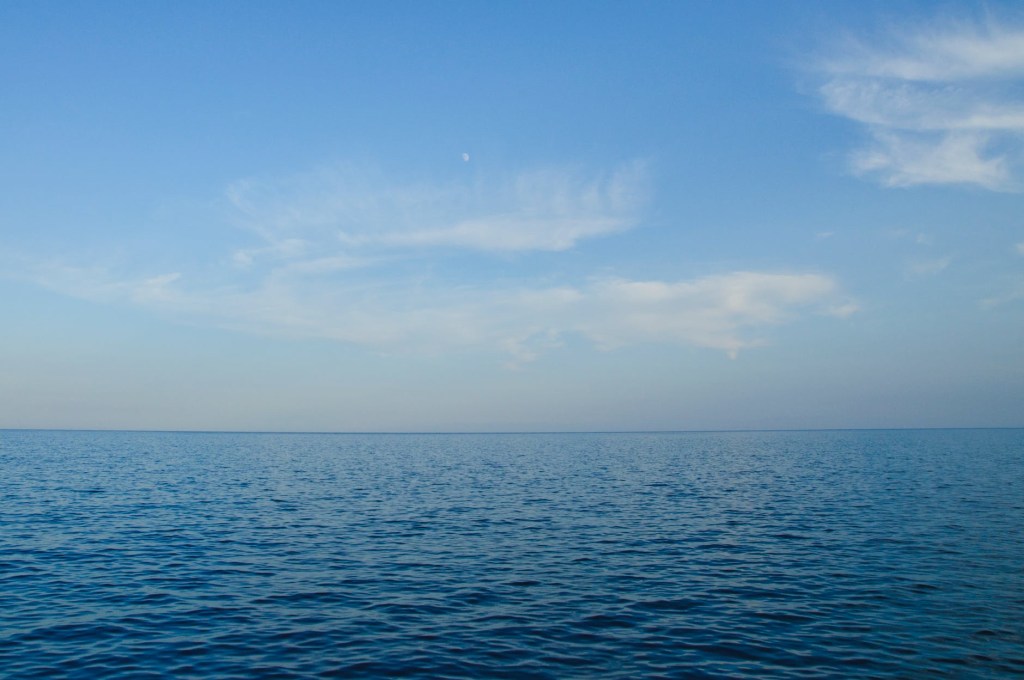
Tan squinted into the middle distance, as if listening for something I couldn’t hear. A faint breeze stirred the water.
“You’ve…grown,” I said.
“So have you.”
It was profoundly strange, seeing a boy change into an old man in the space of a few months. It made me feel old and young. The happiness muddled with sadness. I had to ask. I needed to know.
“Tan. Are you mine?”
For a long time, I thought he wouldn’t answer.
At last he replied, “I was, once. This is the last time you’ll see me. The dream is changing enough to make it near impossible for us to find each other. You’ve healed. So have I.”
I was upset, but not shocked.
His face was clear now. I stayed looking at him for a while, committing every detail of his face to memory, enjoying his quiet. Then I turned and started walking. I knew I’d come to the end of the bridge eventually, leaving the Sea Spectrum behind with Yorn-Tan standing sentinel over it, until the end of dreaming.
 Nightwalks