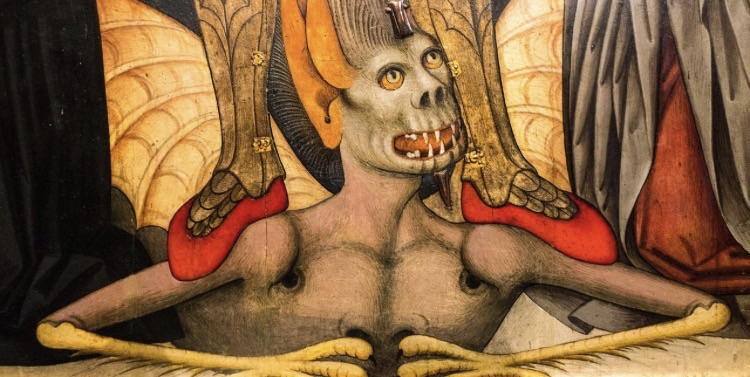
Yesterday we took a look at what sleep paralysis is, its possible causes, and how to cope with it. Now let’s see how sleep paralysis was viewed in history and folklore, and its influence on literature. Because why not?

(This image is licensed under the Creative Commons Attribution 2.5 Generic license).
Many types of hallucinations can be experienced during sleep paralysis, often involving an intruder or malevolent presence in the room. The intruder can take the form of an incubus or a succubus. There can also be an out-of-body sensation or OBE, (something which I have experienced a couple of times in the past). For more about this see part 1.
SP in History
From Mesopotamia in 2000 BC all the way up to the Roman Empire, a demon called the incubus (from the Latin for “to sit on”) was held responsible for bad dreams and physical immobility during sleep.
The earliest treatment recommended for the incubus / nightmares was put forward in the 7th century by Paulus Aegineta, a Byzantine physician. He said that the issue should be treated with “bleeding, drastic purgatives and friction of the extremities.” He reckoned the head was the source of the problem, and suggested that if the above treatment wasn’t successful, then cupping and scarification of the throat, a restricted diet, and shaving the head would work.
The 10th-century Persian Akhawayni Bokhari was the first person to view the disorder as a purely medical complaint without demonic cause. A believer of the old medical “humours” theory, he surmised that SP was caused by vapours of phlegm arising from the stomach into the head, suffocating the brain during sleep. However, his prescription wasn’t so different from earlier treatments – it involved bloodletting.
During the Christian era, SP was seen as a sign of demonic possession and those affected were given prayers and exorcisms.
In Old English, the incubus demons became mare or maere, which derives from the Old Norse word, mara. It comes from the verb merran or “crush”. These were not demons but supposedly people who used magical powers to “ride” their victims just for the thrill of doing evil.
Following that, the mara became the Old Hag or Night Hag myth in folklore. Shakespeare used this for his Queen Mab speech in Romeo & Juliet.
In 1664 a Dutch physician, Van Diemerbroeck, wrote a book, “Of the Night-Mare” detailing the nightly hallucinations of a 50 year old woman.
In the 1700s, SP was understood via the scientific method due to the Age of Enlightenment. Treatment of someone suffering an SP episode now involved shaking them awake, changing their body position, speaking loudly to them or pricking them with a pin.
In 1876, sleep paralysis was called “night palsy” by Silas Weir Mitchell, MD. In 1928, the term “sleep paralysis” was coined in the medical literature by Neurologist A.S.K. Wilson.
In the 19th century, sleep paralysis was often blamed on diet or sudden change in diet.
Samuel Johnson originally defined sleep paralysis as “nightmare” in his A Dictionary of the English Language, but as time went on the word “nightmare” was used for bad dreams in general.
These days, the sleep paralysis demon has likely morphed into the phenomena of alien abductions and other paranormal reports.
Depending on culture, time, and place, sleep paralysis or SP has been and can be experienced in different ways, some more negatively than others. Scientists have suggested that if sleep paralysis is feared in a certain culture, that conditioned fear can worsen the SP experience and lead to higher rates of people having SP.
For example, high rates and long durations of SP episodes have been reported in Egypt, where people have beliefs about SP involving evil spirits called jinn. Fifty percent of Egyptians with SP are extremely afraid of it and associate it with impending death.
In Folklore
Witches
Sleep paralysis has been blamed on “the night hag” in cultures around the world.
In Newfoundland, Eastern Canada, SP is called the Old Hag and sufferers of a “hagging” are said to be “hag-ridden” on waking. Despite the name, the hallucinatory assailant can be male or female, or even an animal that sits upon the sleeper’s chest. In some areas, the hag is believed to leave her physical body at night and her spirit is what is sitting on sleepers’ chests. The Old Hag is well-known enough here to appear in films, plays, and crafted objects, and according to folklore here the hag can be summoned to attack other people. Here they believe the Old Hag can be kept away by sleeping with a Bible under the pillow, calling the name of the sleeper backwards, or even sleeping with a “Hag Board” – a shingle or board with nails in it strapped to the chest.
In Italy, the Pandafeche is an evil witch or ghost – or a bizarre catlike thing – that sits on the victim’s chest and tries to cause harm. Here they believe that the best way to keep her away is to have a bag of beans or sand close by the bed. The witch is thought to stop and become distracted by counting the beans or sand grains. (Hello, Dracula?)
In North Italy, the Trud is also a witch that sits on sleeping chests, suffocating them. She has to be chased away by making the sign of the Cross (hmm, difficult to do if one cannot move!)
In Scandinavia, the hag or mare is related to incubi or succubi but is believed to be a “damned” woman, who is cursed and whose body is mysteriously transported during sleep without her knowledge. Her body is moved onto the chests of other sleeping people, causing them to have nightmares.
In the southern U.S., SP is known as “witch riding.” During the Salem witch trials, many people reported being attacked at night by witches, and these attacks may have been down to SP.
In Hungarian folklore, SP is either caused by a witch, a fairy, a wraith, or a demon lover.
In Brazil, the pisadeira or “she who steps” is a tall, spindly old woman with long, dirty nails, tangled white hair, a long nose, red staring eyes, green teeth and a sinister laugh. She lives over the roofs, waiting to step on the chests of anyone who goes to bed with a full stomach.
Demons / Jinni
In Sardinia, a being known as the Ammuntadore or Ammuttadori sits on people’s chests to give them nightmares, and this being shapeshifts, taking the form of the person’s fears. Sometimes he rips the person’s skin with his nails. Some parts of the island believe he wears seven red caps on his head, and anyone who can resist the pain and steal one of his caps will find a hidden treasure.
In Fiji, SP is known as kana tevoro or “being eaten” by a demon. In some cases the demon can be the spirit of a recently deceased relative.
In Nigeria, it’s known as “the Devil on your back” and is called Dannau by the Hausa people. The Yoruba people of Southwest Nigeria call it ogun oru or nocturnal warfare. The nightly problem is attributed to demonic invasion of the body and psyche while a person is dreaming. There is a perceived feud between the sufferer’s real-life spouse and a “spirit” spouse, and anyone who eats in their dream is bewitched. It is treated with Christian prayers or traditional rituals meant to remove the ingested demonic elements.
In Swahili-speaking areas of south-east Africa, SP is called jinamizi or “strangled by jinn.” It is thought to happen when one sleeps on their back.
In Egypt, SP is called Kaboos or “compressor” and is similar to Ja-thoom. The jinn in this instance may be doing it out of evil, accidentally, or for mischief.
In Turkey, SP is Karabasan or “the dark presser.” A supernatural being known as a jinn comes into a person’s room and holds them down, strangling them. To banish the jinn it is believed that you should recite passages from the Qur’an and pray to Allah.
In Malay, SP is kena tindih or “being pressed,” thought to be the work of demonic entities that occur in the blind spots of one’s vision.
In Pakistan, SP is seen as an encounter with Shaitan or Satan, evil jinns or demons who have taken over the body. The ghoul can be known as bakhtak or ifrit. It’s also thought that SP is caused by black magic performed by enemies or jealous people. Some buildings or places are believed to be haunted by satanic or other paranormal beings that attack people living in them, especially at night.
In Arab culture, SP is attributed to Ja-thoom or “what sits heavily on something,” a shaytan or ifrit that sits on top of a person and chokes them. To keep it at bay, you have to sleep on your right-hand side and recite the “throne verse” of the Qur’an.
In Kurdish folklore, SP is caused by the demon motakka who steals the breath of sleepers who breathe heavily, particularly young children.
In Greece and Cyprus, SP occurs because of a supposed ghost-like demon called Mora, Vrahnas, or Varypnas. It tries to steal the victim’s speech or tries to asphyxiate him or her by sitting on their chest.
Sprites / Goblins
In the Philippines, the Batibat or bangungot takes on the shape of an ancient, grotesque, tree-dwelling female spirit that sits on victims’ chests. She is believed to enter a house when the tree she was living in gets felled and turned into a support post for that house. In revenge, anyone she finds sleeping near the support post gets attacked by her suffocating them and invading their dreams.
In Iceland, Mara, a succubus or goblin, is believed to cause nightmares and SP.
Animals / Creatures
Someone mentioned that in East Chinese folklore, it’s believed that mice can steal human breath during the night and that human breath gives mice strength and a long life along with the ability to become human at night, in a similar way to fox spirits. The mouse supposedly sits close to the person’s face or under their nose. (I cannot vouch for the truth of this statement, but it’s an interesting idea all the same.)
In Kashmiri mythology, SP is caused by the Roch, an invisible creature that supposedly lives in every house and only attacks if the house hasn’t been cleaned or if the victim has been doing something satanic or getting happiness from the bad luck of others. The creature is also known as pasikdhar, sayaa or GharDivta by Kashmiri aboriginals of the Hindu faith.
In Catalonia, SP is caused by the Pesanta, a gigantic dog or cat that enters homes at night and lays itself on people’s chests, causing breathing difficulties and nightmares. The animal is hairy and black with steel paws, but it has holes so it can’t actually take anything.
Ghosts / Spirits
In Fiji, the instance of “being eaten by a demon” or SP is sometimes attributed to the ghost of a recently dead relative who has come back to complete something unfinished or to pass on an important message. Often, people close to the person experiencing SP say “kania, kania,” or “eat, eat!” to prolong the possession so they have a chance to talk to the spirit and ask it questions.
In Albania, SP is caused by a male spirit in a golden fez called Mokthi. He comes to women who are tired or suffering and stops them from moving. If they manage to take his fez, he grants them a wish but then keeps on visiting them, though he isn’t dangerous. There are talismans women here use to keep Mokthi away, or they put their husbands’ hats by their pillows while sleeping.
In Cambodia, Lao and Thailand, SP is caused by one or more ghosts known as Phi Am, and they can cause bruises.
In China, SP is called “ghost pressing on the body” or “ghost pressing on bed.”
In Korea, SP is gawi nulim and is thought to be caused by a ghost laying down on top of the sleeper.
In Hmong folklore, sleep paralysis is caused by a pressing spirit, dab tsog. Dab tsog attacks by sitting on people’s chests, sometimes trying to strangle them. Some people think dab tsog is responsible for SANDS (sudden arrhythmic death syndrome).
In Vietnam, SP is ma đè, (held down by a ghost) or bóng đè (held down by a shadow.)
In Persian belief, SP is caused by bakhtak, a ghost-type creature that sits on the victim’s chest and makes breathing difficult. It is thought that if the dreamer reaches out and holds his nose, he will tell them the location of a treasure.
In Pashtun culture, SP is attributed to khapasa, a ghost without thumbs. It tries to suffocate by sitting on the chest and pressing the throat, but without thumbs it cannot do this effectively.
In Ethiopia, dukak (depression) is used to describe SP, which is thought of as an evil spirit that possesses you in your sleep. Some folks think it’s a symptom of withdrawal from the stimulant khat. The dukak is an personification of the depression which often happens after stopping chewing khat. He often appears to khat-quitters in their hallucinations and gives them weird punishments for offending him by quitting. These punishments often take the form of unfeasable physical things (e.g. the dukak puts the victim inside a bottle and shakes it hard) or outrageous tasks like expecting the victim to swallow a bag of gravel.
In Latvia, SP is a torture or strangling by Lietuvēns, the soul of a person murdered by strangling, drowning, or hanging. It attacks people and domestic animals. If under attack, you have to move your left toe to get rid of the soul.
Magic and Shadow
In Mongolian culture, nightmares and sleep paralysis are referred to as khar darakh (written as “kara darahu”), meaning “to be pressed by the Black” or “when the Dark presses.” Kara means black and might refer to a personification of one’s dark side. Kharin buu means “shaman of the black” (shamans of the “dark side” exist in far-northern Mongolia while tsaghaan zugiin buu means “shaman of the white direction” (i.e. shamans who only invoke beneficent spirits). This compares to the Turkish ‘karabasan‘ or the dark presser, which could originate from pre-Islamic times when the Turks had the same religion and myths as the Mongols.
In Tibet, SP is called dip-non or dip-phok which means “oppressed / struck by dip.” Dip means “shadow,” referring to a sort of spiritual contamination.
Even in present-day Western belief, SP is sometimes attributed to beings known as “shadow people.” Victims often describe a shadowy man in a brimmed hat, an old hag, or a hooded figure.
The influence of SP in literature
Some writers appear to have had sleep paralysis and put their experiences into their books.
For example, Herman Melville described something very like sleep paralysis in chapter 4 of Moby Dick, where Ishmael recalls a childhood memory of “a supernatural hand placed in mine” but being unable to move.
J. M. Barrie, the author of Peter Pan, said that in his early childhood “a sheet… tried to choke me in the night” and there are passages in the Peter Pan stories that hint he was aware of the feeling of loss of muscle tone while in a dreaming state. Barrie described a few parasomnia and neurological symptoms in his books and used them to explore the nature of consciousness.
Other writers who are likely to have had SP include Guy de Maupassant, Erasmus Darwin, Thomas Hardy, F. Scott Fitzgerald, and Ernest Hemingway.
Sources
https://academic.oup.com/book/24530/chapter-abstract/187681185?redirectedFrom=fulltext
The History of Sleep Paralysis
 Nightwalks