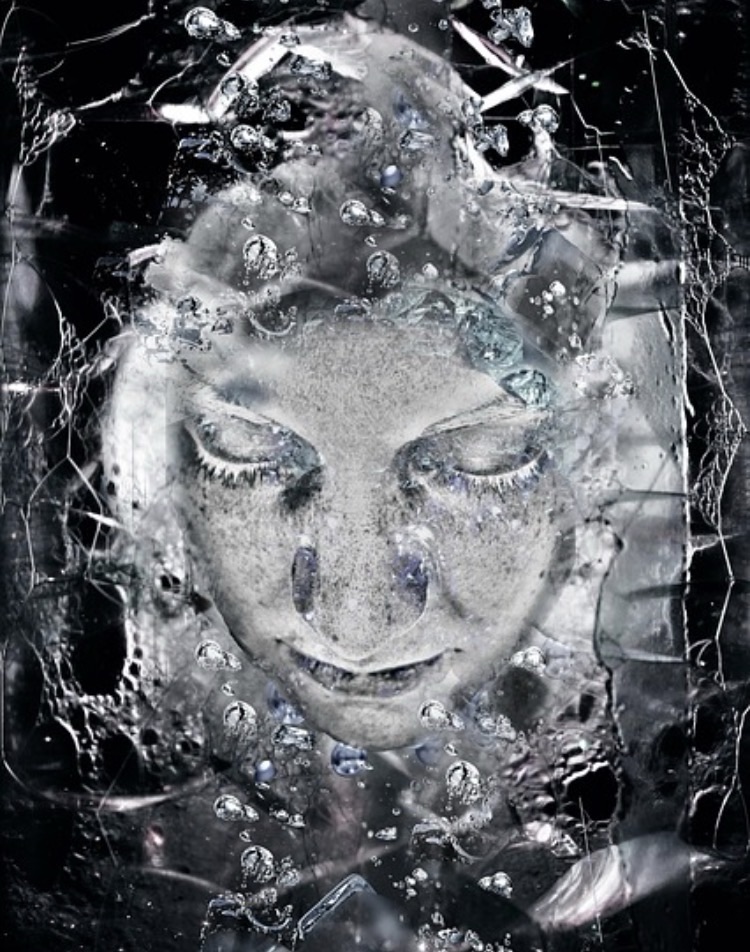
A few weeks ago I mentioned that I used to suffer from sleep paralysis (or being “hag-ridden”) and I’d do a post about that. So, here it is.

From at least three or four years old, I had night terrors. They wore off as I grew but when I was in my mid-teens, the problem resurfaced as sleep paralysis. What follows is an investigation into what these things are about and what causes them, peppered with my own personal experiences. After that I will include some tips on how to avoid or “get out” of a sleep paralysis episode, or SP for short.
Night terrors tend to happen after the first one to two hours of someone falling asleep, and the person having the night terror is not conscious of whatever it is they are doing (namely sitting up in bed and crying, gasping, and screaming with a high heart rate and an expression of, well, terror). The person has no or very little recollection of whatever they were dreaming to cause such a reaction, and they don’t hallucinate. They don’t remember anything about how they reacted to their fear either. Night terrors usually affect small children but adults can sometimes have them too.
SP occurs while a person is either falling asleep or waking up. The brain stays conscious for a short amount of time while the physical body is asleep and therefore paralysed. This causes vivid dreams or hallucinations that are usually terrifying and unpleasant, where the person sees, hears, or feels things in the room with them that aren’t actually there in reality. It can happen as a one-off episode in someone’s life or it can recur, even happening a few times a night. An episode of SP only lasts for minutes but the terror can make it seem like a small eternity.
Between 8 and 50% of people will have an SP episode at some point in their lives, and it affects males and females equally. It is harmless, though it can cause sleep deprivation.
SP has been described throughout history and might be a reason for people’s accounts of alien abductions and other paranormal phenomena.
Sounds heard during SP often take the form of a signal like humming, hissing, static, buzzing or zapping. Other sounds experienced include strange voices, whispers, roars, growling, or screaming.
Physical sensations can include a feeling of pressure on the chest and sometimes head pain. Also the feeling of either sinking or drowning, something dragging you out of the bed, numbness, flying, or electrical sensations such as tingling or vibrations throughout the body, inability to breathe or difficulty breathing.
Visual hallucinations often include an evil presence or a strange dark figure in the room. These figures are called sleep paralysis demons or “shadow people.”
Emotionally, there is usually paranoia or fear and panic.
My first SP episode happened when I was perhaps fourteen, after reading a book in which a woman was staying in a castle and a strange presence would get into the bed with her during the night when the room was totally dark. The stranger didn’t touch her or do anything to harm her, but it paralysed her with fear (perhaps by magic as well, I can’t remember). One night shortly after this an invisible entity seized hold of me while I was dreaming – though in the dream I thought I was awake in bed – and wouldn’t let go, and I was calling out for help but my voice wouldn’t resound. A bubble inflated out of my mouth instead. Then I truly woke up, my heart beating so fast my body was shaking.
I had no idea what that was about and wrote it off as a bad dream… but it kept happening at least once every four to six weeks, and I began to wonder whether I was being haunted or whether there was some kind of demon trying to possess me, although I’m not religious. After some research on the internet, I realised it was sleep paralysis and nothing to worry about. Though that still didn’t stop me from dreading sleep!
Over the next few years I would occasionally be “visited” by this tall invisible presence who may or may not be human. He usually approached from my right side, through the wall somehow, and would lie on the bed behind me (I sleep on my left side usually). Pretty soon I learned to sense when it was going to happen in my dreams and would put up a “physical” fight (though I was dreaming) before he seized hold of my body, preventing it from moving, because I knew once he got hold of me I’d have to wait for him to let go. Often the fight would be for nothing and I’d lose, and it was exhausting. During these episodes I’d be trying to shout for help but my voice wouldn’t sound, or if it did it would emerge as a sedated mumble or a whisper. My heart would race and dread flooded me with ice, an age would seem to pass and finally my eyes would open, he’d be gone, and I could move again, fully awake. I’d sometimes have to pant for breath. There would be a cold sweat, especially if I was a little too warm in the bed.
However, I hardly ever get SP nowadays. I will share what worked for me in getting rid of it later in the post.
What is the cause?
Nobody knows for definite.
It may run in families and be caused by certain genes. Studies of identical twins have shown that if one twin has SP, the other twin is likely to have it.
One theory is that SP is caused by a dysfunctional overlap of REM and waking stages of sleep. Studies have revealed that SPers have shorter REM sleep latencies than normal, along with shortened non-REM and REM sleep cycles, along with fragmented REM sleep.
Another theory is that the neurological functions controlling sleep states are a tiny bit out of whack, causing some sleep states to overlap. The cholinergic or “sleep-on” neurons are hyperactive, while the serotonergic or “sleep-off” neurons are under-active. This means that cells capable of sending signals for waking up have difficulty overriding the signals sent by the cells in the brain that keep you asleep.
During normal REM shuteye, stimuli from the surrounding environment has to be pretty loud / obvious to rouse the brain. In people with SP, the brain doesn’t block out that external stimuli very well, which means it is more likely to wake up while the rest of the body is still in sleep mode. Studies have shown that although SPers cannot move or speak during an episode, they can still move their eyes.
More research is needed to find what genetic component leads to SP and the exact mechanism behind it.
What Triggers SP episodes?
- insomnia or sleep deprivation
- an inconsistent sleep schedule / poor sleep hygiene
- stress
- physical fatigue
- sleeping on your back
- sleeping on your stomach
- sleeping too hot in bed (in my experience)
- being afraid of having an episode (in my experience)
- not having body parts fully supported/ prevented from “dropping” suddenly during sleep (in my experience – more on this later).
Tips and Tricks
Being young when it started, I did try praying out of a sense of desperation. Obviously, this had no effect – probably because I’m not religious, so my brain didn’t believe that method would work. (I even tried telling the “entity” to leave me alone in the name of Jesus Christ, after reading on an online forum that some people found that that worked for them. I even tried sleeping with a small cross on a chain next to the bed, then an ankh.)
I had been keeping detailed dream journals from the age of 12 or 13, so I wrote down all the details of my SP episodes as well, trying to interpret their meaning or find a pattern. It was a cathartic thing to do and took some of the anxiety out of it.
As time went on, it got to the point where I’d be having a mix of SP and false awakening dreams – so I’d dream I’d woken up and it was all over, but I was still dreaming and the entity would pounce a second time. I began to routinely ask myself whether I was really awake or asleep during daily life.
I rarely slept well during my teenage years due to school-related stress anyway, along with difficulty regulating my body temperature and aches and pains (which would later be diagnosed in my twenties as hypermobile Ehlers-Danlos syndrome and Fibromyalgia). A typical night would involve me turning in at 9.30pm or 10pm then waking up at 1 or 2am, then lying awake until 5am or almost dawn, hot one minute, cold the next, aching, tired, sometimes exhausted to the point of nausea. The sleep deprivation was likely causing the SP.
So, I tried going to bed cold. I made sure to turn my radiator down to zero at least two hours before bed. If it was warm enough I’d also crack open a window for a few minutes. I improved my sleep hygiene as much as possible by avoiding caffeine full-stop and having a warm bath a couple of hours before bed, avoiding screens in the evening, not eating or drinking straight before bed, etc.
That seemed to work for a few months. Then all of a sudden it didn’t. The SP came back. I didn’t understand what I was doing wrong.
I read through more online forums about SP and got more advice, though it was counterintuitive.
The best way to get out of an SP episode is to stop fighting it or fighting to wake up. The more you panic, the longer it lasts. (I saw the sense in that, though I didn’t much like it!)
Someone else said the best way to get out of an episode was to mentally “move” yourself in the direction of the pressure rather than against it, imagining yourself sinking through the bed.
Someone else said the best way to wake up from SP was to try to make a tiny movement rather than a large one, e.g. twitching a toe or twiddling one of your fingers rhythmically, or pulling an exaggerated scrunched-up face like a grimace.
I utilised all of those methods as well. Though the frequency of the SP episodes did reduce over time as I left school (and also learned not to be afraid of having an episode) I still hadn’t completely got rid. There must be something else.
As time went on, my conditions meant I had to start experimenting with stacking different cushions and pillows around myself in bed to keep my joints and spine more aligned whilst I was unconscious. I found it was a little better to put a pillow between my knees and a pillow under the armpit of the arm I wasn’t lying on to save my shoulder.
During all of this I realised something: without the pillow under it, my right arm was getting poor circulation and slithering forwards off my side when I reached a deep sleep, creating a confused sense of a foreign arm reaching over to grab me from behind. That was what the strange invisible entity had been: me. My sodding arm moving by itself. Which then sent my unconscious brain into panic mode and caused a sleep paralysis nightmare.
I haven’t had an SP episode for years now.
So, a recap on how to beat SP:
- Have a consistent sleep routine
- Maintain good sleep hygiene
- Avoid caffeine (and probably alcohol) before bed
- sleep at a comfortable temperature
- don’t stress
- make sure joints are adequately supported
- If you do get an SP episode, don’t panic – either try to twitch a finger or a toe and / or grimace and scrunch your face up.
In part two (dropping tomorrow) I’ll be covering sleep paralysis in history, folklore, and art.
Other News:
My flash fiction “You Are What You Eat” has been published in Slash magazine. It’s a tongue-in-cheek horror about a weird being that takes on the properties of whatever it ingests:
https://www.theslashmedia.com/you-are-what-you-eat/
And my poem “Landscape One” has won first prize in the poetry category for the “Prithvi” anthology competition run by The Chai magazine. It will most likely be released later this year.
You can see past issues of Chai magazine here:
 Nightwalks