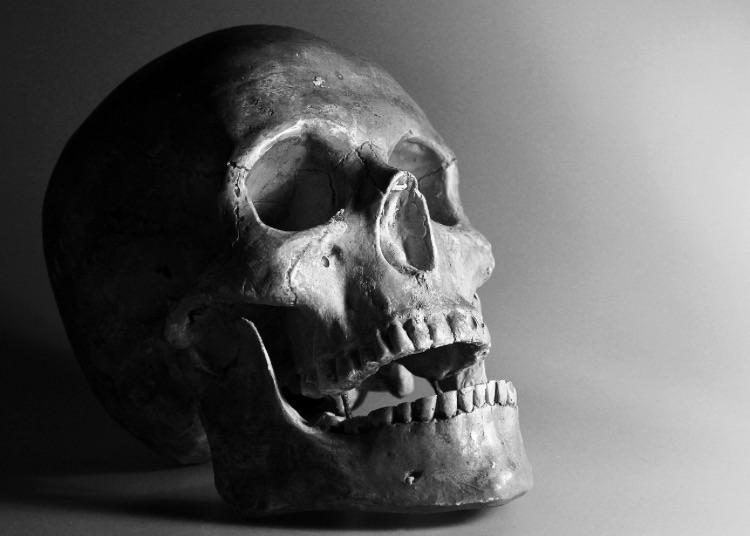
After hearing about the Stone Tape Theory from the Exploring with Fighters channel on YouTube, I did some delving into what it is and where the theory comes from, along with a theory about primal sound and how particles dance to music. Then I looked a little further inward; if the world can record old emotions, what old things might be recorded in our bones?

The Stone Tape Theory holds that memories of traumatic events and strong emotions are stored in the materials of the locations in which they occurred.
Materials like stone, wood, bricks, and especially quartz are thought by some people to hold onto this record of emotions / events, ready for the right conditions to trigger them into replaying.
This is the theory behind the idea of “residual hauntings” or non-intelligent ghosts or paranormal phenomena that keeps repeating itself in a certain place at particular times of the day or of the year, or when conditions are right. They’re also thought to be triggered in previously quiescent buildings undergoing renovation-work or other sudden physical alterations, due to those materials being broken and releasing whatever they absorbed in the past.
This is associated with other ideas like “place memory” and energy imprints. Overwhelming feelings such as pain, fear, or joy supposedly create energy imprints on certain substances.
Like an old videotape – which is magnetic – materials are thought to record things that happened in their environment. Perhaps this ties in to the phenomena of the correlation between high electromagnetic fields and subjective ghostly experiences.
The usual magnetic resonance of the Earth (or the Schumann resonances) is fairly low. Schumann resonances are natural electromagnetic waves released when lightning hits the Earth, which usually happens fifty times a second. The waves bounce between the ground and the ionosphere, travelling around the globe. Depending on the speed of light and the ionosphere’s conductivity, the primary Schumann resonance is about 7.83 Hz, with subsequent harmonics at roughly 14, 20, 26, 33, 39, and 45 Hz. These resonances not only impact climate monitoring but could also affect human brainwaves. There is ongoing research into how they affect our circadian rhythms.
The History
The Stone Tape Theory or “The Trace Hypothesis” gained a lot of popularity in the 1970s, but the ideas within it originated from much further back in time.
Humanity has almost always sensed that certain places harbour the past, either through some sort of spirit or a strange energy. The Ancient Egyptians thought that temples and tombs absorbed energy from the pharaohs and from rituals. Places devoted to gods like Osiris were viewed as being imbued with long-lasting power, the landscapes remembering religious events.
In the 8th century BC, the Greeks had similar beliefs around the Oracle of Delphi, a sacred place that allowed priestesses to communicate with the gods.
Somewhere around 500 BC, the ancient Celts thought that stone circles and burial mounds held memory-like qualities, linked to the spirits of their ancestors and important events. Examples include Newgrange and Stonehenge.
In 1837, Charles Babbage (a computer pioneer and mathematician who built the world’s first programmable mechanical computer) published “The Ninth Bridgewater Treatise.” It was a book about natural theology, and in it he posited that because of the transfer of motion between particles, sound waves created by human speech left a permanent, though inaudible, mark on the atmosphere. This meant the air itself could be a huge library of everything that had ever been said!
In 1842, Joseph Rhodes Buchanan came up with the idea of psychometry, or the ability to percieve things about the history of an object by just holding it or touching it. The belief was that objects held onto imprints from previous owners.
The Society for Psychical Research began in London in 1882, and investigators like Edmund Gurney and Eleanor Sidgwick looked at “place memory” as a possible explanation for hauntings of certain locations. In the SPR proceedings and in such books as Edmund Gurney, Frederic Myers, and Frank Podmore’s Phantasms of the Living (1886), they examined ghostly apparitions and possible non-spiritual causes for them. They suggested buildings and materials could record events that were then replayable by sensitive people.
The founder of the Society, Sir William Barrett, also proposed that emotional traces lingered in places.
H. H. Price, who was president of the SPR in 1939 and 1940 (and was a Welsh philosopher of perception) pursued the concept. In his works and lectures, he put forward the idea that the afterlife was a region of mental images in a “psychic ether” between the mental and material worlds. According to him, these mental images could break away from the mind that first thought of them and attach to a place (or an object) where sensitive minds could later experience the imagery as hallucination. If a haunting went away with the passage of time, that was because this psychic ether had worn down with repeated exposure. He argued that objects carried residues of emotions and that it might be proven by science (though nobody has proved any of this so far)!
In the 1950s and 60s, an archaeologist and parapsychologist known as T. C. Lethbridge took the theory further, stating in his book Ghost and Ghoul that non-interactive recordings were made in energy fields around natural things like mountains, streams, and forests. He did experiments at ancient sites using dowsing and a pendulum and detected what he called “emotional energy.”
Other tomes like Gog Magog: The Buried Gods in 1957 and Witches: Investigating an Ancient Religion in 1962 had a look at this idea.
In 1972, the BBC aired a horror drama titled The Stone Tape, about some researchers finding a haunting that was a “recording” in stone walls. Thus the term “Stone Tape Theory” became popularised, though it isn’t an accepted scientific theory.
After 1972, the theory was discussed by others such as Peter Underwood and Brian Righi, and Tom Perrott (chairman of the SPR in the 70s) conducted some studies of hauntings that fitted into the residual haunting / stone tape idea.
The Science
Scientists and critics of the Stone Tape Theory have found no geological basis for it or any rational scientific mechanism behind it.
A recent study involved a GIS analysis using spatial tools to look at supernatural events near quartz and limestone deposits.
Believers in the theory think that certain materials like limestone, quartz, or iron-infused rocks are very conductive to energy. In a way, they’re not wrong – quartz has piezoelectric qualities, able to produce electricity when put under a lot of mechanical stress, e.g. earthquakes. However, this is a different type of energy to emotional energy, and no empirical evidence exists of emotions being able to interact with piezoelectric qualities.
(Although, as a side note, neurological impulses are electrical, and neurology influences behaviour such as reflexes, and emotions are also controlled by neurology. I find this fascinating. However, the electrical impulses are contained within neurons, so how on earth could they escape into the environment?)
Conditions in which the “recorded” energy is believed to be triggered into replaying include changes in temperature and humidity, (like fog) specific times of day (e.g. dusk) or anniversaries of historical events, and the presence of a psychically sensitive person. However, there is no such thing as a device that can scientifically record emotional imprints, so the theory cannot really be tested.
Recordings need to be played on some type of device in order to be heard, and back when the Stone Tape Theory was first posited, recordings had to be rewound before they could be listened to again. Obviously, no explanation was put forward for how that could work.
Old Vases and Archaeoacoustics
Way back in 1902, Charles Sanders Pierce put forward the theory that ancient pottery could perhaps be played on a phonograph in the same way as a phonograph wax cylinder, and that playing the pottery could reveal accidental recordings from far-flung history, i.e. the sounds that were occurring in the potter’s environment whilst the pot was still a lump of wet clay being shaped on his wheel. Phonograph cylinders stored sound recordings as grooves engraved into the wax.
In the 1960s, Richard G. Woodbridge the III coined the term “Acoustic Archaeology” and made some early experiments in that area, making clay pots and oil paintings and trying to play sound from them. He used a record player cartridge attached to a pair of headphones, and claimed to be able to hear the hum of the potter’s wheel from the pot’s grooves and the word “blue” from a patch of blue colour in a painting.
As recently as 1993, archaeology professor Paul Astrom and acoustics professor Mendel Kleiner were able to extract sounds from pottery, but mostly in the upper frequencies. Seeing as the ancient potters didn’t have the technological means to deliberately record sounds into their artworks, the idea of actual voices and discernible sounds emerging from them hundreds of years later has been discredited.
However, this helped to give rise to the usage of acoustics in archaeology, either for studying ancient musical instruments or for ancient architectural structures / sites. Acoustic measurements and computer simulations can be used to suss out how old artefacts sound or recreate what a particular site would sound like if one were standing in it.
For example, it has been found that prehistoric cave paintings in France and northern Spain appear to have been positioned according to acoustic effects.
In 1999, Aaron Watson studied the acoustics of different sites including Stonehenge, some chamber tombs and other stone circles. In 2011, Steven Waller argued that Stonehenge was likely built according to a blueprint of acoustic interference patterns. In 2020, a detailed study was described in the Journal of Archaeological Science in which an acoustic scale model of Stonehenge was made to examine how speech and musical sounds were altered by its acoustics!
Archaeologist Paul Devereux studied “ringing rocks” and Avebury in his book Stone Age Soundtracks. Ringing rocks produce a metallic or bell-like sound when struck with a small “hammerstone.” See Paul Devereux’s Landscape and Perception project here: https://pauldevereux.co.uk/landscape-perception.html
Ian Cross of Cambridge University has studied “lithoacoustics” or musical instruments made out of stone.
Rock gongs in Sudan have also been studied.
A Related Note: The Chladni Plate Experiment
This involves a tone generator, a metal plate attached to a speaker, and particles of something like sand.
If you sprinkle the sand onto the metal plate and play a tone through the speaker, the sand dances and forms intricate geometrical patterns.
This is because specific frequencies cause the plate to vibrate in specific patterns, some regions vibrating in opposing directions so that some areas of the plate contain no vibration at all. (The areas of no vibration are “nodal lines.”) The sand grains fall into the nodal lines, creating different patterns in reponse to different sounds.
Water Reacts To Words?
In 1994, a Japanese doctor of alternative medicine named Dr Masaru Emoto began conducting strange experiments on the effects of language on… water molecules?
He realised that water shows us its “true nature” in frozen crystal form. He froze droplets of water and looked at them through a dark field microscope that had photographic capabilities.
In his experiments, he compared different types of water molecules to each other and observed how they reacted to different types of music and different words (he wrote words on pieces of paper and taped them to the bottles the water was in).
He found that water from mountain springs and streams had perfectly formed crystalline structures and that crystals from polluted or stagnant water were often distorted or deformed.
He also claimed to have found that when distilled water molecules were exposed to classical music, they took on intricate but symmetrical shapes. He then claimed that if the words “thank you” were taped to the bottle of distilled water, the crystals formed were similar to those formed after exposure to Bach’s “Goldberg Variations,” which were composed out of gratitude.
He said that water that was exposed to heavy metal music or labelled with negative words or thoughts, e.g. “Adolf Hitler,” didn’t form crystals but made chaotic structures instead.
He also said he found that water treated with aromatherapy oils formed crystals that often imitated the shape of the flower the oil was extracted from.
There has obviously been debate over the validity of this experiment and Dr Emoto’s methods – water molecules can temporarily change in response to vibrations from sound or music, but it doesn’t permanently change their basic structure. However, it has sparked more exploration into water’s energetic and relational qualities.
Feeling it in Our Bones?
Every human baby is born with their skull consisting of separate bony plates joined together by tough, flexible tissue, which allows their brain to expand as it grows. Over many years, the bony plates fuse together into an almost wholly solid skull, but the lines where the bony plates joined together remain throughout life – long, intricate wiggling lines in the skull known as “cranial sutures.” Forensics people use the extent of suture fusion to estimate the age range of bodies. Everyone’s cranial sutures are different, like fingerprints.
The poet Rainier Maria Rilke put forward the theory (in his short essay “Ur-Gerausch” or “Primal Sound”) that the cranial sutures on a skull could be played through a gramophone or phonograph if the needle was placed on a cranial suture instead of on the usual wax cylinder containing music. He noticed that, in the case of the zigzagging coronal suture of the skull, it resembled the audio track on a phonograph cylinder. He was aware of how the “seams” of the skull represented the passage between our inner and outer world, a passage that grows more and more rigid through the years until it ends up as a mere symbol, an engraved sign.
The essay can be found in its entirety here: https://archive.org/details/rilkeprimalsound/page/n5/mode/1up
Nerves also feed into the bones of our skeletons, both sympathetic nerves and parasympathetic nerves, not just alerting us to inflammation and injury but helping bones to grow and heal and remodel themselves in reponse to our environment.
Strong emotions can affect bones (though arguably, they affect every system in the body). According to both Traditional Chinese Medicine and Ayurveda, negative emotions such as fear and worry have the capacity to erode or weaken bones, increasing the likelihood of osteoporosis development.
As a thought-experiment, supposing that the Stone Tape Theory was true in some way, perhaps it isn’t just the stones of our environment that “record” strong emotions and traumatic events, but the “stone” inside our bodies as well – our bones. Perhaps one could even be affecting the other, and we just don’t know about it yet.
What do you folks think? Let me know in the comments!
Sources:
What Is the Stone Tape Theory?
https://the-line-up.com/stone-tape-theory
https://www.cambridgeskeptics.org.uk/post/the-stone-tape-theory
https://my.clevelandclinic.org/health/body/skull-sutures
What Is the Coronal Suture? Structure and Function
https://en.wikipedia.org/wiki/Archaeoacoustics
https://archive.org/details/rilkeprimalsound/page/n5/mode/1up
The Water’s Response to Positive Words – Dr. Masaru Emoto’s Scientific Experiment
https://pauldevereux.co.uk/landscape-perception.html
Earth’s Resonance
 Nightwalks