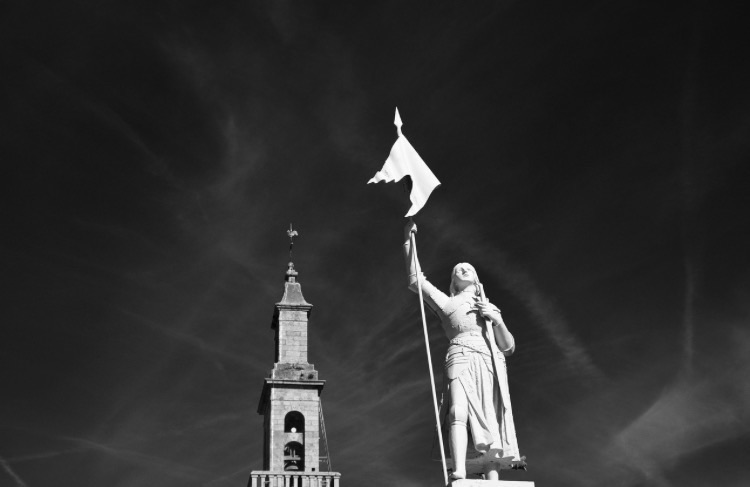
A young French girl claimed to hear messages from God and angels telling her to lead her country to victory over the English. But where did these voices originate from?
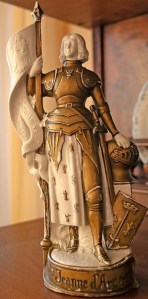
Joan of Arc, widely known as the French peasant girl who heard God and the voices of angels and saints beseeching her to lead the defenders of Orleans against the English soldiers besieging the city, played a part in helping France win the war against the English invaders… but unfortunately, she never lived to see that ultimate victory.
She came from Domremy village in north-eastern France, on the borders of Lorraine and Champagne, born on January the 6th, 1412 to Isabelle Romee and Jacques d’Arc. Jacques was a farmer and a minor local official.
At that time, not only was France at war with England but the country was divided against itself, with many nobles in north and east France supporting the English claim to the throne and others staying loyal to the idea of a French king. In spite of being surrounded by pro-English landowners, Joan and her family were on the side of the French crown.
For years beforehand, there had been prophecies circulating that a woman would make France desolate and that a maiden in armour from Lorraine would save it. The woman was Queen Isabella, who allied herself with the English.
Joan’s early life is made murky by the distance of time and modern historians are not certain what her real name was. She claimed to be called Jehanne la Pucelle, but also said she didn’t know her true surname. Some historians believe she was actually named Jehanne Tarc or Jehanne de Vouthon.
The story of her birth and upbringing has been called into question, as Joan of Arc somehow learned to ride warhorses and use a sword, when peasant girls of that era would have been indoors having to do domestic tasks such as weaving and spinning, and caring for domestic animals. However there is other evidence that she was most likely from a peasant family, such as her being illiterate.
It wasn’t until she turned 13, in 1425, that Joan began to hear voices, usually when alone in the woods or sitting in church. She also had visions which she believed were sent to her by God. Saints and angels apparently told her to live a strictly religious life and attend church. Sometimes, even the bells in the steeple seemed to be speaking to her.
Her visions consisted of seeing St Margaret, St Michael, and St Catherine along with bright lights and the sounds of bells. The first voice she heard was that of St Michael, whom she said would return to her over and over when she was alone in the fields. The saints and angels asked her to save France from the English and help put Charles VII, the rightful French king, on the throne.
When Joan was 16 years old, she asked her uncle (Durand Lassois / Laxart) to take her to Vaucouleurs so she could ask the garrison commander (Count Robert de Baudricourt) for permission to enter the court at Chinon to the south-west of Paris. Knowing her father wouldn’t let her go or understand about the voices or visions, she got Durand to ask her parents to allow her to go to Vaucouleurs to take care of her sick aunt, and Durand came to fetch her.
After she told Baudricourt about her visions, the man at first said “Box her ears and send her home to her mother,” but on February the 12th 1429, when Joan told him the French had been beaten by the English at the Battle of Herrings (two days before the news arrived from the battlefield, which was hundreds of miles away), Baudricourt agreed and gave her an escort of two knights to Chinon. They were Sir Jean de Metz and Sir Bertrand Poulengey, and they both came to believe in her quest. During the journey Joan disguised herself as a man and travelled through Burgundian territory.
Joan was given a private audience with Charles VII, because she impressed him. Charles had ordered a subtle inquiry into her claims and to make sure she was loyal and genuine, and when she arrived in court, Charles gave her a test.
The would-be King swapped places with one of his court-members and put on plain clothes before Joan walked in. He maintained that if Joan were really sent by God, she would be able to spot him standing in the crowd.
Joan of Arc entered the court and saw through the King’s ruse, directly approaching him instead of the man on the throne. She addressed him as the dauphin. He insisted she had got it wrong to begin with, but she stood firm and didn’t back down. She told Charles what he had said to God during his private prayers, which further impressed him. He accepted her as a devout Christian and a loyal subject.
Charles VII’s mother in law, Yolande of Aragon, was helping to prepare an expedition to the besieged city of Orleans. Joan asked for permission to bear the weapons and armour of a knight and travel with the army headed there. As Joan had no money, she relied on people’s donations for horses, swords, armour, banner, and entourage. According to Margaret Nicholas, Joan wore white armour with a scarlet and white surcoat, with a sword in a red scabbard by her side. The sword had once belonged to Charles Martel, who stopped Muslims invading France in the 8th century. It had been hidden somewhere for hundreds of years, but Joan’s voices guided her to ask for the old sword marked with five crosses which was buried at Fierbois in the church of St Catherine. The clergy in the church didn’t know what she was talking about, but she insisted it was buried behind the altar. They dug behind the altar, and there the sword was.
Joan also rode out of Chinon on a white charger with a white banner painted with a fleurs-de-lys.
The earlier prophecies made Joan popular in the city and an inspiration to its defenders. She was given command of 6000 men at Blous and arrived at the siege of Orleans on April the 29th, 1429, still aged sixteen, but was quickly excluded from the war councils by the leader of the French defence, Jean d’Orleans.
Joan was tenacious. She would burst into meetings, arguing and criticising decsions made by the senior commanders who were there. She got the population of the town involved at times, turning the siege into a religious war with God on the French side. She walked amongst the locals daily giving them food and other supplies, as well as encouragement.
Some historians maintain that Joan was only a standard-bearer in the army. Other historians maintain she was a great strategist and a skillful tactician.
Within nine days of her arrival, the siege of Orleans ended.
After that, Joan led the French counterattack against the English, which ultimately would help Charles VII gain the crown. The city of Rheims was occupied by the Burgundian allies of the English. Despite scepticism from the commanders, Joan planned to simply march into Rheims and take back the land, relying on God to protect her.
Joan’s victory at Orleans brought the army quite a few new recruits from different parts of the country. In the end she was successful in convincing the commanders to accept her suggestions for the taking of Rheims.
The French had become so good at retaking their land by this stage (with other victories at towns such as Patay), the Burgundians surrendered the city of Rheims, not even offering any opposition when Joan and the army opened its gates. Charles VII was crowned King of France in Rheims cathedral in July 1429, with Joan by his side.
The medieval French writer Christine de Pizan composed The Tale of Joan of Arc shortly following these events, and Joan was seen as a hero. Only Paris remained to be recaptured to ensure a French victory.
However, the assault on Paris didn’t go to plan, Joan was injured, and a ceasefire was arranged. During the temporary peace the Burgundians captured Joan of Arc in 1430 and sold her to the English! King Charles VII didn’t help her.
She was imprisoned in the English-controlled city of Rouen, and was put on trial for heresy and witchcraft. She was supposed to have been placed in an ecclesiastical prison guarded by women, but instead she was put in a normal prison where she was threatened and harrassed by male guards.
Many religious leaders refused to go to Joan’s trial until the English threatened them. The English were determined to convict her for heresy; several theological traps were laid during her interrogation, for example she was asked whether she was “in God’s grace.” If she answered yes to that question, she would be deemed a heretic, but if she said no, that would be the same as saying her visions had been false. Instead, she replied:
“If I am not, may God put me there and, if I am, may God keep me there.”
Joan was put on trial for 70 charges, mostly of witchcraft and sorcery, but once the trial was half over the charges reduced to 12, all references to witchcraft gone apart from one.
Threatened with being burned at the stake, Joan eventually denied that she had been directed by God. Following this, more visions came to her, scolding her for lying to save her own life. She withdrew her denial, was found guilty of heresy and sentenced to death.
On May the 30th 1431, Joan of Arc was burned at the stake, holding a cross in her hands, made of two sticks and passed to her by an English soldier. She called upon the name of Jesus even as she was being burned. To make sure she was dead, they burned her twice, casting her ashes into the River Seine.
Twenty-five years later, the church formally exonerated Joan and she was beatified in 1894. In 1920, the Pope declared her a saint.
Modern doctors have put forward the view that Joan was suffering from some form of mental illness. The bells and lights that came with her visions are the sort of thing that happens during hallucinations. She could have been suffering from migraines, brain lesions, bipolar disorder or schizophrenia.
More in-depth information can be found here: https://www.jeanne-darc.info/
What do you think? Was Joan being guided by something beyond the veil – good or bad – or was she living with a mental difference and the rest was only coincidence? For example, how did she know which one was the true Charles VII when she entered the court at Chinon? Let me know in the comments!
Sources:
Joan of Arc: Divinely Inspired or Mentally Ill?
The World’s Greatest Psychics & Mystics by Margaret Nicholas
 Nightwalks