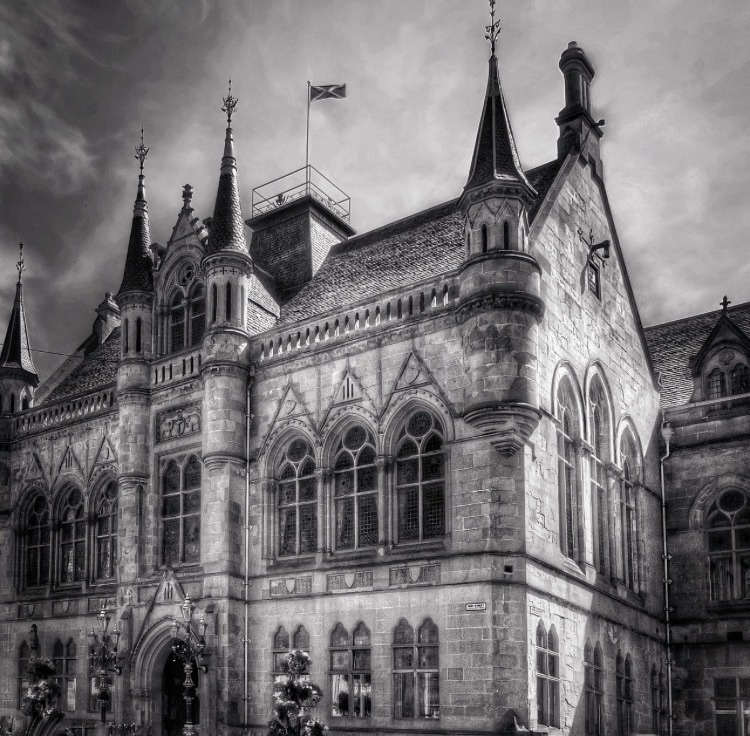
Sounds painful, doesn’t it? Anyhow, this is a list of some of the most ghost-ridden old buildings in the UK.
Scotland
Inveraray Castle
On the north-east of Glasgow, upon the edge of Loch Fyne, this castle is perhaps one of the most haunted buildings in Britain.
It has five ghosts, the most disturbing of which can be found in the MacArthur Room. In 1644, the Duke of Argyll left his castle to evade capture by the Marquess of Montrose, leaving behind a young Irish lad who had been his harp-player.
The Marquess’s mercenaries found the boy and, angry at the prospect of one of their fellow countrymen serving a Scotsman, they killed the poor fellow and left his mutilated body lying on the Duke’s bed.
Though this murder took place in the old castle, the boy’s ghost is said to have become so attached to the bed, he remained haunting it after it was moved to the more modern castle.
Glamis Castle
Built in 1372 and continuously owned by the Bowes-Lyons family, this castle in Angus, East Scotland is said to be cursed after Sir John Lyon took an ancestral chalice away from the family seat at Forteviot (where it was meant to stay in perpetuity).
The castle is haunted by the ghost of Earl Beardie, who had been a guest at the castle and got drunk, then expressed outrage that nobody wanted to play a game of cards with him, and said that instead he would play cards with the Devil! After this a tall man in dark clothes knocked on the door and offered himself as an opponent.
The stranger and Earl Beardie locked themselves in a room, from which could be heard a lot of shouting and swearing. A curious servant tried spying through the keyhole and was blinded by a strange bright light. The Earl opened the door to remonstrate with the servant, only to find that the stranger – the Devil – had left with his winnings – the Earl’s soul!
People who listen hard can sometimes hear the sound of Earl Beardie rolling dice and shouting imprecations. Some folks who stay the night, and often children, wake to find the apparition of the Earl peering into their faces. Not a pleasant wake-up call.
There is also a White Lady, someone who used to live in the castle and was burned at the stake for witchcraft outside Edinburgh Castle, and is believed to roam Glamis ever since then.
Also there is a ghost of a woman with no tongue, who appears pointing at her injured face.
England
Chillingham Castle, Northumberland
This may be the most haunted castle in England. Its glowing apparition of a “Blue Boy”, whose cries of terror resound through the corridors, is the castle’s most well-known ghost, usually seen in the Pink Room.
There is a “White Lady” in its inner pantry, a malignant poltergeist in King Edward’s room and a crowd of ghosts hang out in the torture chamber, where John Sage (the Butcher of the Scots) did a lot of gruesome things to them.
Felbrigg Hall, Norfolk
In this building’s library, the books move on their own. Some people maintain the one moving them is the ghost of William Windham III, a lover of books who died in 1809. He died trying to save his collection of books from a fire which began in that library, and this 17th century Hall is otherwise calm and peaceful (apart from the sound of unknown hands turning pages after dark…)
Blickling Hall, Norfolk
This Jacobean mansion is now owned by the National Trust, but it would seem that a few of its Tudor residents never fully left.
Every May the 19th – the anniversary of her beheading – Anne Boleyn (one of Henry VIII’s wives) is said to return here in a spectral coach driven by a headless horseman, her own head either resting on his lap or her lap. For more information check out this earlier post.
Raynham Hall, Norfolk
One of the most famous photographs of an apparition was taken here in 1936, that of a “Brown Lady” gliding down a staircase.
The Lady may be Lady Dorothy Walpole, the sister of one of the earlier Prime Ministers, Robert Walpole, who died in 1726 under suspicious circumstances.
Visitors in the present-day have heard disembodied footsteps, whispering, and an intense feeling of dread in the upper corridors.
Burton Agnes Manor House, East Yorkshire
Built in 1610, this Elizabethan manor is haunted by the ghost of Anne Griffiths, who is what you might call a quiescent poltergeist.
Anne was the youngest of three sisters who lived here, and she was attacked by robbers and injured fatally. As she was dying, she asked her sisters to always keep a part of her with them forever.
Later on, her skull was found hidden in the manor. Whenever the skull was moved or disturbed, inexplicable noises and poltergeist activity would happen.
The building is calm today, but Anne is still supposedly present in some way.
Treasurer’s House, York
This one is home to a ghostly battalion of marching Romans!
Believed to be the most haunted place in York, the House is also home to the spectre of a cat, a grey lady who tries to converse with children, and the ghost of the building’s previous owner, who leaves smells of cigar smoke wherever he goes.
Longleat, Wiltshire
Louisa Carteret and her husband Thomas Thynne (the second Viscount Weymouth) lived here. She was a kindly and attractive woman, whilst Thomas was suspicious and often bad-tempered.
He became aware – perhaps only in his imagination – that Louisa was in an over-familiar relationship with one of the footmen. In a jealous rage, Thomas shoved that footman down some stairs, killing him. He comcealed the man’s body under the flagstones in the basement, and told his wife the footman had just departed suddenly.
Louisa, incredibly upset, caught some form of illness and died in childbirth aged 22 in 1736.
After her passing, servants claimed they saw Louisa still moving along the corridors in search for her footman, and she can still be heard today banging on doors.
When central heating was put in at Longleat, a body dressed in 18th-century attire was indeed discovered beneath the flagstone floor!
Dorney Court, Windsor, Berkshire
This is a strange one – the place is haunted by the spectre of a bald woman who is only visible to men.
In the 19th century, the Palmer family (who lived there then) were so frightened by the bald ghost they got a priest in to work out what was going on.
Whilst in there, the priest received a supernatural instruction to remove some panelling in an upstairs bedroom. He obeyed, and behind the panels was a secret alcove containing the long tresses of a woman’s hair!
Fulham Palace, West London
This was once a country house for Bishops of London for over 1200 years (obviously the city of London hadn’t expanded so much back then).
It wasn’t such a relaxing holiday destination, however, due to the constant switching of allegiances between Catholicism and Protestantism. During King Edward VI’s reign, the Catholic Bishop Edmund Bonner was sent to Marshalsea Prison, then while Catholicism was popular once again under the reinstated Queen Mary, Bonner’s successor (Bishop Ridley) was burned at the stake!
Bishop Bonner is sometimes still seen by staff and visitors in the present-day, ambling through empty hallways, his footsteps echoing.
Ham House, London
This 17th century mansion is in Richmond, on the bank of the Thames. The ghost of the Duchess of Lauderdale, Elizabeth Murray, still somehow persists here, her perfume able to be smelled in deserted rooms.
Members of staff have experienced cold draughts, weird sounds, and creepy sensations in the basement.
Buckland Abbey, Devon
Located in Dartmoor, this 700-year-old Abbey is associated with Sir Francis Drake, who once owned the house.
Some say that after signing a contract with the Devil, Francis Drake’s ghost lingers in the house, in its grounds, or in Dartmoor in general. His ghost has to drive a black cortège pulled by headless horses, hellhounds, and goblins. If seen, this bizarre and terrifying line-up is an omen of danger.
Hinton Ampner, Hampshire
Today it is a Georgian house. However, a different manor stood on the site in earlier days, and that manor was so saturated in paranormal goings-on that it was abandoned in the 18th century.
People reported groans, banging, and apparitions.
The house that stands today, built in 1790, has a more relaxed vibe, though some people who visit claim to have odd experiences, particularly in the garden and the cellars.
The original ghost-story inspired Victorian ghost-hunters.
Wales
Dinewfr, Carmarthenshire
The 800-acre estate has a 17th-century manor AND its own ruined castle, so there are a lot of areas of a spectral persuasion.
The ghost of Lady Elinor Cavendish wanders the halls of the house, after being murdered by a lover she rejected.
Llancaich Fawr Manor, Rhymney Valley
This Tudor manor house is near Nelson village just north of the old Llancaiach Colliery.
The semi-fortified building was erected on the site of a medieval building (or perhaps incorporated into the eastern part of the older building).
The manor was once the home of Colonel Edward Prichard, who in 1645 hosted a visit by King Charles I of England. Prichard died in 1655.
It was thought to have been constructed for a Dafydd ap Richard in 1530 (ap Richard coming from the Welsh patronymic “ap Rhisiart” or son of Rhisiart). However, dendrochronology dates the roof-timbers to 1548 – 1565.
The building closed to the public in 2024 but has been used in different TV and film productions including Dr Who and an episode of Time Team.
It is supposed to be haunted by four ghosts.
 Nightwalks