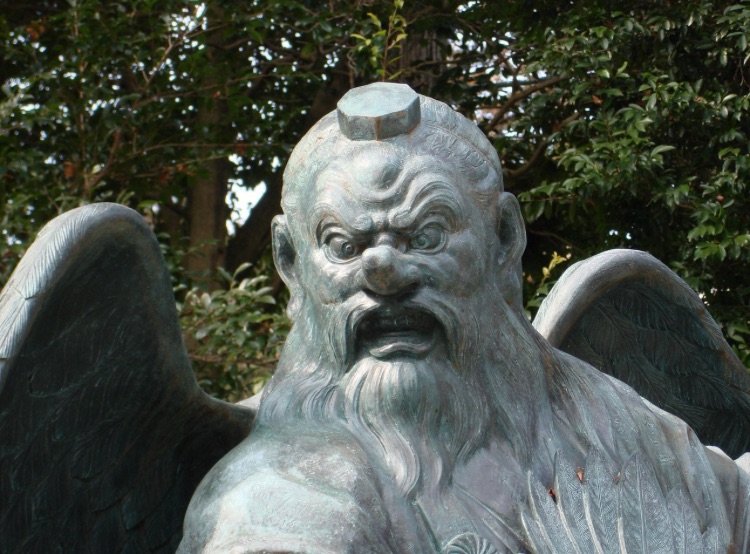
Whilst I was halfway through writing a book of short stories (still a work in progress) about a particular character, “The Crow King” – a sort of minor bird-god – I found out about the Tengu, and noticed a bizarre and uncanny resemblance. I thought I’d share my findings and how this serendipity occurred here.
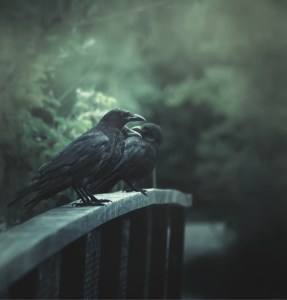
Back in 2011 or 2012, I suffered an odd dream. During childhood and adolescence I was often having crazy and detailed dreams (possibly to do with sleep paralysis, but that’s something I’ll do a post about later) and since the age of 13 I kept lengthy records of what I dreamt. This encouraged more deranged nightly adventures that were even more vivid, until it got to the point where not only was I dreaming from the viewpoint of different animal species and genders, or people of a different age or culture to me (sometimes from multiple viewpoints simultaneously), or having long dreams set in the past or far into the future, but I was having dreams which did odd constricting and expanding things to time. For example, I would dream something that seemed to take place over the course of three hours, when I’d only been asleep for a few minutes.
Anyway… the odd dream I had in 2011 or 2012 was the most lovely yet sad, disturbing, and disorientating one yet. The events of the dream took place over 3 days and 3 nights, although I was only asleep in reality for one night (and spent the rest of the week wondering why it wasn’t three days later).
In this squashed-time dream, I was an older man who could transform himself into a crow who still kept his human mind and memories whilst in that other shape. I had left a race of people similar to me who were suffering from a fatal, contagious, incurable disease, and the purpose of my journey was to find the cure. I was in a town I didn’t recognise as anything like anywhere I’d been in real life, but it was like London crossed with Berlin and close to the sea.
An elderly wizard was trying to help me. He approached me in a cafe and somehow stopped time so everyone around us froze in place. He said to find the cure to my people’s illness, I had to fly to the Moon and carry the cure all the way back to my people in my beak without swallowing or dropping it. He gave me a (rather troublesome) fairy to act as my guide, and together we worked out that to reach the Moon I had to wait for its light to paint a pathway on the surface of the ocean during the small hours of night, then follow that path.
(I never actually reached the Moon, because I got sidetracked rescuing someone who was being threatened by a group of men on the roof of a block of flats. I told the men to “get in that bin” and they were so afraid of me they jumped into a nearby skip, which meant I woke myself up laughing.)
However, traces of the character I had just been stayed with me for years afterwards and I knew I had to write his story, so that’s what I’m in the process of doing (as well as juggling other writing projects).
Fast-forward to 2025. I started watching anime series on Netflix and one caught my eye: “Witchwatch.” It was funny, suspenseful, amazing, with a cast of unhinged characters I quickly grew to care about:
One of the characters (Kanshi Kazamatsuri) appeared to have control over, and an affinity with, crows. Though he (like the other characters) was human-looking, he was in fact a “tengu.” What was even weirder was his ability to control the winds, because a few years before this I’d made the decision to make my crow-sorceror protagonist the child of a Wind Goddess.
It looked like the universe was waving a flag at me by this stage, so I started to do some research into what exactly a tengu was.
Tengus
Tengus are a form of yokai (supernatural beings) or kami (gods or spirits) in Japanese folklore. They are mischievous and bird-like, though the word “tengu” means “Heavenly / Celestial Dog.”
Tengu used to be believed to take the shape of birds of prey and were often shown with avian, monkey, and human characteristics. They often had a red face and a long nose.
In Buddhism, tengu were seen as evil demons and omens of war, but over the years their image became less harsh, and now they are seen as protective spirits of mountains and forests (though still dangerous).
Early images of tengu showed them as kite-like creatures who could take on the shape of humans with wings, avian heads or beaks (this detail is very similar to what I dreamt). The beak was most likely humanised into a long nose sometime in the 14th century.
Tengu are often shown holding a magical feather-fan with which they can either grow or shrink people’s noses (oo-er) or control the winds.
The term “tengu” may have originated from a Chinese folkloric demon called the tiangou, a canine man-eating monster that resembled a comet. The tiangou was said to make a sound like thunder and cause war wherever it landed. One story from 1791 described the tiangou as having an upright stance and a sharp beak, which is interesting.
The first mention of a tengu in Japan was in a story from 720AD, in which a comet appeared and the Buddhist priest Bin identified it as a “Celestial dog, the sound of whose barking is like thunder.” This comet preceded a war. The Chinese letters for tengu were used in this story, but followed by the phonetic letters for “heavenly fox” (amatsukisune). Perhaps this tengu was a mixture of the tiangou and the fox spirits known as huli jing, before the meaning of the word expanded to include local Japanese kami (and therefore the “true” appearance of the tengu).
Some scholars have speculated that the tengu’s image comes from the Hindu god Garuda, who was also a race of non-human beings in Buddhist scripture. The garuda are also humanoid with wings and bird-beaks. The tengu may be derived from an ancient Shinto bird-demon which was blended with the tiangou and the garuda when Buddhism arrived in Japan – though there hasn’t been much evidence to prove this.
In a collection of old Buddhist stories (from about 794 – 1185, or the Heian period), tengu were angry trickster spirits who would mislead people with false images of the Buddha, abduct monks and leave them stranded in remote areas, possess women and try to seduce holy men using their bodies, rob temples, and give those who worshipped them unspeakable powers. Their actual form was like a kite’s, but they usually disguised themselves as priests or nuns.
In the 12th and 13th centuries, tengu became the ghosts of angry or heretical priests who had fallen into the tengu-realm or tengudo. They would possess people (often women and girls) and speak through their mouths. They started to target the royal family – an Empress was possessed, and an Emperor was made blind by a tengu. One nefarious tengu was even the ghost of an Emperor!
Stories from the 13th century had tengus abducting boys as well as priests – the boys were often released, but the priests would be found tied to the tops of high places like trees, and all the victims would come back close to death or close to insanity, sometimes having been fooled into eating animal faeces.
Between 1185 and 1333, tengu had been sorted into two classes, “daitengu” or greater tengu, who had been knowledgeable men in life, and “kotengu” who were ignorant. There was a list of the names of the most well-known daitengu by this point, and daitengu were more human-looking but with long noses, while the kotengu were more bird-like. The kotengu were sometimes called karasu-tengu or Crow Tengu. (Hmm…)
(There are other creatures who don’t fit the bird-image which are also called tengu – for example, the river tengu who is believed to make strange fireballs and annoy fishermen in the Greater Tokyo area.)
As time went on, tengu were seen as either good or bad, though it was believed the good tengu were under the command of the bad ones. The good ones had become demons through lesser sins like pride or ambition, but were still basically the same law-abiding people they had been in life.
From the 14th century onwards, tengu were held to possess a lot of knowledge about combat and martial arts skills.
In the 17th century, the tengu became gentler, sometimes seen as protecting or blessing Buddhist institutions rather than setting them on fire. One tale from the 18th century had a tengu taking on the form of a yamabushi (a Japanese mountain ascetic) and serving the abbot of a Zen monastery until the abbot guessed he wasn’t human.
In the 18th and 19th centuries, tengu became known as the dangerous protectors of certain forests. Some people in Japan believe that tengu detest mackarel, and have used this fish as an amulet to protect themselves from a tengu haunting or kidnapping them.
Tengu are worshipped as good kami (gods or spirits) in certain regions of Japan. One of the main deities is Izuna Shugen, which is also associated with fox sorcery, interestingly enough (I love foxes!)
Japanese mythology is incredibly complex and fascinating and I know I have barely scratched the surface here. To read more about the history and origins of the tengu and about books that mention them, and some summaries of folktales about them, you can visit this page:
https://en.wikipedia.org/wiki/Tengu
I sense I will be doing a deeper dive into kami and yokai in my spare time over the next few months. If you have recommendations for books about them, please let me know in the comments!
 Nightwalks