What follows are some ghostly and historical tidbits about the most haunted locations in the country in which I fester (and places surrounding that).
Peterhead Prison (Aberdeenshire, Scotland)
Often referred to as Scotland’s Gulag or Scotland’s Alcatraz, this prison had its inmates help in the construction of the Harbour of Refuge beginning in August 1888. (The convicts were sentenced to penal servitude or hard labour. While they didn’t actually build the harbour, they worked in the granite quarry 2.5 miles south of Peterhead, breaking up huge boulders by hand).
Peterhead became Scotland’s high-security prison, and like a lot of prisons in the 1980s there were many riots including a rooftop siege, where an officer was taken hostage, which lasted 4 days and had to be ended with the intervention of the SAS!
The prison closed in December 2013. Visitors to the prison have experienced apparitions, inexplicable noises, and sudden cold spots.
Shepton Mallet Prison, Somerset
Known as the world’s oldest and most haunted prison, this building has a “White Lady” – the spirit of a woman who killed her husband and was executed for it. As she floats down the prison corridors, she leaves traces of perfume.
This prison is also known as the Cornhill or the Mallet, and started operating in 1625. Cornhill or Cornehille house used to be owned by the Reverend E. Barnard, who sold it for £160 to be converted into the prison or “House of Correction”. George Sheephaye became the first governor.
It had unsanitary and disorganised conditions in its early years, with men, women, and children being holed up together. The gaolers had little to no pay so there was hardly any discipline, there was promiscuous behaviour and drunkenness, and the dirty conditions caused outbreaks of “gaol fever”.
In the 1800s the Victorians expanded the prison and introduced hard labour to punish the inmates (e.g. oakum picking, or the treadwheel, which powered a mill close to the gaol outside) as well as total silence among the inmates and separate cells for each one.
After public executions were banned, Shepton Mallet Prison became responsible for overseeing executions (and also became the County Gaol). From 1889 to 1926, men convicted of murder were executed, their bodies buried in the prison grounds, where they still lie at present.
Hardly any inmates were there in the 1900s, so the prison was closed in 1930… only to be reopened as a British Military Prison (The Glasshouse) at the start of World War II. In 1942 the U.S. took over the prison.
During the war, the old women’s wing of the prison became a top-secret area for the National Archives, which were moved from the Public Records Office in London to keep them safe (these included the Magna Carta and the Domesday Book).
At the end of the war the Americans left and the prison came back under British control. In 1966, it became a prison for civilians again, and in 2001 it turned into a prison for men who had committed serious offences but had already spent an amount of time within the penal system.
Shepton Mallet Prison was finally closed in March 2013.
Shrewsbury Prison (Shropshire)
Completed in 1793 and named after Reverend Edmund Dana, this prison is also monikered “The Dana.”
Shrewsbury Prison was a place for executions, which used to be done in public and drew huge crowds of spectators. People would arrive early to ensure they bagged a good vantage-point and posters were made as souvenirs!
The last public hanging was that of John Mapp in April 1868 – he was hung for murdering a nine-year-old girl.
From 1902 to 1961, there were eight executions inside the prison including that of George Riley, who had murdered a 62-year-old lady. During redevelopment in 1972, the remains of ten executed prisoners were exhumed – one of them was George Riley, whose remains were handed to his relatives. The other nine were unrecognisable and were cremated.
Within the notorious Cell 210 or “poltergeist cell” lurks a former prisoner who took his own life.
Pluckley, Kent (England’s most haunted village)
This village in Kent is host to many odd sightings of ghosts, including a screaming man, a murdered highwayman, and a schoolmaster who was found hanged by his pupils. There are lady ghosts in shades of white and red. The centre of the supernatural activity is said to be The Black Horse Pub.
The “Screaming Woods” are also a concentrated area of paranormal activity. Officially known as Dering Wood, it lies two miles south-west of Pluckley. It has one of the oldest Neolithic sites in the world.
Many people hear horrible screams coming from these woods at night, or whispers and footsteps during misty days. It is rumoured to be haunted by the ghosts of people who have gotten lost in there over the years, for example a suicidal army colonel from the 18th century and a highwayman who was captured by the villagers, pinned to a tree, and beheaded. People from nearby villages say they have had black shadows stalking them while they were journeying through the forest.
On November the 1st, 1948, the bodies of twenty people – eleven of whom were children – were found in the woods, forming a massive pile of flesh with no visible wounds anywhere. Many people claimed they saw strange lights coming from the wood the night before (which was Halloween). Autopsies were unable to find the cause of the deaths, and after a few weeks the investigation ended with the authorities stating the twenty victims had been killed by carbon monoxide poisoning.
In 1964, a private investigator called Robert Collins started interviewing witnesses to the case, hoping to get information about an alleged unknown religious cult in the village of Smarden. He died in a car accident the following year.
On October 1998, fifty years after that Halloween night where the twenty people were somehow killed, four students who were visiting the woods went missing after some people from Pluckley noticed seeing “figures of light” similar to spiderwebs in the sky. The investigation into the students’ disappearances stopped after three weeks though they were never found.
Ghost hunters continue to venture into the woods despite local discouragment and signs warning them to stay away…
Edinburgh, Scotland
It contains Mary King’s Close, an underground warren of streets haunted by victims of the Black Death, one of which is the ghost of a little girl called “Annie” – see this post for more information – and also Edinburgh Castle, haunted by a headless drummer boy and other ghosts.
Pendle Hill (Lancashire)
This was where witch trials took place in the 17th century. Visitors report sightings of ghosts of the Pendle witches, odd lights, apparitions, and disembodied voices.
Rumoured to be a site of devil worship and Satanic goings-on, this was the place where, in 1612, twelve locals were arrested and accused of witchcraft. Ten of them were hanged.
On Halloween, ghost-hunters gather on the hilltop in the hopes of making contact with something beyond the veil.
Borley Rectory (Essex)
This once held the dubious honour of being the most haunted house in England. Ghosts seen here include a ghostly nun and a headless horseman. The house sadly burned down in 1946, but its reputation persists.
Chillingham Castle (Northumberland)
This fortress, situated close to the Scottish border, is haunted by a “blue boy” in the Pink Room, a “white lady” in its inner pantry, a malevolent poltergeist in King Edward’s chamber and a crowd of ghosts in the torture chamber, where John Sage (the Butcher of the Scots) did a lot of gory things to them.
There are cold spots, disembodied voices and uncomfortable feelings of dread to be experienced here.
The Ancient Ram Inn (Gloucestershire)
This inn has existed since the 12th century and is said to have been built on an ancient pagan burial ground with intersecting ley lines (two of which can be traced all the way back to Stonehenge!) It is also a building associated with witchcraft, and has a reputation for sightings of ghosts, strange happenings, weird inexplicable sounds, cold spots and uneasy sensations.
According to its website, ancientraminn.co.uk, “Guests can explore the 1000-year-old inn through events such as tours led by mediums, aura readings, psychic art sessions, and rune casting. TV personalities Andy Moore and Chrissie Howe host some of these events. Ben and Louisa Winfield also present a demonology talk, exploring myths and truths about the supernatural. Events are held on specific dates, with options for both daytime and nighttime experiences.”
There are stories of burning witches, monks, the ghost of a Roman centurion on horseback, evidence of Devil worship and ritual sacrifice.
Berry Pomeroy Castle (South Devon)
This haunted castle was the home of the Pomeroys, a family whose history extends far back to the days of the 15th century. The manor of “Berri” was granted by William the Conqueror to the Norman knight Sir Ralf de Pomaria, though it is uncertain when exactly the castle was built. It was erected on an unused piece of land in a deer-park a mile north-east of the village church. The Pomeroys previously lived in an unfortified manor by the church, which was still being used in 1496.
The motive for building a castle was that in those days, Devon was an area of social unrest and lawlessness leading up to the Wars of the Roses. For more about the history of this castle, visit this National Heritage page. By 1700, the castle was abandoned, parts of it demolished and the walls left to ruin.
A “blue lady” has been seen floating through the building’s hollow facade (she is said to have been impregnated by her own father, smothered her baby when it was born, and now walks the grounds in sorrow).
More ghosts are in the dungeons under St Margaret’s Tower, where visitors have seen a “white lady”, had their hair and clothing tugged, and heard odd voices whispering in the darkness.
The Tower of London
Built on the foundations of a Norman keep, this tower has borne witness to a smorgasbord of imprisonments, burnings and assassinations over hundreds of years. The home of the Bloody Tower, this fortress has amongst its ghosts such notorious names as Anne Boleyn, Sir Walter Raleigh, Lady Jane Grey, Guy Fawkes, and the two Princes King Richard the III walled up in the tower to die (Edward V and Richard, Duke of York, who were aged 12 and 9 respectively and were Richard the III’s nephews). There are also ghosts of women, monks, and even a bear named “Old Martin” who may have been part of a royal menagerie.
For the history and stories connected with the Tower, go here
Whitby Abbey
The ruins of this abbey in Whitby are where Bram Stoker set some of his novel Dracula. It is a Gothic building overlooking the North Sea, and the ghost of Saint Hilda, the Abbey’s founder, has been seen flitting about the grounds here or peeking out of the windows. She is accompanied by the ghost of a Constance de Beverley, a nun who broke her vow of chastity and was bricked up in the Abbey walls while still alive as punishment.
Blickling Hall, Norfolk
This Jacobean manor house was where the Boleyns lived, and where Anne Boleyn (one of Henry the VIII’s wives) is supposed to have been born.
Anne is believed to visit the manor on May the 19th (the day she was executed), arriving at night in a coach driven by a headless driver who may even be carrying Anne’s detached head in his lap (how dreadfully overfamiliar of him!)
Anne’s ghost is then believed to wander about inside the manor visiting her father Thomas and brother George (who were also beheaded). What a bizarre family reunion that must be.
The library here is a hub of ghostly goings-on – a house steward once saw a grey lady sitting in the room reading (who may have been Anne).
Another ghost here is Sir John Fastolf, who was one of the inspirations for the character of Falstaff in Shakespeare’s The Merry Wives of Windsor and others of his plays.
For a complete history of Blickling, go here.
Highgate Cemetery
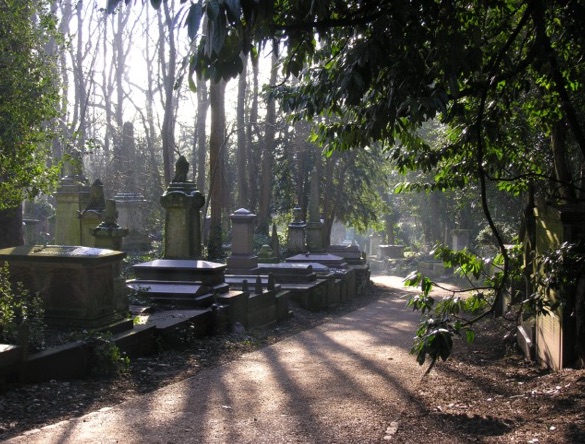
This cemetery in London opened in 1839, fell into decline in the 1970s and was restored by the charity The Friends of Highgate Cemetery Trust. The place is secluded, consisting of many winding paths snaking their way up a wooded hill, with lots of ivy-coated monuments and Gothic architecture.
The cemetery is the final resting site of people such as Karl Marx, the writer George Eliot, Michael Faraday (a scientist), George Michael, Douglas Adams, Christina Rossetti (a poet), and Malcolm McLaren (manager of the Sex Pistols).
The cemetery is still actively in use for burials, so visitors must act respectfully!
For a history of the cemetery, go here
Sources:
https://www.thetimes.com/travel/destinations/uk-travel/the-uks-most-haunted-places-nf6zzkvwq
https://www.english-heritage.org.uk/visit/places/berry-pomeroy-castle/history/
https://www.nationaltrust.org.uk/visit/norfolk/blickling-estate/history-of-the-blickling-estate
https://www.hrp.org.uk/tower-of-london/history-and-stories/
 Nightwalks
One thought on “Most Haunted Places in the UK and Its Environs”