
Digitally looking back to a less complicated time, I found the first reviews I wrote on Goodreads in 2012, when I was aged 19 to 20.
My Mother She Killed Me, My Father He Ate Me: Forty New Fairy Tales edited by Kate Bernheimer
5 out of 5 stars

I often think of books as gateways into other worlds, some weirder than others. “My Mother She Killed Me, My Father He Ate Me” has been one of the strangest in a long time – and not just one odd world. This is a collection of modern day fairy tales, or stories based on fairy tales, for adults. The book is full of many extraordinary places, many extraordinary characters, e.g. a performance artist who sews shirts out of nettles so her brothers won’t be trapped in swan shape.
In some of the stories, you know which tale originally inspired them (and that’s no bad thing – it gives you something familiar, a foothold… almost… and then there is a sudden surprise, a twist in the plot, like the somewhat cliched spiral staircase, and you find yourself freefalling. Which is good, trust me.)
In others, you’re not sure which story you’re in. You’re a tourist. By the end you get to find out what fairy tale – or tales, sometimes the writers’ weave more than one into their stories – it was based on. After each story, the author tells us a little bit about what was going on in his or her head at the time of writing it. (This helped me to understand in most cases, other times it mystified me, but I enjoyed it nevertheless.)
And then there are the other stories in the book (such as Kelly Link’s “Catskin”) that are so unlike anything you’ve heard before in fairy tales, they might as well be completely new ones, you’re an alien, you’re setting foot on a new planet – and that’s a good thing.
Angela’s Ashes (Frank McCourt, #1) by Frank McCourt
4 out of 5 stars
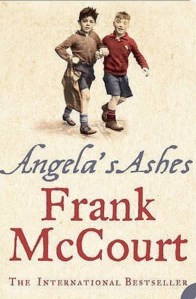
This is a book by turns funny, heart-warming and sad. Frank McCourt shares his childhood memories growing up in poverty in Ireland with a father who drinks all the dole money. Frank has a unique, quirky way of describing the hardships he had to go through in a way that highlights the humour in each experience.
I really enjoyed reading Angela’s Ashes, and it gave me an insight into things I wasn’t fully aware of – e.g. what happens in your life if you are a Catholic, or when your father decides to “mend” your boots by nailing flappy bits of an old tyre to the soles!
The question on my mind is, why is the title “Angela’s Ashes”? Angela is Frank’s mother, but she doesn’t die in the novel. What “Ashes” is Frank referring to?
The Little Village School by Gervase Phinn
4 out of 5 stars

I recently had the pleasure of listening to Gervase Phinn doing one of his stand-up routines in my home town (admittedly I was the only person there under 30, but didn’t let that bother me) and I can geniunely say he is one of the funniest people I know of to have gone from being a school inspector to writing books based on his experiences.
I didn’t know who Gervase was before then, and for my birthday I was given “The Little Village School” which was pretty much ‘unputdownable.’ I became totally absorbed in Barton-on-the-Dale. The characters were vivid and quirky, by turns humourous then sad. I especially empathised with James Stirling, the doctor’s son who had selective mutism and ran away, only to be found huddled in the new headteacher’s garden. It was poignant.
Shadow & Claw by Gene Wolfe
5 out of 5 stars

Everything about this story was alien – in a GOOD way. Alien… but with some slight familiarities, as if I was absorbed in a dreamworld that suddenly gave me little reminders of the waking world. For example, the creatures are similar to the prehistoric animals that are now extinct, e.g. thylacodons and megatheres. And one of the characters told a story based on a Greek legend.
The novel is set on Urth, a planet whose sun is dying. It is a widely-held belief on Urth that once the old sun finally expires, a New Sun will be born, and a new age will start. It is an account written by Severian, a journeyman of the Torturer’s Guild with a photographic memory, in an unheard-of language translated into English by Gene Wolfe (or so he would have us believe) recounting how he fell in love with a prisoner and was sent into exile, and what befell him on his long journey, including beheadings, trickery, acting, love, betrayal, mystery, and courage.
I still had questions burning once I’d reached the end, which hopefully will be answered in the next book of the series. I look forth to it.
Bleak House by Charles Dickens
4 out of 5 stars
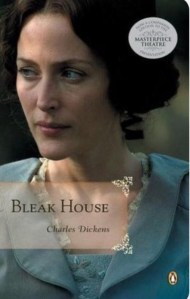
To be frank, (although my name is not Frank) this is the first novel by Charles Dickens that I managed to read all the way through, and I was never bored. (I did once endeavour, as a very inexperienced six-year-old, to read The Mystery of Edwin Drood, simply because the book was there. I never reached the end… because there wasn’t one! It didn’t make much of an impression on me.)
Bleak House is a long, intricate creature of a plot, and it took some concentration to follow the twists and turns at the beginning, but you soon get into it with practice and I would heartily recommend this book (if only for use as a prop for your wobbly desk-leg, or a doorstop, or even better, a potential hitting device for Unwelcome Strangers In The Night.)
The novel makes excellent use of two narrative viewpoints (an omniscient, unknown narrator in the present tense, and a past-tense, single-person viewpoint of one Esther Summerson, a girl raised in the loveless household of her “godmother” who is sent to live with Mr. Jarndyce along with her two cousins, Ada and Richard. She shows kindness and compassion throughout the trials of the ever-dragging and confusing Chancery court case that affects all their lives, yet seems utterly bewildered to receive any in return.)
At first Bleak House seems like a fragmented (though humorous and interesting) account of different unrelated events happening to characters who do not know each other, yet as the novel progresses, Dickens manages to tie all these different odds and ends together through the use of coincidences made plausible by the seemingly “natural” way they occur.
Dickens’s characters are delightful. Personally I prefer his “bad guys” to his “good guys” or at least I like them to have a few strange flaws. Though I liked Esther, she was a tad sentimental and modest to seem completely realistic.
Some critics could remark, when Bleak House was written, that Mr. Dickens was churning out more of the same (weird people acting oddly) that he did in previous books, to keep readers interested. “It’s enough,” as Mr. Guppy the lawyer might say, “to badger a man blue!” But you don’t have to listen to them. They’re a weeny bit dead at present, and Bleak House lives on.
Anno Dracula by Kim Newman
5 out of 5 stars

Normally, I don’t bother reading books in the vampire genre (The Twilight movies tend to put me off) and up until now, I hadn’t read any alternate-history novels. This was my first venture into reading a book that is in both categories, and surprisingly, I really loved it. Set in a world where Bram Stoker’s Dracula succeeded in taking over humanity (instead of being destroyed) the story focuses on the vampires as another race of people, living side by side – and feeding off – the “warm.” It wasn’t cliched. It was totally believable, and cleverly done. None of it was corny, even the romantic bits. Mr. Newman, I take my (proverbial) hat off to you.
Anno Dracula is the first book in the series. I look forward to the next!
Songs of the Dying Earth: Stories in Honour of Jack Vance edited by George R.R. Martin & Gardner Dozois
5 out of 5 stars
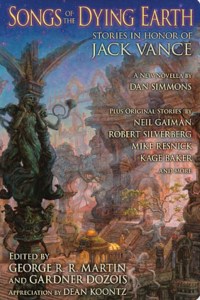
The rain came down in buckets. I was lurking in the dry, browsing in a shop that sells arts and crafts materials alongside books. On a shelf at ankle height sat a book with a very strange cover (not the cover you see above). It depicted a huge Sun with a tiny black dot on it. I picked it up, wondering why the Sun had a dot. Then I realised it was the Earth, and suddenly realised how very small and vulnerable we are on this floating rock we call home.
“Songs of the Dying Earth” was the name of the book, and it was a collection of short stories by different writers set in the world of the Dying Earth, originally created by Jack Vance. The stories were a tribute to him from some of the writers he had influenced.
I can’t say I’m surprised. To be honest (and now this makes me feel a wee bit guilty, like I’m telling this to my old headteacher or something) I have never read anything by Jack Vance. Ever. (Where have I been all this time, I wonder?)
But once I delved into this mad, colourful, detailed, dark, humorous and deep world, and met the locals – most of them dangerous, I warn you – I realised just what I’d been missing. It was like stepping into a painting by an old genius that you had seen once in a dream and half-forgotten. I couldn’t put it down. It was like a drug, filling my mind with colours and landscapes I could feel and taste long after I shut the book.
The Songs of the Dying Earth are not just stories. They are beautiful harmonies.
Dare you to read it.
Wormwood by G.P. Taylor
3 out of 5 stars
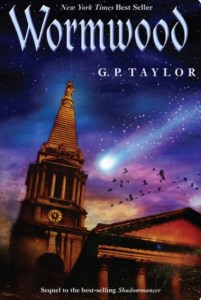
To begin with, I wasn’t sure I could get into this book. Some stories are easy enough to slip into, like a second skin. Although this book is good, it takes a little work to start with.
For me, I think the reason for this was that the destruction of the ‘sky-quake’ at the beginning of the story, when Dr. Blake saw Wormwood in the sky through his telescope, was described as happening to crowds of people, and because of that, I found it difficult to imagine. Maybe if G.P. Taylor had described the thoughts and emotions of some of the people on the street below Blake’s window at the time of the panic, it would have been more vivid.
HOWEVER, as I read on, the excitement and intrigue of the story gripped me and would not let go. Angels and demons and sorcery abound, and although I sometimes found the actions of Agetta – one of the main characters – somewhat frustrating, that just added to my urge to read further. I wanted to make sure she would be all right.
This book, set in 17th century London, had the same kind of feeling to it as “The Haunting of Alaizabel Cray” by Chris Wooding, with a pinch of Philip Pullman and even some Dan Brown added. If you’ve read any of these folks and enjoyed them, I recommend you try this one.
Is It Just Me? by Miranda Hart
4 out of 5 stars

If anybody out there in the cyberspacial ether has watched “Miranda” on TV, you’ll know the kind of oddball humour that lurks within the pages of “Is It Just Me?” by Miranda Hart. And when I say oddball, I mean unique and uninhibited. Divided into 18 chapters concerning socially-confusing topics we don’t always know how to deal with in life, from Music to Dating to Holidays, this book reveals Miranda Hart’s thoughts on the problems that arise from them and – sometimes – how to deal with them.
This book’s purpose is not to instruct, though – it’s to make you laugh! And it certainly did in my case, especially the hilarious anecdotes the author put in, taken from her own experiences, and also when she had arguments with her eighteen-year-old-self, Little M.
Don’t know what I’m talking about? Read it…
 Nightwalks