
Digitally travelling back in time to a less complicated era, I found old reviews I wrote for books on Goodreads. This was what I was feeding my brain more than ten years ago.
Poison by Chris Wooding
4 out of 5 stars

Poison is one of my favourite characters – brave, wilful, a high sense of justice, but also stubborn and ready for an argument. I also love Andersen the phaerie cat. I think it’s a pity there’s no backstory for him. How did he become so clever? Where did he originate from? Was he always a cat? This must be the fourth time I’ve read it but it never grows tiring.
We Are All Completely Beside Ourselves by Karen Joy Fowler
5 out of 5 stars

One of those coming-of-age amazing novels right up there with The Catcher in the Rye or When God Was A Rabbit. Unfortunately I already guessed the nature of the older sister, because I happened to read the quotes from various reviews at the beginning of the book (as you do) so if you don’t want spoilers, skip the review comments. I won’t reveal, either.
This story is moving – funny, sad, human. And it carries a message of equality, not just between the sexes but between humans and non-human animals.
Wondering what that could be about? Read it. Go on, I dare you.
The Complete Maus by Art Spiegelman
5 out of 5 stars
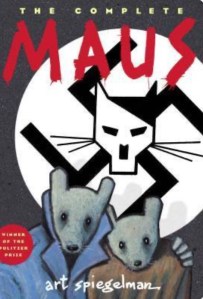
I love this. It’s an autobiographical account of Art Spiegelman’s father telling him an account of his experiences in a Jewish ghetto and in Auschwitz during World War Two.
But the imagery of the graphic novel is interesting too. Jewish people are depicted as mice, which has connotations of hiding and being constantly hunted. The Nazis are portrayed as cats, the Polish as pigs (I’m not sure why this is) and the Americans as dogs, because they save the mice (Jews) from the Nazis (cats). They all wear human clothing and act like people.
I really liked the way Art incorporated stories inside the main story, not necessarily in chronological order but there to explain the kind of relationship he had with his mother and father, and the kind of strained relationship his father had with his new wife Mala after the war.
The book is painfully honest, it holds nothing back regarding the character’s thoughts and feelings. Despite the harrowing and sometimes horrific nature of the story, it’s not overly sentimental. There are bits that make you smile, and bits that make your heart crumble around the edges.
To Kill A Mockingbird by Harper Lee
5 out of 5 stars

Cor.
Collected Poems, 1909-1962 by T.S. Eliot
4 out of 5 stars
T.S. Eliot is maybe the first poet I ever read who split himself into constituent parts and made them morph into each other at the drop of a pin, regardless of gender, religion, class, and their chronological space in time. Often it confused me, but it was still a vivid and engaging experience.
It was also odd how some of his earlier poems were alluded to (subtly) in his later poems, if you approach his writing from a certain headspace. E.g. there were a few themes he used in new ways time and again: birds/birdsong signifying secret iniquity and loss of innocence, Biblical prophets – Ezekiel, Isaiah, Ecclesiastes – I’m not a Bible buff, I had to look most of these allusions up – characters from classical Greek/Roman literature he kept referencing (Philomela, Phlebas the Phoenician) and death by water and all the fires of Hell, courtesy of Dante.
I really liked “Triumphal March” in which Eliot described a Roman victory parade and joined it seamlessly to the First World War in a surreal and almost Carrollesque way. Also his “Five Finger Exercises” revealed a quirky and comical side that I wasn’t previously aware of. How pleasant it was to meet Mr. Eliot, with his “porpentine cat and a wopsical hat.”
The Hunger Games (The Hunger Games, #1) by Suzanne Collins
4 out of 5 stars

Intriguing… not just for the danger and the fight-or-flight situations, but for the emotional and personal drama involved in the plot as well. A post-apocalyptic world, a tyrannical government, a sadistic televised game startlingly like I’m A Celebrity Get Me Out of Here crossed with Dancing on Ice – except the winner is the survivor. The losers die.
The main character, Katniss Everdeen, has a similar outlook and way of talking as Maximum Ride (a character in a YA sci fi thriller series by James Patterson). Only, when it comes to personal relationships, Katniss knows the best way to get the viewing audience of the Hunger Games to sponsor her and send her gifts for survival is to pretend to fall for a boy, a competitor from the same district as her. But IS it pretend… or isn’t it?
The Collector by John Fowles
5 out of 5 stars

The Collector is creepy, but in a subtle way. Very, very subtly dark, but the darkness haunts you well after the last page.
I like how the novel tells both sides of the story from each character’s point of view; the first part is narrated by a man – Frederick Clegg – who at first seems innocent, if with a skewed perception of class and gender. He collects butterflies. He lives with his aunt. But then he comes into some money, winning the pools, and he decides to act out one of his dreams: to have a girl he’s had his eye on. He tells of how he made meticulous preparations and kidnapped the girl, Miranda Grey.
The second part of the book is told by Miranda, and we get to see the kind of person she is, her life outside the cellar of the old cottage he has locked her in. She is clever, an art student who almost unwittingly has an older painter, George Paston, head over heels for her. It is only when she has the time and solitude to ruminate in her captivity that she realises she might love George. However, she is never free again. Something happens – covered in the third part of the novel – to prevent this from happening. Frederick doesn’t touch her – I won’t tell you what does happen because I’d hate to spoil it for anyone who hasn’t read it.
One of the most chilling bits is at the end, chapter 4. When Fred goes out and sees a girl just like Miranda, and thinks about doing the same thing to her. He says he wouldn’t really, and he only moved the stove into the cellar because it needs drying out, but by now the reader knows he is not a narrator to be trusted when it comes to his motives.
Some of the language Miranda used was confusing to me, but after a bit of research I understood her idioms, and I reckon anyone who likes psychological thrillers and/or coming-of-age stories should take a peek at this.
Flowers for Algernon by Daniel Keyes
5 out of 5 stars

This is a story about a warm, happy-go-lucky man with an I.Q. of 68 (due to untreated phenylketonuria) who undergoes brain surgery for an experiment in increasing intelligence.
At first, he thinks nothing is happening – but then he rockets up to beyond-Einstein-levels, and becomes a self-centred, cynical person who feels he has no friends and more problems than he had before the operation.
He is the first human to undergo such a procedure; beforehand, it was tested on a white lab mouse named Algernon. As Algernon’s behaviour becomes more and more erratic, and his performance in lab mazes starts to decline, Charlie Gordon – who is now smarter than the psychiatrists and neurosurgeons who did the brain surgery on him – must race against the clock to find the flaw in their own experiment, before his own mind begins to fail.
I loved this story. It had the amazing bits, the funny elements (such as Charlie releasing Algernon at a scientific convention in Chicago, then running away with the mouse himself) the sad parts (he falls in love with his old teacher, Miss Kinnian, and struggles to find a way to express his new emotions towards her, and he remembers a lot of things from childhood which explain his fear of intimacy) and the sensitive insight into human nature which are often included in books I love and want to read again.
And the underlining point of the story I picked up on (out of several) was that human affection and friendship is more important than how clever you are – and if you are clever, don’t take yourself too seriously.
But I still don’t understand what the “pair-production of the nuclear photoeffect” is, or how it can be used for exploratory work in biophysics. That sentence was a foreign language to me!
In Search of Lost Gods: A Guide to British Folklore by Ralph Whitlock
3 out of 5 stars

You can tell by the tone and sentence structure of this book that it was written in the seventies by a very English person, which added to its interest from my point of view.
The book was well-researched, covering everything from the old customs and traditions of places in England (e.g. Morris Dancing, Mumming Plays, and superstitions to do with weddings, death, and witches) to sacred natural haunts such as Stonehenge and the embarrassingly well-hung, deranged hill figure of the Cerne Abbas Giant, and there is even a section at the back describing old playground games and their roots in ancient pagan religion.
Most of the terms mentioned in the book were explained at some point or another, e.g. Ralph Whitlock did tell the reader about the Celtic gods (the Dagda, Epona, etc) but in some instances, he seemed to treat some of the names of old gods and festivals as self-explanatory, for example, who exactly was the Celtic god Robin-a-Bobbin, the big bellied Ben? What was the festival of Corpus Christi?
However, as the author pointed out at the start of the work, the book wasn’t supposed to be exhaustive, more of a starting point to whet your appetite. And it worked. I wonder if anybody has found anything out about the old festival of Imbolc, or of Lady Day?
On the Road by Jack Kerouac
5 out of 5 stars
Mind-blasting. As yet I have never seen America, but this book, in all of its crazy complexity, fast-paced driving, and hairpin turns, made me feel as if I was almost there.
There were odd points in the narrative where I felt confused, a) because there were a lot of different (weird) characters in it, and I couldn’t always remember who they were without flipping back – maybe it could have done with a list of the cast, but the edition I read doesn’t have one, and b) I do not speak 1940s American jazz dialect, but I worked it out as I went along.
I couldn’t help wondering why Jack Kerouac treated his male and female characters as if they were polar opposites, at either end of the spectrum – nearly all of the men were deranged, drunk, and callous, and nearly all the women were either painfully sensible and oversensitive or just plain evil and oversensitive. (I had a suspicion this was to contribute to the humour inherent in the story.)
However, when you finally get your head out of this novel, you’ll feel like you’ve been on the road for years, and if you’re much like me, you won’t be able to stop worrying about the characters.
 Nightwalks