Whilst I was ferreting about in a graveyard testing Ghost-hunting apps on my phone last week, one of the apps mentioned that ghosts may be part of Carl Jung’s “Collective Unconscious”.
So… who was Carl Jung, and what had he got to say about ghosts? Read on to find out.
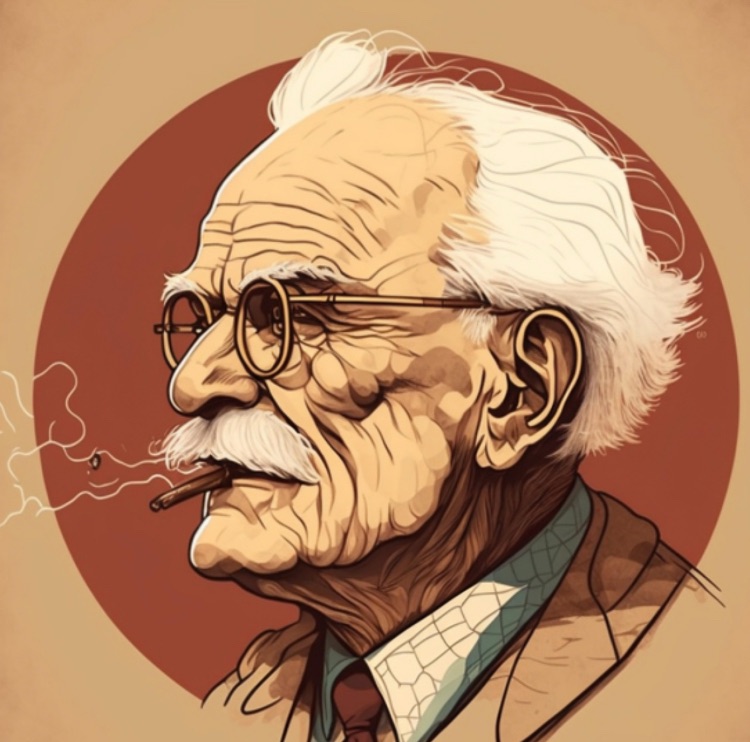
Carl Jung
This fellow was a Swiss psychologist, psychiatrist, and psychotherapist, born on July 26th 1875. He invented a school of analytical thought about psychology and came up with some theories you probably are already familiar with, such as the concept of archetypes (hello, any creative writers out there!)
Jung’s work has been useful to not just psychiatry but anthropology, archaeology, lierature, religion, and philosophy. He was friends with Freud (the psychologist who came up with the idea of the Oedipus Complex) and they both wrote long letters to each other which played a part in their vision of human psychology.
Eventually, Jung’s ideas differed from Freud’s to such an extent that they parted ways.
Carl Jung wrote more than 20 books, was an artist, craftsman, and a builder, too. Most of his work was not published until after he died.
His treatment of an alcoholic politician in 1926 using a “vital spiritual or religious experience” led to the formation of Alcoholics Anonymous.
Some of Jung’s more well-known concepts include the idea of extroverts and introverts, synchronicity, archetypal phenomena, the psychological complex, and something called The Collective Unconscious.
The Collective Unconscious
In psychology, this is a theory that the unconscious mind has within it all the instincts of Jungian archetypes (or symbols which are somehow understood from birth by all humans).
“…in dreams, fantasies, and other exceptional states of mind the most far-fetched mythological motifs and symbols can appear autochthonously at any time, often, apparently, as the result of particular influences, traditions, and excitations working on the individual, but more often without any sign of them. These “primordial images” or “archetypes,” as I have called them, belong to the basic stock of the unconscious psyche and cannot be explained as personal acquisitions. Together they make up that psychic stratum which has been called the collective unconscious.”
From “The Significance of Constitution and Heredity in Psychology” (November 1929).
In Jung’s head, the Collective Unconscious surrounded and underpinned the individual unconscious mind. He believed that a Collective Unconscious explained why so many different mythologies from different cultures have similarities or similar themes.
He claimed the Collective Unconscious had a significant influence on the lives of people, who acted out its symbols and also gave them meaning through their own lived experiences.
Critics of the theory said it was very difficult to test scientifically (and to be fair, the idea is rather mystical-sounding).
“The collective unconscious comprises in itself the psychic life of our ancestors right back to the earliest beginnings. It is the matrix of all conscious psychic occurrences, and hence it exerts an influence that compromises the freedom of consciousness in the highest degree, since it is continually striving to lead all conscious processes back into the old paths.”
“The Significance of Constitution and Heredity in Psychology” (November 1929).
What’s this? Ancestors?
“It is the mind of our unknown ancestors, their way of thinking and feeling, their way of experiencing life and the world, gods, and men. The existence of these archaic strata is presumably the source of man’s belief in reincarnations and in memories of “previous experiences”.
Reincarnations and past lives, eh? Intriguing…
Ghosts and the Collective Unconscious
Carl Jung suggested that understanding of the Collective Unconscious could be gleaned from the realm of parapsychology, alchemy, occult ideas, astrology, and different cultural and spiritual practices.
Based on his concept of synchronicity (or unusual coincidences) and his interpretation of extra-sensory perception (or ESP), Jung said that psychic activity went beyond the brain.
In childhood, Jung heard many family stories concerning the supernatural, including dreams which foresaw the death of certain people, clocks that stopped at the moment of someone’s death, and glasses shattering.
As a young woman, Carl Jung’s mother Emilie Preiswerk, would sit behind her father, the Reverend Samuel Preiswerk, while he wrote his sermons, to protect him from “ghostly disturbance.” The man wrote all his sermons in Hebrew because he believed that was the language spoken in Heaven, and he also was convinced ghosts were surrounding him. While Jung’s mother attended Samuel, she wrote a journal in which she took note of any strange happenings concerning ghosts or precognition. She also maintained she was visited by spirits in the night.
One day of every week, the Reverend spent “conversing” with the spirit of his deceased first wife, setting out an empty chair for her in his study!
Samuel’s second wife, Augusta Preiswerk, (Jung’s grandmother) was herself a clairvoyant ever since the age of twenty, when she suffered a coma for 36 hours. She claimed to see ghosts of people who were later found to have existed in history.
Both of Jung’s parents were the thirteenth children in their respective families. Jung held a peculiar terror or unease towards his mother, saying that she had two personalities – a normal, loving one during the day but an uncanny one at night:
“At night Mother was strange and mysterious. One night I saw coming from her door a faintly luminous, indefinite figure whose head detached itself from the neck and floated along in front of it, in the air, like a little moon. Immediately another head was produced and again detached itself. This process was repeated six or seven times.”
Memories, Dreams, Reflections by Carl Jung
Like his mother and grandmother, Jung also believed he himself had two personalities, one for normal social life and one which was ancient, “close to Nature, to the night, to dreams, and to whatever God worked directly in him.”
While studying at home one morning in 1898, Jung was shocked by a loud cracking noise. A heavy, walnut table which had been in the family for many years had suddenly cloven itself in two.
A fortnight later, there was another sound. Inside a cupboard, the bread knife (which had just been used an hour ago) had snapped into four quadrants for no reason. Jung kept hold of the broken objects as a reminder of the unseen realm. They are still in possession of the Jung family.
The table that had broken had often been used in seances featuring his cousin, the medium Helena Preiswerk. Jung attended these along with members of his own family whilst they tried to speak with their ancestors.
Jung penned his doctoral dissertation (On the Psychology and Pathology of So-Called Occult Phenomena, published in 1902) on mediums, based on the experiences of Helena. He attended seances and witnessed mediums “materialising” objects from the ether, as well as levitation, which he became convinced were real phenomena. At first, his writings saw mediumship as a type of pathology, but his views on ghosts and mediumship changed as time progressed.
Jung was interested in how Helena seemed to produce a wholly different personality to her usual one while in a trance. This ability to manifest an array of personalities later contributed to Jung’s ideas about complexes and archetypes.
He later acknowledged the universal nature of belief in spirits inhabiting the same world as humans and having the power to influence humans. Jung ultimately said that spirits, “…viewed from the psychological angle, are unconscious autonomous complexes which appear as projections because they have no direct association with the ego.”
He placed autonomous complexes in dreams and other psychic goings-on too. This was after he got one of his students (Aniela Jaffe) to analyse letters that related direct experiences of spirits. Aniela published her findings in “Apparitions: An archetypal approach to death, dreams and ghosts” after Jung died.
In 1913, Carl Jung began an imaginative self-experiment he labelled his “Confrontation with the Unconscious”: a mental journey into his mytho-poetic fantasies, that he jotted down in a series of seven notebooks later known as “The Black Books.”
Those notebooks were rather private, so he took necessary details from the first few of them and compiled “The Red Book” which contained material recorded in the Black Books up to the year 1916. The Red Book was illustrated with his own paintings and medieval-style illuminations.
Jung continued to write The Black Books for decades, and they were eventually translated and published in 2020 along with an essay about them by Sonu Shamdasani.
The Black Books showed Jung’s personal cosmology and how he tried to use insights from this self-investigation in his life and relationships. One of the “guides” he often spoke with was a being called Philemon, a pagan with an Egyptian / ancient Greek air about him. He appeared in Jung’s night-time dreams as a figure with kingfisher’s wings. Bizarrely, shortly after this (while awake) Jung found a dead kingfisher in his garden. [This was an example of synchronicity.]
The writings he published about archetypes and his memoir, (Memories, Dreams, Reflections) could be seen as his way of processing his experiences in “places that some spiritual practitioners call the world of the celestial spheres, Bardo, the astral plane, the spirit world, the space between the worlds. Notably, Jung did not publish the versions of his work that were closest to his direct experience; instead his works that referenced the experiences were heavily abstracted from the original content.” (quote from Journal of Jungian Scholarly Studies, Vol. 19, 2024)
Albert Einstein was a dinner-guest of Jung’s a few times, and his theories about space-time relativity helped Jung to see that synchronicity and other paranormal phenomena were likely to be acausal and not causal, i.e. happening simultaneously rather than one causing the other (e.g. think of the butterfly effect – if a butterfly flaps its wings on one side of the world, the other side of the world experiences a hurricane, or something.)
Bonus tidbit: Carl Jung said the phenomenon of UFOs was a “living myth”, or a legend in the process of being made. He said that belief in an encounter with UFOs demonstrated that even if rational, modern thought repressed images from the Collective Unconscious, its fundamental images would inevitably pop back up in some way, for example the flying saucers’ circular shape has a symbolic connection to ideas of divinity (halos).
To find out more about Jung’s life and his bizarre paranormal experiences and visions, visit this blog.
Sources:
Journal of Jungian Scholarly Studies, Vol. 19, 2024
Wikipedia
Amazon
Reddit: r/Jung
The Psychology of The Paranormal – Carl Jung
 Nightwalks
Thanks for this extra tidbit of information! I suppose it’s a good example of “the more you know, the less you know” – as we age and gain more knowledge and experience of life we become less certain of what we “knew” when we were younger, and our minds gradually open wider…
LikeLike