
Comparing old-fashioned and modern methods of capturing spirit phenomena.
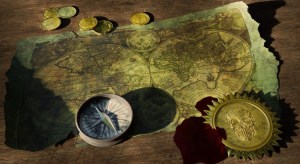
While the Spiritualism movement was at its peak in the 19th century and early 20th, mediums and other folks looking to contact the dead or otherwise prove the existence of ghosts used a few different tools:
Spirit boards or Ouija boards
Originally sold as a type of board game, these things consist of a planchette (a small, usually flat pointing object) and a board with all the letters of the alphabet, numbers, and the words “yes” and “no” on it. The idea is to ask a ghost questions and the ghost is supposed to “nudge” the planchette to letters on the board to spell out answers.
If using a board, or something similar to it, it’s a good idea to begin with positive intentions, use a fresh planchette each time, and never attempt to use a Ouija board alone…
Dowsing rods
These come in two forms: L-shaped and Y-shaped.
L-shaped rods are held, one in each hand, grasping the short ends so the long ends can swing freely. The rods cross or move apart in reaction to “energy.”
Y-shaped rods are used in a similar way but are often made of wood or metal.
Dowsing rods were originally used to find sources of water underground, before the ghost-hunting community adopted them as part of their toolkit.
Pendulums
These can be made of anything like a bit of crystal or old coin on a chain, or a stone with a hole on it threaded onto a string. The person using it holds one end of the string so the object dangles and asks, or thinks of, a question with a yes or no answer.
If the pendulum swings around clockwise, the answer is yes. If anticlockwise, it means no.
This technique was used in one of my favourite works of fiction, Marco’s Pendulum by Thom Madley.

Pendulums can also be used in a similar way to dowsing rods to locate lost items or detect increases or decreases in “energy”.
Vintage cameras
(Although to people in the 1900s, they wouldn’t be “vintage”).
Some ghost investigators still prefer to use old-fashioned cameras today. They have more likelihood of picking up weird lights or “ghostly figures.”
I wrote a bit about ghost photography in a previous post which explains why.
EMF or electromagnetic field meters
(These were in fact used in the early 1900s)
These devices detect um… electromagnetic fields. They were originally designed to check for surges affecting household wiring and industrial equipment. Sudden increases in electromagnetic readings are associated with paranormal goings-on in ghost investigations.
This may be because human beings are more likely to experience chills, hallucinations, and a feeling of paranoia or of being watched when exposed to a certain level of electromagnetic radiation (e.g. infrasound, which can be generated from things like electronic fans, and are less than 20Hz so imperceptible to the human ear, can produce feelings of unease and a presence in the room.)
EMFs are generated by appliances, lighting, mobile phones, and other technological stuff, as well as having natural geological causes.
More about EMFs and how they can cause hallucinations and uneasiness here.
A compass
This would have been used in the same kind of way as a pendulum or dowsing rods. Questions with a yes or no answer would be voiced and the movement of the needle – clockwise or anticlockwise – indicated yes or no.
If the needle of a compass started moving erratically and not pointing true North, that was a sign there was a spirit close by.
Automatic writing
This was when a spirit supposedly took control of a medium’s hand while they held a writing implement, putting odd words and phrases to paper or simply making strange marks.
Automatic writing was covered in last week’s entry.
Modern Methods
In contemporary times, the tools used in ghost-hunting or paranormal investigations have advanced and evolved quite a bit. Ouija boards, EMF meters, (and sometimes automatic writing, dowsing rods, and pendulums) are still used, but this is in addition to:
SLS cameras
SLS = Structured Light Sensor
These cameras use an invisible infrared laser “grid” to detect movement. The camera software produces stick figures, trying to guess the limbs and body of a “person” whenever it senses a disturbance in that grid.
The use of SLS cameras for ghost-hunting started after 2010, when an SLS camera was originally used in the Microsoft X-Box 360 Kinect for gaming and users noticed that the device was detecting stick figures when there was nobody else present.
Voice recorders / MP3s
These are used to record EVPs or Electronic Voice Phenomena.
The person doing the recording asks open-ended questions and stays quiet for a while after each one, trying not to make any rustling or scuffing noises that would affect the results.
On playback later, any EVPs supposedly uttered by a ghost would show up on the recording in response to the investigator’s questions, or even unprompted by any question.
EVPs are often down to the interpretation of the listener as to what words might be being spoken / whispered. They are rarely clear and could be the unintended result of such things as digestive noises from the investigator’s stomach, his / her swallowing or breathing in a certain way, or moving or rustling their clothing without realising, or the movement of something like mice or other local wildlife in the background.
Digital 4K / and / or night vision cameras
Night vision cameras use infrared to record in the total darkness, which helps to pick up any visual oddities that might be happening around the ghost-hunter(s) when they are in places too dark for them to see.
Night vision goggles are also often used.
In daylight, 4K cameras record at the highest resolution of 3840 x 2160 pixels, so nothing is missed.
Spirit box
This can be a radio – preferably an analog one – or it can be a specific device meant for ghost-hunting which has a lot of arbitrary words preprogrammed into it.
If a radio is being used, the ghost-hunter turns the tuning knob / dial, constantly moving between the different radio stations, and the ghosts nearby “use” the syllables uttered by the different radio stations to construct phrases of their own to communicate.
If an actual spirit box is being used, the ghost chooses words from the random list programmed into it and creates short phrases from those in response to questions.
Infrared thermometer
This is to get a baseline reading of the room’s temperature, then check for sudden decreases in temperature in certain areas, called “cold spots” which is seen as a sign of a spirit trying to materialise.
Thermal imaging cameras
These display objects and people in the room as splotches of colour according to what temperature they are.
Obviously a ghostly entity would show up as an extra “figure” with a cold temperature, in an ideal world. These cameras can also pick up remains of a presence such as handprints, footprints, the traces of extra body heat on a chair where someone was just sitting, and so on.
Full-spectrum cameras
These cameras capture the entire electromagnetic spectrum of light.
In these devices, the internal infrared blocking filters (or low-pass / hot mirror filters) are replaced by a clear filter. Therefore these cameras can perform several different functions, e.g. normal photography, infrared photography, and astrophotography. You just put a filter of your choosing on the lens depending on what you want to photograph.
Motion detectors
These are usually handheld devices that light up whenever they detect movement near them, which is a similar idea to the SLS camera.
There are a few different mobile phone apps out there that are used for ghost investigations. Next week I will be testing a few and giving you my impressions of them.
 Nightwalks
One thought on “Analog and Digital Ghost Hunting”