otherwise known as Psychography
Automatic writing is claimed to be a method of communicating with spirits, or the subconscious, using writing implements and often a trance state.
The belief is that spirits take control of the medium’s writing-hand to put words and marks on paper, sometimes in a foreign language or in a strange alphabet. There is no scientific evidence that proves this but mediums still continue to use the method, with either paper and a pen, a planchette, or a Ouija board.
Where did it all begin?
In old Chinese folk religion, fuji is what they called planchette writing or spirit writing. Messages from gods, ancestors, or ghosts were sent through a wooden or metal pen in the hand of a medium or a group of people trying to receive those messages. They would often use a sieve or tray filled with sand or incense ash called a “planchette” in which characters would be scratched using a pen or stylus.
Fuji was practiced as early as the Song dynasty (960 – 1279 AD). People doing fuji would often do it gathered at an altar and were seeking help or advice regarding health problems or societal / moral problems.
In the 16th-century Western world, magicians John Dee and Edward Kelley utilised automatic writing to “communicate” with Enochian angels. It was an important part of their Enochian magic, a sort of Renaissance magic supposedly received from communication with or control of angels. These angels gave Dee and Kelley a strange alphabet known as the Enochian language. (Apparently, the Biblical character of Enoch had been the last human to understand the language.)
The Enochian language was said to have been detailed and intricate with its own grammar. According to John Dee, the angels had given instructions regarding an elixir of life in the ruins of Glastonbury Abbey.
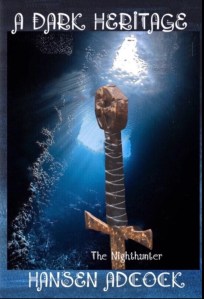
[The idea of the Enochian language was what inspired the magical alphabet known as The Scryfennu in the first book of the Nighthunter series, “A Dark Heritage.” This alphabet can only be seen and read by people (or animals) that have magic in their blood, and is used to leave cryptic messages scorched in the ground by mysterious storm-beings known as Brontides.]
The Hermetic Order of the Golden Dawn (1887 – 1903) later incorporated elements of Enochian magic into their beliefs and rituals.
Psychography / automatic writing became used by the Spiritualist movement in the late 19th to early 20th centuries, with writers and poets such as W. B. Yeats and his wife Georgie Hyde-Lees, and Sir Arthur Conan Doyle dabbling in it.
Conan Doyle led an automatic writing seance in which his wife Lady Doyle wrote fifteen messages purportedly from Harry Houdini’s deceased mother while Houdini was present. Houdini discounted the messages as fake.
It wasn’t only messages — even letters and entire books have been written, ostensibly through automatic writing, whilst the author was in a trance state. When Charles Dickens passed away in 1870, he left a novel unfinished — The Mystery of Edwin Drood — and the printer T. P. James claimed that the spirit of Dickens was so annoyed by this that he channeled the rest of the novel through T. P. James’s hand starting on Christmas Eve 1872, three times a week, until the book was finished.
Other people who have used automatic writing include Aleister Crowley, the occultist and ceremonial magician who invented the religion known as Thelema. The “Book of the Law” used in Thelema was, according to Crowley, dictated to him by an entity known as Aiwass.
Fernando Pessoa, a Portuguese poet and writer in the 20th century, claimed to have used automatic writing, saying he felt “owned by something else” and experiencing a strange sensation in his right arm, which he claimed would be lifted aloft without any conscious input from him.
In 1919, Breton and Philippe Soupault used what then became the “Surrealist automatism” technique to compose the book The Magnetic Fields (Les Champs Magnetiques) which was a series of imaginative, almost nonsensical stream-of-consciousness writings. The Surrealist artists began to use automatic drawing, inventing art with as much conscious attention removed as possible.
How Does It Work?
Scientists and skeptics say automatic writing is likely a result of the ideomotor effect. This is a phenomenon that happens to all of us where we make movements unconsciously.
A thought or mental image can often stimulate a reflex muscular action — usually a tiny movement that the person isn’t aware of making. This phenomenon has been posited as what is actually occurring during Ouija board sessions, table-turning, and dowsing.
The neurologist Terence Hines said that automatic writing is a mild form of dissociative state (or emotional detachment from reality).
The psychologist Theodore Flournoy studied the automatic writing of the 19th century medium Helene Smith, who claimed her messages were in Martian and came from the planet Mars. This “Martian language” bore a close resemblance to her native French language, and her automatic writing contained details from things she had seen before but forgotten, e.g. books she read as a child. Theodore named this fluke of memory “cryptomnesia” — when a person remembers a memory of something but is convinced it is not a memory but their own original thought or something new. He concluded that psychography was a result of autosuggestion produced by autohypnotisation or self-hypnosis, that then led to a “secondary self” emerging. (Somehow, I find that idea even more disturbing than it being a ghost!)
Automatic writing has been said to be a psychological technique to tap into the unconscious mind.
It is also a behaviour displayed by people with certain brain differences, for example three patients with damage to the right hemisphere of the brain did automatic writing in 2001, and in 1986 two patients suffering from seizures demonstrated ictal hypergraphia — an intense urge to write or draw during a seizure, stroke or headache.
In 2012, during a study of ten psychographers using single photon emission computed tomography, it was found that there were differences in brain activity and writing complexity during “trance” episodes and during normal writing states.
Modern Day
Some of Van Morrison’s “Astral Weeks” record was inspired by his dreams and automatic writing.
The film director Jan Svankmajer created the screenplay for his film Insect using the technique.
William S. Burroughs said his book “Naked Lunch” was “automatic writing gone horribly wrong” and that his subconscious seemed to have been taken over by a hostile entity.
The musician David Byrne said he was interested in psychography because of Brian Eno’s influence.
 Nightwalks
One thought on “Adventures in Automatic Writing”