
Last week we covered some different versions of will-o-the-wisps from various corners of the Earth, some well-known, others almost unheard of (by those in the Western world, that is).
What follows are some extra ghostly oojamaflicks that didn’t make it into that post, including a phantom fireship.
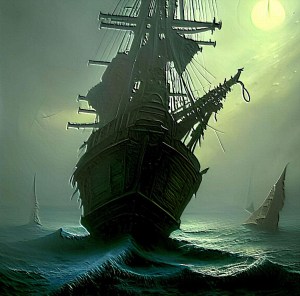
The Fireship of Baie des Chaleurs
Otherwise called the Chaleur Phantom or the Phantom Ship, this ghostlight is sometimes spotted in Bathurst, New Brunswick, Canada, and sometimes seen in New Carlisle, Quebec across the bay.
There are a few different stories as to its origin:
- A Portuguese Captain arrived on Heron Island on Chaleur Bay in 1501. On his second journey there to try to abduct more of the Mi’kmaq natives for the slave trade, locals seeking revenge tortured and killed him. A year later, his brother came looking for him and the locals also attacked him. The brother’s ship caught alight and the people on board jumped into the water, swearing to haunt the bay for a thousand years.
- A woman from Restigouche County in New Brunswick maintained that there was a pirate crew who murdered a woman. As she died, she cursed the pirates by saying “For as long as the world is, may you burn on the bay.”
- Sailors heading out to sea in stormy weather were afraid they would die, blaming their bad luck on the murder of one of the crew members (whom they had killed!) The ship caught fire, and it was said that the disaster was Catholic blood gaining its vengeance.
The fireship takes the form of an arc of light, often before a storm. In tales, it is said to resemble a fiery, three-mast galley similar to the type of ship featured on New Brunswick’s flag. Local stories of the ship claim the screams of the ancient burning passengers can be heard if one submerges their feet in the bay’s waters.
The Ghost Road of Saratoga
In the Big Thicket of Southeast Texas, between Beaumont and Livingston, 16 miles west of Kountze, there is a dirt road running north to south, its north end close to the ghost town of Bragg Station. A mysterious light appears on this road, sometimes called the Bragg Light or Saratoga Light by the locals. It appears and disappears in the dark of night without a satisfactory explanation.
The light could be car headlights on the highway nearby — but the light is usually visible when an observer is facing north, and the highway can only be seen when facing south. Hmmm…
The Gurdon Light, Arkansas
Near old railway tracks in a wooded area of Gurdon, Arkansas, a ghostlight appears that is the subject of local folklore. The tracks are long disused and partly removed or covered over, though the spot remains one of the most popular Halloween attractions.
The light can be blue, green, white, or orange and has a bobbing pattern of movement.
According to some folklore, the light is the swinging lantern of a ghostly brakeman who was accidentally decapitated by a passing train.
Perhaps the light is from cars passing on Interstate 30, but the lights have been seen here since the 1930s and the Interstate was not created until the 1950s…
The Maco Light, North Carolina
Between the late 1800s and 1977, a weird light could be seen along a bit of railway track near Maco Station, Brunswick County, North Carolina.
The light was said to belong to Joe Baldwin, a train conductor. He was in the rear carriage of a train heading to Wilmington on a rainy night in 1867, and as he came near Maco, he noticed the carriage had become detached from the rest of the train. He knew another train was approaching, so he ran to the rear platform and tried waving a lantern to signal to the oncoming train.
However, the driver didn’t see the signal and poor Joe Baldwin was beheaded in the resulting crash. Some versions of the story state that his head was never located.
Not long after the accident, locals began to see a white light along some of the track through the swamps to the west of Maco Station, and people started to believe it was Mr Baldwin searching for his misplaced head.
The light would often appear distantly then approach along the tracks facing east, bobbing at about 5 feet from the ground, either flying to the side of the track in an arc or ebbing away from the observer. Other accounts mentioned a red or green light and other movement patterns.
The earliest accounts from the 1870s until the Charleston earthquake in 1886 mentioned two lights instead of one.
More information can be found here
Naga Fireballs / Mekong Lights
Once a year, at the end of Buddhist Lent in late October (Wan Ok Phansa), on the Mekong River in Thailand, glowing balls of red light are seen rising from the water into the air. The lights range in size from tiny embers to the size of basketballs, and tens and thousands of them are seen on that night before they disappear into the sky.
The locals believe a gigantic serpent (Naga) lives at the bottom of the Mekong, and the fireballs come from that creature.
The fireballs are most likely from flares and tracer rounds fired by Lao soldiers across the river from the festival.
Paasselka Devils
Around the swampy / forested parts of Lake Paasselka in Finland (and on the lake), strange lights are seen.
The lake formed inside an impact crater such as that left by a meteor, and there is a magnetic anomaly (or a variation in Earth’s magnetic field) in its centre.
The light, or Paasselka Devil, appears in the air and moves at different speeds, or even remains stationary on other occasions. Sometimes there are several balls of light, and the ball of fire has been said to behave as if it were sentient by the locals. It follows fishermen’s boats but can escape torchlight.
Part of the folklore, the ball of light was likely seen as an evil creature in earlier times. The lights are still sometimes spotted in the modern day and have been photographed and filmed.
And now just for the fun of it, why not…?
 Nightwalks