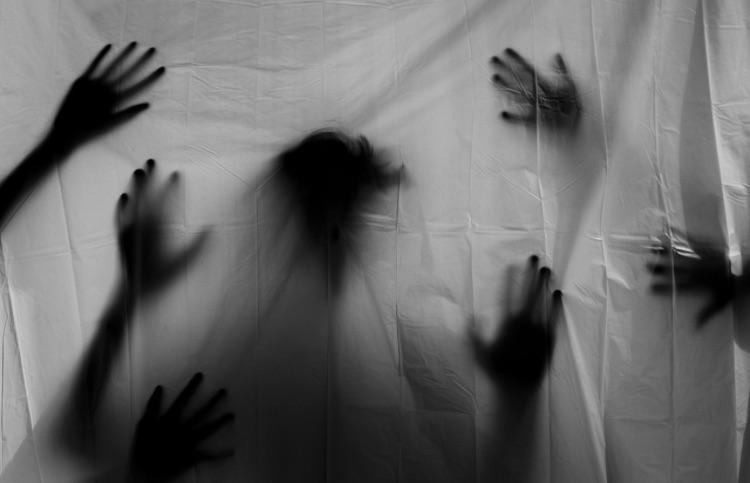
In the late 19th century, during the advent of photography, the way to “photograph ghosts” was stumbled upon accidentally through the usage of long exposure. Sir David Brewster decided this method could be utilised to create deliberate ghostly photographs in 1856, prompting the London Stereoscopic Company to make a series of images known as The Ghost in the Stereoscope.
Even today, people making ghost or spirit photographs use some of the same ideas that were used back then, along with contemporary ways such as ghost overlay apps that work on a tablet or smartphone, photo editing software that uses effects like motion blur, and filters.
Long exposure can be used to create a faint reflection-type image of a person or object “moving” into or out of the frame. This was done by accident to begin with, when photographs were made with the daguerreotype process in the 1830s (which required long exposure times to capture the subject of the photo).
Exposure plates started to be reused with the beginning of glass-plate negative processes circa 1859. Previous images could leave a subtle trace on the plates if they were not cleaned properly between uses and those traces would reappear as “ghosts” in the next photograph. This was also discovered accidentally, but was then adopted as a means to fake spirit photographs by the likes of William Mumler and Fredrick Hudson. (Other techniques included smudging the glass negative, the equivalent of adding a “motion blur” effect today.)
Double or multiple exposure is still a technique used today that can either be done in-camera or with digital post-processing. More than one image is captured in the same frame of film — one might be a background of a scene or person, the other might be a “foreground” of something blurry or translucent, and they are layered on top of each other e.g. in Adobe Photoshop. In the past, this was done by subtly getting someone posing as the “ghost” to quietly stand or walk behind the main subject of the photo for a short length of the exposure time, then leave before the exposure time was up, which made a faint image of the “ghost” appear in the background of the photo.
In the case of contemporary photographers like Lee Kirby, a second image can be projected onto the main image using a projector in real life, then photographed.
The modern-day equivalent of doing a double-exposure using an iPhone camera is to:
- Make sure the phone is kept steady using a tripod or propped up against something
- Select the “live” photo mode and set the photo timer to 10 seconds (this gives you time to enter the frame and pose – you could even wear a historical costume to make it more authentic).
- After the timer is up, walk out of the shot.
- Then on the live photo you just took, scroll down to the list of different shots that made up the photo, then scroll along and select “long exposure.”
- This results in an image that amalgamates all of the shots, so it looks like a faint “ghost” of a person is in the photo.
A more in-depth look at how to construct ghost photographs using a human model, flash, timings, and exposure can be found here.
ICM, or Intentional Camera Movement, is another method used today, often in conjunction with long exposure. This creates blurring or streaking in the photo and can be used to make the final image look more like a painting.
Light and shadow can be used as well to evoke a supernatural look, e.g. “ghost light” which is when a subject is lit by an invisible source of light that isn’t included in the frame or is otherwise hidden. This technique was discovered by the photographer Ibai Acevedo.
Certain marks and stains can only be visible using UV light and a quartz lens. This is a method used in forensic photography but can be used to fake sudden images or words “appearing” on walls or other surfaces, presumably “written by a paranormal entity.”
Ghost overlay apps enable you to insert predesigned ghost stickers / images into your photos to prank people or share with friends for entertainment purposes, e.g. Ghost in Photo app.
Next week we will delve into the ways that spirits or ghosts get accidentally photographed in the modern day, including what orbs are and how they work.
 Nightwalks
One thought on “Ghost Photography Techniques, Past and Present”