
Part XVIII of Amulets & Talismans
By now, mostly everyone knows what the Holy Grail is. According to this BBC article from 2022, it may be on display in Valencia Cathedral… but what exactly was it used for, and where did the stories about it originate from?
When it was first mentioned in Perceval, The Story of the Grail, a poem by Chretien de Troyes in 1190 (which was unfinished), the Grail was merely mentioned as “a grail / graal”, not a holy chalice but a common, wide dish or bowl that contained a Communion wafer meant for the sustenance of the wounded father of the Fisher King. It may be that the wafer was meant to be of importance and the graal was just a prop.
The injured king’s mystic fasting was a popular trope in stories from that time — some saints had been said to have survived on nothing but Holy Communion.
Troyes asserted that the story of Perceval was influenced by a book gifted to him by Count Philip of Flanders.

Four different writers finished Chretien’s 1190 romantic poem, taking it in different directions. The first continuation followed the adventures of Sir Gawain and a few other knights of King Arthur’s day in six episodes, ending with Gawain failing the test of the Grail Castle and returning to Arthur’s court asleep in a swan-shaped boat.
In the second continuation, we are back in Perceval’s story, where he returns to the Grail Castle and mends a broken sword, though not without a hairline flaw in it.
The third continuation (by Manessier) had Perceval succeeding the Fisher King to his throne and ruling for seven years before leaving to become a hermit in the woods, dying shortly afterwards. Manessier said that Perceval took the Grail (and the Lance / Spear and silver plate) with him to Heaven.
In the fourth continuation (or Gerbert’s continuation), the story was developed independently of Manessier’s, and contained an episode featuring Tristan as well as other additions to tie up the loose ends in Chretien’s poem.
For more about the continuations of Perceval, see this article.
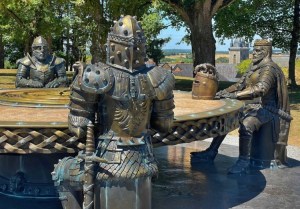
In Robert de Boron’s Joseph d’Arimathie (written 1191 – 1202) the Grail is the chalice Jesus drank out of at the Last Supper, and Joseph got ahold of it, then collected some of Jesus’s blood in it after he was removed from the cross.
After a visitation from Jesus in prison, Joseph gathered his family and followers and travelled west, founding a dynasty of Grail-guardians that at last included Perceval.

In Perlesvaus, another continuation of Chretien’s poem, the Grail is a relic of holy blood, appearing as a floating chalice that provokes strange visions.
Wolfram von Eschenbach wrote in his Parzival that the Grail was a gemstone in which all the angels who hadn’t taken a side during Lucifer’s rebellion had hidden themselves. It was called lapis exillis, which is the alchemical name for the Philosopher’s Stone, and granted immortality to whoever owned it.
In the Vulgate Cycle (Lancelot – Grail cycle), the virgin Sir Galahad (Lancelot’s son) takes Perceval’s place as the one destined to attain the chalice. The story follows the antics of some of the other knights, some of whom join Galahad towards the end of his quest (including Percival) and witness him ascending to Heaven.
That story was picked up and modified by Thomas Malory in his 15th century Le Morte d’Arthur. In this version, the Grail is invisible.
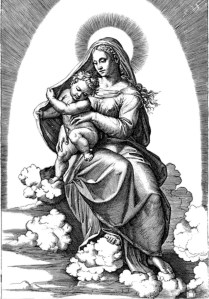
The idea of the Grail was likely inspired by the many tales of magical cauldrons in Celtic and later Welsh mythology, including the cauldron of Bran the Blessed, who had certain parallels to the character of the Fisher King, according to Roger Sherman Loomis.
However, there were sources of Grail imagery in 12th-century wall paintings that existed before Chretien de Troyes wrote Perceval. These paintings were in churches in the Catalan Pyrenees, and they showed the Virgin Mary holding a bowl that radiated streams of fire.
After the Arthurian romances, a few medieval relics were said to be the Grail, though in one case this happened before the Arthurian stories. In the 7th century, a pilgrim known as Arculf said the chalice from the Last Supper was on show near Jerusalem.
In the 12th century, there was said to be a Grail in Byzantium. This was supposedly looted in the Fourth Crusade and taken to Troyes in France, but then lost during the French Revolution.

A few objects were associated with the Grail in the 20th century, including a wooden medieval bowl near Rhydyfelin in Wales and a glass dish found close to Glastonbury in England. (Glastonbury was seen as an Arthurian place and associated with Avalon by the 12th century. In the 13th century, a legend arose that Joseph of Arimathea founded Glastonbury Abbey.)
Two relics associated with the Grail are still extant.

One is the Sacro Catino or Sacred Basin or Genoa Chalice, a green glass dish held in Genoa Cathedral. There are two differing accounts of how it was brought to Genoa by 12th-century Crusaders. The basin was moved and broken during Napoleon’s conquest, showing that it was made of glass rather than emerald.
The other Grail is the Chalice of Valencia, an agate cup / dish with a golden mount. The cup part may come from Greco-Roman times. The earliest fact we can know about it is that it was gifted to Martin I of Aragon in 1399 AD. This Grail is not associated with Jesus’s blood or Joseph of Arimathea, but is said to have been brought to Rome by Saint Peter and entrusted to the care of Saint Lawrence. The monarchy sold the cup to the cathedral in the 15th century.
For more about the Grail, see this page.
This mystical chalice – and a copy of it – feature in “The Dark Rider: Snow, Time, Bones” a YA Arthurian retelling by yours writerly on Wattpad (free to read):

So what do you reckon the Grail was, if it ever existed? Speak your mind in the comments!
The Spear of Destiny
Otherwise known as the Holy Lance or the spear of Longinus, this was allegedly the spear a Roman soldier (named, um, Longinus) pierced Jesus’s side with when he was dying on the cross.

Relics that were claimed to be the spear started appearing in the 6th century in Jerusalem. By the late Middle Ages, relics said to be the spearhead or other fragments of it had been described throughout Europe.
Usually used for religious purposes, some of these spear-relics have been viewed as guarantees of a favourable outcome in battle, in the same sort of way that King Arthur always won if he had Excalibur in his hand. For example, the Crusaders thought their finding of a Holy Lance was what helped them win the siege of Antioch.
These days there are four “Holy Spears” or parts of it. These are in Rome, Vienna, Vagharshapat (religious capital of Armenia) and Antioch. The one in Vienna is on display with a golden cuff.

The idea of the Holy Lance was conflated with the bleeding lance in Chretien de Troyes’s Perceval, as well as the javelin that had wounded the Fisher King. This particular spear was given many supernatural, destructive powers inconsistent with the Christian idea of the Holy Spear.
The Turin Shroud
The Holy Shroud is a length of linen cloth that has a faint image of the front and back of a naked man on it along with bloodstains. This cloth has been revered for centuries as details of the imprint coincide with traditional images of how Jesus looked after his death.

The shroud is believed by many to be the shroud Jesus was buried in. The image on the shroud is easier to see on a black and white photographic negative, which was discovered in 1898 by Secondo Pia.
The microscopist Walter McCrone took a sample of the shroud using adhesive tape in 1978, and found the image had been painted in red ochre mixed with gelatin. The “bloodstains” were painted in vermilion pigment, also mixed with gelatin. McCrone’s findings were debated by many people including other researchers who were working with him.
In 1988, three independent labs did radiocarbon dating on the shroud and found that it dates back to the Middle Ages, between 1260 and 1390.
The authenticity of the shroud is still under debate. The Catholic Church neither accepts or rejects it as a relic.
For more about the history of the Shroud and what scientific tests have been done on it, go here.
 Nightwalks